- Ocena BGG
- 8,7
Red Storm: Baltic Approaches – The Air War Over the Baltic, 1987
- 1–2 graczy
- 60–360 min
- Złożoność 3,5/5
- 2022
2019
Pomoc w zasadach gry Red Storm: The Air War Over Central Germany, 1987
Zrozumiałe wyjaśnienia tur, efektów kart i spornych sytuacji z odnośnikami do oficjalnych źródeł i zapisaną historią pytań.
Dla 1 gracza
Co chcesz wiedzieć?
Odpowiedzi pochodzą z oficjalnej instrukcji, ze stroną do sprawdzenia.
Red Storm: The Air War Over Central Germany, 1987 to gra planszowa wydana w 2019 roku dla 1–2 graczy, z rozgrywką trwającą 120–720 minut i dla osób od 14 lat. Projekt gry: Lee Brimmicombe-Wood i Douglas Bush. Główne mechaniki: Dice Rolling, Grid Movement i Hexagon Grid.

Po angielsku
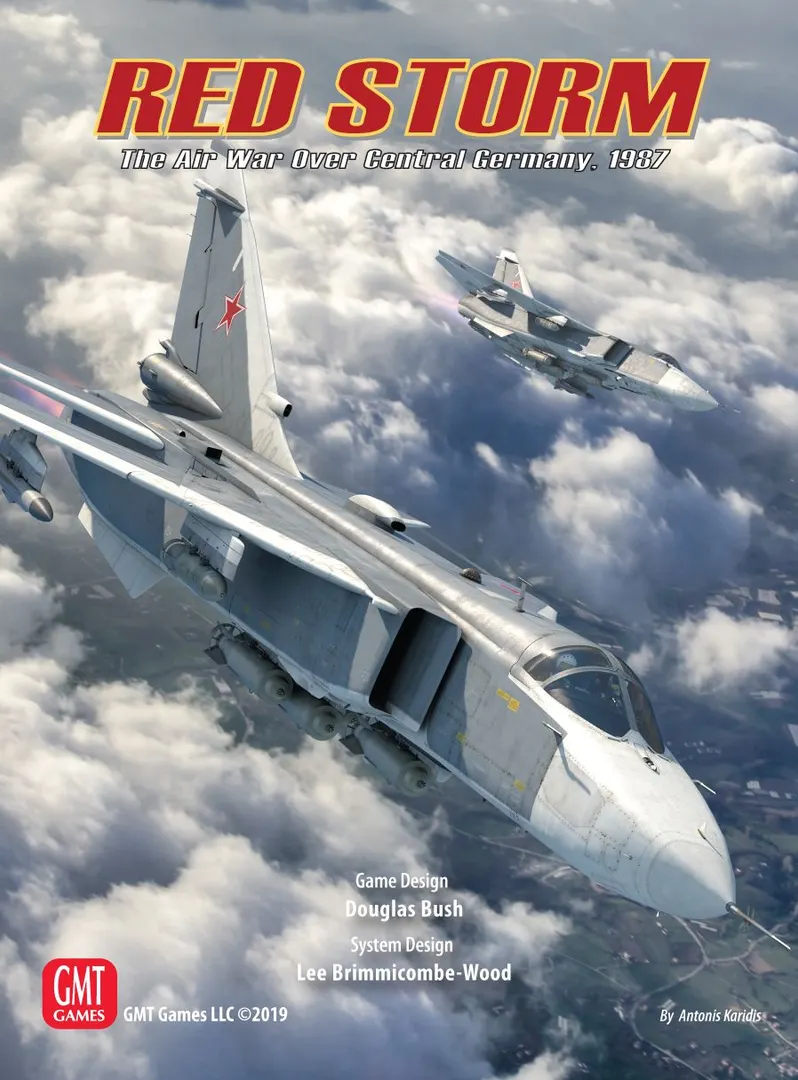
"Red Storm" is the second sequel to the Charles S. Roberts Award-winning game Downtown. Red Storm is a standalone game that utilizes the Downtown game system to depict a hypothetical air war in May/June 1987 over the central portion of the NATO/Warsaw Pact front in central Germany. Like Downtown and Elusive Victory before it, Red Storm is an “operational” level air warfare game where players manage large strike packages and numerous combat air patrols in an effort to strike enemy targets, protect their own ground troops, and secure control of the air over the land battle raging below. Both sides have highly advanced all-weather aircraft, long-range missiles, precision bombs, sophisticated electronic warfare assets, and dense air defense networks of surface-to-air missiles and radar-guided AAA. The game features aircraft from the United States, United Kingdom, West Germany, Canada, Belgium, the Netherlands, Soviet Union, and East Germany. As the NATO player, you fight outnumbered in the air, but with a qualitative edge in technology and better-trained pilots. NATO faces the daunting task of contesting the air in the face of the initial onslaught from the WP air forces while also getting bombs onto targets on the ground both on the frontline and rear echelon forces of the Soviet and East German armies. As the Warsaw Pact player, you must push your numerous but less flexible forces to the absolute limit in an effort to overwhelm NATO forces in the air and destroy them on the ground, all while supporting advancing ground forces. Both players also have to manage their air defense networks consisting of overlapping layers of SAM and AAA. Units Like earlier games in the series, units in Red Storm are flights of 1 to 4 aircraft, each tasked with different roles such as bombing, combat air patrol, close escort, or jamming support. Red Storm features more than 50 types of aircraft, including both older “3rd Generation” workhorses like the F-4E Phantom II and MiG-23 Flogger as well as advanced “4th Generation” fighters including the US F-15 Eagle, the UK/West German Tornado, and the Soviet MiG-29 Fulcrum. Aircraft from the air forces of Belgium, West Germany, the United Kingdom, the United States, the Soviet Union, and East Germany are provided. Ground units depict various types of troop concentrations, SAMs, and AAA assets. The SAM network on both sides is both more numerous and more dangerous than ever, with low-altitude SAMs like the UK Rapier, US Chaparral, and Soviet SA-13 Gopher joining a daunting array of medium/high altitude SAMs like the US Patriot and Soviet SA-12. Maps and Terrain Two 22” x 34” map sheets depict the rough terrain in the central portion of the NATO front line, reaching from the Rhine river in the west to the Thuringia region of southwest East Germany. The map uses the same scale of approximately 2.5 nautical miles per hex used in earlier games in the series. This densely populated region of Europe features numerous rivers, cities, and airfields dot the map. Unlike earlier games in the series, Red Storm features a frontline that moves steadily west as the Warsaw Pact armies advance. Game System Like the earlier games in the series, Red Storm requires both players to do planning for both their air and ground forces prior to a scenario. Raid forces must be generated, targets and routes planned, and aircraft loadouts determined. SAM, AAA, and radar units must be placed to take advantage of the rough terrain and frequently poor weather of central Germany. During a scenario, players go through a sequence of phases each turn where they conduct electronic warfare, use various means to detect and track enemy flights, and move and fight with their flights while potentially being attacked from the ground. The heart of game is the movement phase where players use a chit-draw system that allows players to alternate moving one to five flights at a time. Scenarios The war depicted in Red Storm is a short one, with just six weeks between the start of the air war and a fateful initiation of nuclear warfare by both sides. More than 20 scenarios feature a mix of day and night operational missions for both sides, including missions to directly support frontline ground troops as well as many missions that “go deep” behind enemy lines to strike enemy airfields, logistics, and air defense networks. These range in size from smaller, partial-map ones that can be played in an afternoon to very large, full-map scenarios that might take a couple of days to complete. There are also scenarios depicting reconnaissance missions, airborne drops, helicopter assaults, special forces insertions, cruise missile strikes, and delivery of nuclear weapons. Components Two 22” x 34” maps 1,260 die cut counters One Rules Booklet One Scenario Booklet One Appendices Booklet Five Full-Color Player Aid Cards Three Full-Color Aircraft Data Cards Two 10-sided dice NATO and Warsaw Pact log sheets
Według katalogu Red Storm: The Air War Over Central Germany, 1987 obsługuje od 1 do 2 graczy. Ten zakres odpowiada liczbie graczy podanej przez wydawcę, więc grę można przygotować dla dowolnej grupy w jego granicach. Przygotowanie, niektóre zasady i punktacja mogą jednak różnić się w zależności od liczby graczy; dokładną konfigurację sprawdź w instrukcji swojego wydania.
Podany czas rozgrywki w Red Storm: The Air War Over Central Germany, 1987 wynosi 120–720 minut. To szacunek wydawcy dla pełnej partii. Rzeczywisty czas zależy od grupy, liczby graczy i znajomości zasad: pierwsze partie zwykle trwają dłużej, a doświadczone grupy kończą szybciej. Przygotowanie gry i tłumaczenie zasad nie są wliczone w ten szacunek.
Katalog podaje dla Red Storm: The Air War Over Central Germany, 1987 wiek od 14 lat. To zalecenie wydawcy, które uwzględnia wymagania dotyczące czytania, złożoność zasad i drobne elementy, a nie tylko tematykę. Młodsi gracze często mogą dołączyć z pomocą dorosłego; sprawdź zalecenie wiekowe swojego wydania i weź pod uwagę doświadczenie grupy z grami planszowymi.
Red Storm: The Air War Over Central Germany, 1987 ma ocenę złożoności 4,4 na 5 według graczy BoardGameGeek, co czyni ją grą ciężką. Ocena pokazuje, ile znajomości zasad, planowania i podejmowania decyzji wymaga typowa rozgrywka. Cięższe gry wymagają dłuższego pierwszego tłumaczenia, dlatego przed wieczorem z grami warto skorzystać z przewodnika przygotowania.
Red Storm: The Air War Over Central Germany, 1987 należy do tych kategorii: Wargame, Modern Warfare i Aviation / Flight. Główne mechaniki to Dice Rolling, Grid Movement i Hexagon Grid. Kategorie opisują temat i świat gry, a mechaniki to, co gracze faktycznie robią w swojej turze. Każda mechanika prowadzi do strony katalogu z podobnymi grami, co pomaga znaleźć coś porównywalnego na kolejny wieczór.
Autorzy wymienieni przy Red Storm: The Air War Over Central Germany, 1987 to: Lee Brimmicombe-Wood i Douglas Bush. Te informacje pochodzą z opublikowanych danych gry i wskazują osoby odpowiedzialne za jej projekt, a nie ilustratorów czy wydawców. Strony autorów w MeepleRules zbierają inne tytuły tych samych twórców, co pomaga, gdy gra ci się podoba i szukasz podobnych.
W katalogu Red Storm: The Air War Over Central Germany, 1987 figuruje jako gra podstawowa. Można w nią grać samodzielnie, korzystając z elementów z pudełka, bez żadnego innego tytułu. Dodatki, jeśli istnieją, dokładają nową zawartość lub zasady i są wymienione w katalogu osobno, z odnośnikiem do tej gry podstawowej.