
- Ocena BGG
- 7,4
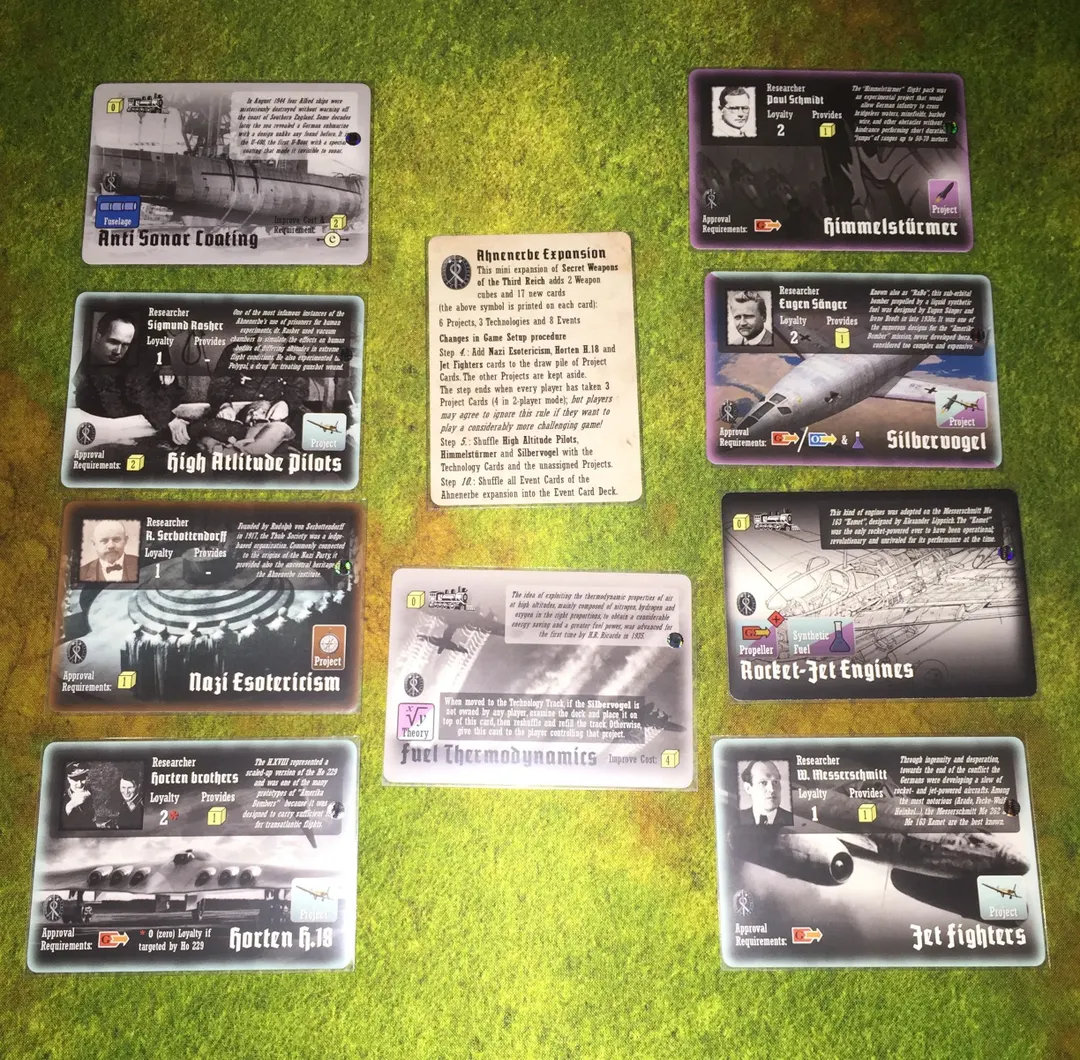
Secret Weapons of the Third Reich: Ahnenerbe Expansion
- 1–4 graczy
- 120–180 min
- Złożoność 3,0/5
- 2015
2015
Pomoc w zasadach gry Secret Weapons of the Third Reich
Zrozumiałe wyjaśnienia tur, efektów kart i spornych sytuacji z odnośnikami do oficjalnych źródeł i zapisaną historią pytań.
Dla 1 gracza
Co chcesz wiedzieć?
Odpowiedzi pochodzą z oficjalnej instrukcji, ze stroną do sprawdzenia.
Secret Weapons of the Third Reich to gra planszowa wydana w 2015 roku dla 1–4 graczy, z rozgrywką trwającą 120–180 minut i dla osób od 12 lat. Projekt gry: Luca Cammisa. Główne mechaniki: Cooperative Game, Open Drafting i Worker Placement.


Po angielsku
The date: March 1938. The vast majority of Austrians cheer the Anschluss of their country by the German Reich. Central Europe is falling into Nazi hands and all the best European scientists will soon compete under the aegis of Heinrich Himmler, for whom no scheme is too wild or too improbable — but which team has the imagination, the courage, and the drive to most successfully accomplish their goals? Secret Weapons of the Third Reich is a game for one to four players simulating the arms race of World War II from the German perspective. From secret submarine bases in Greenland to the mysterious Base 211 in Neuschwabenland, Antarctica, this game recreates the incredible tales of Nazi technology, from the famous V-1 buzz bombs and V-2 rockets to the unlikely flying saucers derived from the work of Nikola Tesla. Will players be able to deliver the Haunebu project to completion? Will Hans Kammler escape with his last battalion of flying saucers to the dark side of the moon? Will the secret submarine fleet sail to Antarctica to pursue the war after the war? Or could German scientists produce an atomic bomb to be dropped on New York by an electro-gravitational flying saucer or within the warhead of a futuristic intercontinental V-3? Would it even be possible to build a huge solar satellite gun to strike America? In the game, each player controls one or more research groups, each working on a secret weapon project. Each research group has a leading researcher, who provides an initial bonus (expressed in resource cubes or scientist cylinders) when the project is assigned. The researcher has a regime loyalty value that measures both the ability to make requisition attempts and the ability to resist opposing attempts. A player tries to get their projects approved, then completed. Certain requirements (resource cubes and/or scientist cylinders and technologies attached to projects) must be met and costs paid in order to reach the stage of development of a project. Each turn, approved projects generate specific amounts of resource cubes as funding. Completed projects award victory points (VP) and allow, in most cases, weapon production. Produced weapons award VP to the owning player in addition to helping to achieve a cooperative goal for all players. In fact, if together the players fail to reach a certain number of weapons produced by the end of the game, they all lose. The weapon production goal varies depending on the number of players. Play begins in 1938, one year before the outbreak of world war. At the start, players can only place research groups for their approved projects (project plants) in the portion of the map representing Germany and Austria. In 1939 and later, the conquests of Nazi Germany allow players to deploy their project plants in occupied European territories — but players will have to pay attention to the various locations because some areas allow only research and development, others only weapon production, and still others only research and development for U-Boat projects. Also, players must operate in a "state of warfare". This means that as time goes on they are more and more subject to enemy bombardments that can cause a great loss of resources and technologies. In addition, as starting in 1943 Allied and Soviet advances on Berlin make the map progressively smaller, players must face logistical issues never encountered during the early years of the war. Should a completed project or produced weapon fall into Allied hands, players not only lose VP, but the weapons production goal recedes as well! Thus a certain amount of player cooperation is a must. Each player must balance his personal interests with the common need to share technologies and resources in order to fulfill the common goal. Last, but not least, via events one player may secretly become the turncoat, working in the shadows to help the enemy, and winning the game if all players would otherwise lose.
Według katalogu Secret Weapons of the Third Reich obsługuje od 1 do 4 graczy. Ten zakres odpowiada liczbie graczy podanej przez wydawcę, więc grę można przygotować dla dowolnej grupy w jego granicach. Przygotowanie, niektóre zasady i punktacja mogą jednak różnić się w zależności od liczby graczy; dokładną konfigurację sprawdź w instrukcji swojego wydania.
Podany czas rozgrywki w Secret Weapons of the Third Reich wynosi 120–180 minut. To szacunek wydawcy dla pełnej partii. Rzeczywisty czas zależy od grupy, liczby graczy i znajomości zasad: pierwsze partie zwykle trwają dłużej, a doświadczone grupy kończą szybciej. Przygotowanie gry i tłumaczenie zasad nie są wliczone w ten szacunek.
Katalog podaje dla Secret Weapons of the Third Reich wiek od 12 lat. To zalecenie wydawcy, które uwzględnia wymagania dotyczące czytania, złożoność zasad i drobne elementy, a nie tylko tematykę. Młodsi gracze często mogą dołączyć z pomocą dorosłego; sprawdź zalecenie wiekowe swojego wydania i weź pod uwagę doświadczenie grupy z grami planszowymi.
Secret Weapons of the Third Reich ma ocenę złożoności 3,9 na 5 według graczy BoardGameGeek, co czyni ją grą ciężką. Ocena pokazuje, ile znajomości zasad, planowania i podejmowania decyzji wymaga typowa rozgrywka. Cięższe gry wymagają dłuższego pierwszego tłumaczenia, dlatego przed wieczorem z grami warto skorzystać z przewodnika przygotowania.
Secret Weapons of the Third Reich należy do tych kategorii: Science Fiction i World War II. Główne mechaniki to Cooperative Game, Open Drafting i Worker Placement. Kategorie opisują temat i świat gry, a mechaniki to, co gracze faktycznie robią w swojej turze. Każda mechanika prowadzi do strony katalogu z podobnymi grami, co pomaga znaleźć coś porównywalnego na kolejny wieczór.
Autorzy wymienieni przy Secret Weapons of the Third Reich to: Luca Cammisa. Te informacje pochodzą z opublikowanych danych gry i wskazują osoby odpowiedzialne za jej projekt, a nie ilustratorów czy wydawców. Strony autorów w MeepleRules zbierają inne tytuły tych samych twórców, co pomaga, gdy gra ci się podoba i szukasz podobnych.
W katalogu Secret Weapons of the Third Reich figuruje jako gra podstawowa. Można w nią grać samodzielnie, korzystając z elementów z pudełka, bez żadnego innego tytułu. Dodatki, jeśli istnieją, dokładają nową zawartość lub zasady i są wymienione w katalogu osobno, z odnośnikiem do tej gry podstawowej.