
- Место в рейтинге BGG
- BGG #11 214
- Оценка BGG
- 7,8
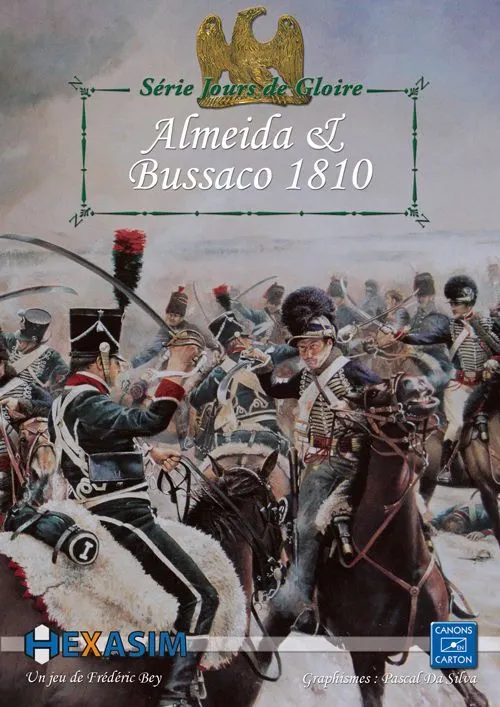
Almeida et Bussaco 1810
- 2 игрока
- 120–240 мин
- Сложность 2,4/5
- 2010
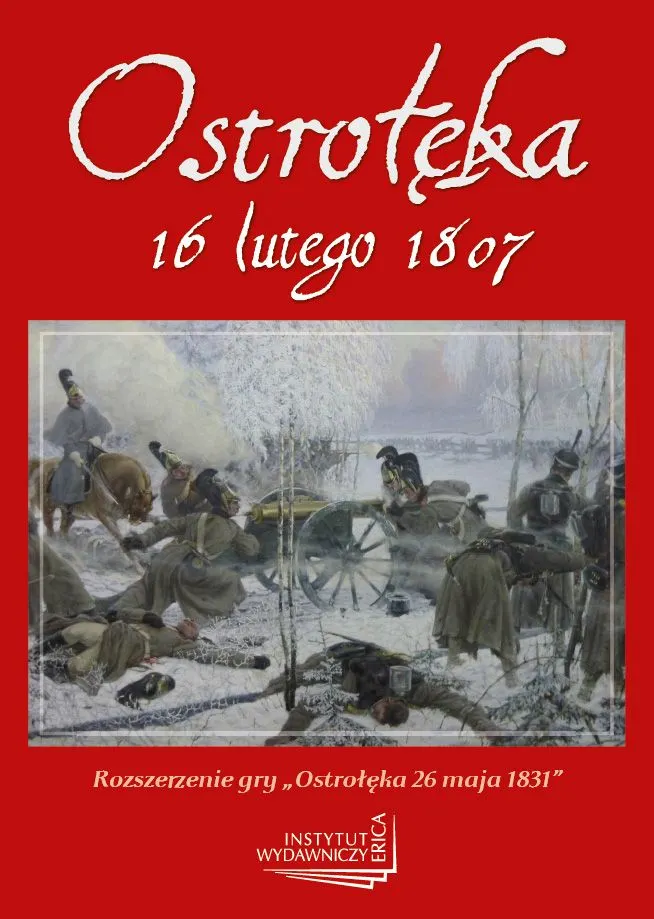
Помощник по правилам Ostroleka 16 lutego 1807
Понятные объяснения ходов, эффектов карт и спорных ситуаций со ссылками на официальные источники и сохранённой историей вопросов.
Что хотите уточнить?
Отвечаю по официальным правилам и показываю страницу для проверки.
«Ostroleka 16 lutego 1807» — дополнение к игре «Ostroleka 26 maja 1831», выпущенное в 2019 году: для 2–4 игроков, 150–600 минут на партию и возраст от 16 лет. Авторы игры — Ryszard Kita; основные механики — Dice Rolling, Hexagon Grid и Simulation.





На английском
Ostrołęka 16 lutego 1807 covers the battle of Ostrołęka, fought on Feb. 16, 1807 between the French 5th Corps commanded by Gen. Jean-Anne-Marie Savary and the Russian Corps commanded by Gen. Ivan N. Essen. The main goal of the French Corps was to secure the supply line of Napoleon’s main army fighting with Gen. Bennigsen. Just after the bloody battle of Preussisch Eylau (Feb. 7-8, 1807) both sides started to look for possibilities of taking advantage over the enemy and draw away some opposite forces from the main theater before the next expected battle. After set of back and forth operations in the north Mazovia, Russians decided to launch an offensive against units of the Frech 5th Corps situated near Ostrołęka. Russian commander, Gen. Essen, strengthened by the 6th Division of Gen. Sedmioradski, prepared a plan of attack. He decided to divide his forces into two wings. One of them (6th Division and a part of 9th Division), commanded by Gen. Wolkonski, had to attack the town Ostrołęka from the north, approaching along the west bank of Narew river. The other wing (10th Division and a part of 9th Division), commanded by Gen. Essen, approaching along the east bank of Narew river, had to attack the town Ostrołęka from the east. Russians had significant numerical advantage but their problem was that both operational groups were completely separated by the impassable river with marshy banks and in effect could not suport each other. Before the battle started, Russians had made feign attacks near Myszyniec along the line of communication of the main French army, north-west of Ostrołęka, fooling the French command. Gen. Savary decided to send there whole 1st Infantry Division of Gen. Suchet. Before the battle started, two events had taken place that had great impact on the course of it. The first one caused that Russians completely lost surprise effect. French caught the Russian messanger with letter from Essen to Bennigsen, from which they got to know the plan of the offensive. However we do not know how many details of it. The second event was also disadvantageous for the Russian Corps command. Gen. Bennigsen, who was the commander-in-chief of all Russian forces operating against Napoleon, recalled 6th Division of Gen. Sedmioradski to the main Russian army, to the north. Gen. Wolkonski, supported by Gen. Essen, tried to convince Gen. Sedmioradski to postpone execution of this order and take part in the planned ofensive against French 5th Corps, but Sedmioradski decided to obey strictly order from the upper commander and had marched to the north just befeore the offensive started. The effect was that Wolkonski’s group which had to advance along the west bank of Narew river was reduced to 1/3 of its units. The battle of Ostrołęka fought in 1807 is a classical example of the maneuver from a central position. Knowing more or less enemy’s plans, early morning of Feb. 16, 1807, near 4 AM Gen. Savary also decided to divide his forces into two groups. He found the Russian wing approaching along the west bank of the Narew river as more dangerous because it could had cut him off from his line of communication. That is why he decided to march with the majority of his forces to the north, defeat it as the first and then revert back to the Ostrołęka to fight with the rest of the Russians. In Ostrołęka Savary left only 8 battalions with some artillery and cavalry. They had to defend and keep the town until he had defeated the enemy approaching from the north. Battle fought by Savary with Wolkonski’s group near Stanisławów was quick. Russian General, seeing enemy strongly outnumbering his group, after short combat started retreat. It was 10 AM when being near Stanisławów Savary heard the sound of cannonade coming from Ostrołęka. At that moment he realised the Russian group he defeated was the smaller one and the main Russian forces were at Ostrołęka attacking small French contingent he had left there in the morning to defend the town and area around it. Leaving some units to pursuit Wolkonski’s group Savary ordered force march to Ostrołęka. It was noon when the first units of his group appeared near the town where they met coming back from the north west 1st Infantry Division of Gen. Suchet. How defenders of the town were able to keep control of it to that time is another story. Some historical sources mention that although outnumbered, they even attacked Russians in the first part of the battle, confusing them and disturbing the decisive attack. Also some parts of Essen’s group were delayed. Finally, near noon, when the defenders were about to lose, suprisingly Russian attacks on the town stopped. Russian command decided to withdraw to the positions to the east of Ostrołęka, stay there until the end ot the day and make retreat during night. When Savary’s group and the 1st Infantry Division crossed the Narew river and formed the battle line, the last part of the battle commenced. There were no more than 2 hours to the dusk but it was enough for the French to break Essen’s group, however in effect of darkness, early coming during winter, the victory was not so overwhelming as it had been if the French had had more time. It is estimated that Russian lost 2500-3000 casualties, while French 1500-2000 ones. The game is an expansion for Ostrołęka 26 maja 1831. It means that Ostrołęka 16 lutego 1807 uses system rules (also charts & tables), markers and the board which are in Ostrołęka 26 maja 1831. There are special rules for this historical period and battle (2 pages only). There are three scenarios in the game: - The Defense of Ostrołęka, - Operational, - The Battle on the East Bank of the Narew River. The first scenario covers the initial part of the battle. Its feature is a chit-pull system, used to simulate activity of the French units at the beginning of the combat and their better command system. The second scenario, the largest one, allows to play the whole battle. Its aim is also to show the operational background around the battlefield. It tries to join two levels of warfare: tactical and operational. In fact it is a kind of scenario generator: each player can choose among few options how to divide his forces among two groups. This decision has a great impact on the course of the game. Another important decision up to the Russian player is possible bringing to the battle Russian 6th Division of Gen. Sedmioradski, what gives him more forces but changes victory conditions to more demanding for the Russians. There is a plenty of additional options for this scenario. The third scenario depicts the last part of the battle, great frontal struggle on the east bank of the Narew river with most of the units participating in it. The playing time varies depending on the scenario, style of play and many other factors. The third scenario is the shortest while the second scenario as a whole is definitely the longest one. However in case of lack time, basing on the second scenario you can create little battles which can be played in 2-3 hours. Components (all packed in ziplock): - 324 die-cut counters (9 small counter sheets) - One rulebook and scenariobook (both in one book) - Two sheets with unit rosters (for French and Russians) - One sheet with turn tracks - Four bags for counters
По данным каталога, «Ostroleka 16 lutego 1807» рассчитана на 2–4 игроков. Этот диапазон соответствует числу игроков, указанному издателем, поэтому игру можно подготовить для любого состава в его пределах. Подготовка, отдельные правила и подсчёт очков всё же могут зависеть от числа игроков; точную конфигурацию проверьте в правилах своего издания.
В каталоге для «Ostroleka 16 lutego 1807» указано время партии 150–600 минут — это оценка издателя для полной партии. Фактическая длительность зависит от состава, числа игроков и знакомства с правилами: первые партии обычно идут дольше, опытные компании заканчивают быстрее. Подготовка и объяснение правил в эту оценку не входят.
В каталоге для «Ostroleka 16 lutego 1807» указан возраст от 16 лет. Это рекомендация издателя: она учитывает необходимость чтения, сложность правил и мелкие компоненты, а не только тему. Младшие игроки часто могут участвовать с помощью взрослого; проверьте возрастную рекомендацию на своём издании и учтите опыт вашей компании в настольных играх.
Сложность «Ostroleka 16 lutego 1807» — 4,2 из 5 по оценкам игроков BoardGameGeek, это сложная игра. Оценка отражает, сколько знания правил, планирования и решений требует типичная партия. Сложные игры дольше объяснять в первый раз, поэтому перед игровым вечером пригодится руководство по подготовке.
Категории игры «Ostroleka 16 lutego 1807»: Wargame, Napoleonic и Expansion for Base-game. Основные механики: Dice Rolling, Hexagon Grid и Simulation. Категории описывают тему и сеттинг игры, а механики — то, что игроки на самом деле делают в свой ход. Каждая механика ведёт в раздел каталога с похожими играми, и так проще найти что-то подобное для следующей партии.
В каталоге авторами «Ostroleka 16 lutego 1807» указаны: Ryszard Kita. Эти данные взяты из опубликованной информации об игре и называют людей, ответственных за её дизайн, а не иллюстраторов или издателей. Страницы авторов на MeepleRules собирают другие игры тех же авторов — это удобно, когда игра понравилась и хочется найти похожие.
В каталоге «Ostroleka 16 lutego 1807» отмечено как дополнение к игре «Ostroleka 26 maja 1831». Дополнения добавляют новый контент, правила или сценарии к базовой игре и обычно не играются сами по себе, поэтому для него нужна «Ostroleka 26 maja 1831». Проверьте, что ваше издание «Ostroleka 26 maja 1831» совместимо: некоторые дополнения перерабатывались между изданиями.