

- BGG-Rang
- BGG #572
- BGG-Bewertung
- 8,1
Fire in the Lake
- 1–4 Spieler
- 180 Min.
- Komplexität 4,2/5
- 2014
2023
Regelhilfe für 2040: An American Insurgency
Verständliche Erklärungen zu Spielzügen, Karteneffekten und strittigen Situationen mit Verweisen auf offizielle Quellen und gespeichertem Fragenverlauf.
Für 2 Personen
Was möchtest du wissen?
Antworten stammen aus dem offiziellen Regelheft, mit Seitenangabe zum Nachprüfen.
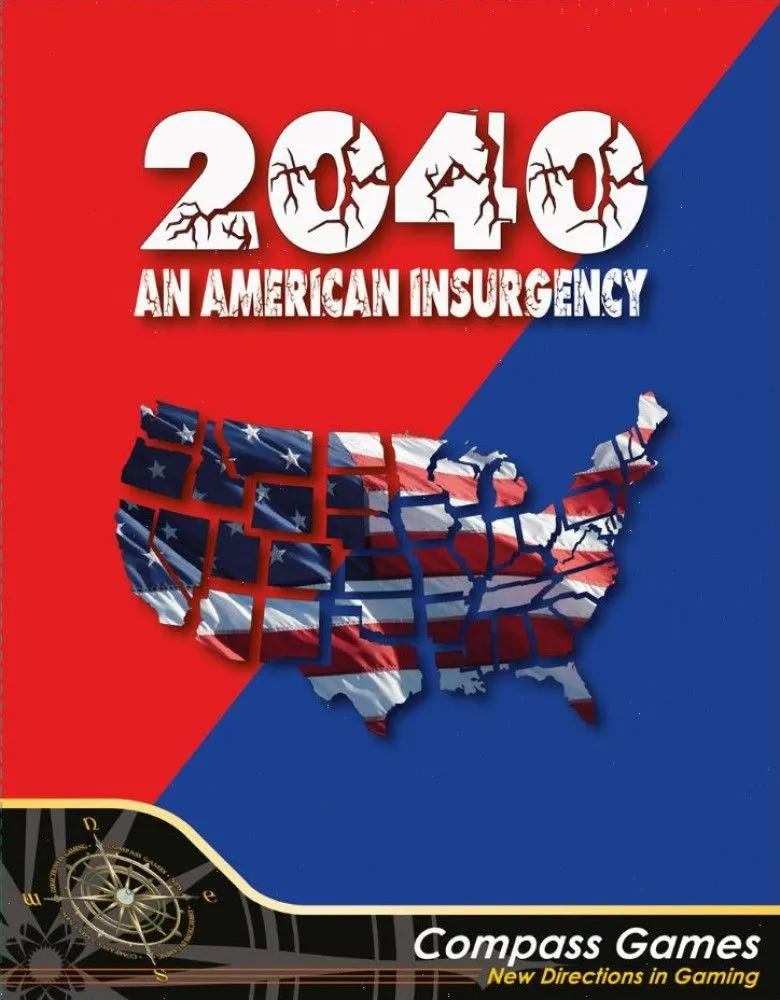
2040: An American Insurgency ist ein Brettspiel aus dem Jahr 2023 für 2 Personen und mit 120–180 Minuten pro Partie. Entwickelt wurde es von Edward Castronova; die wichtigsten Mechaniken sind Variable Player Powers und Dice Rolling.





Auf Englisch
2040: An American Insurgency simulates a US civil war in the 21st century. In this 2-player, 3-hour game, the blue team is the Federals, agents of the government in Washington. The red team is the Rebels, militia groups trying to seize control of states, highways, and cities. The conflict spreads across the entire continental US, from Miami to Seattle and from Los Angeles to New York. Two scenarios are presented. One depicts a rebellion that emerges from rural areas in the Midwest and South. The other puts the rebellion in urban areas along the coasts. As such, the game is open to multiple interpretations of future politics in the US. The game was designed not to make political statements of one kind or another, but rather to accurately model counter-insurgency operations in the continental US, regardless of who the rebels happen to be. Many of the game mechanics are familiar from the existing body counter-insurgency sims. The resources and operations available to the two players are different; the insurgency is depicted as an asymmetric conflict. Gameplay is card-driven, however with events depicting situations that may arise in the US context. For example, if a civil war to occur, the Supreme Court is likely to make rulings that affect the conflict. Therefore, there are SCOTUS cards involving the Second Amendment and the government’s ability to make arrests. Other uniquely American features include truck stops as information networks, police brutality events, and the sports-entertainment complex. While some of the game’s mechanics are familiar, 2040 brings many new mechanics to the table. For example, there is a fully fleshed-out social media system that affects the power of the rebellion. The Rebel player does his recruiting and fundraising through the internet, so that Federal online control measures can dramatically reduce the Rebel’s money and troop levels. This net-based conflict adds a third dimension to the insurgency, one that has not been extensively modeled in previous commercially-available simulations. Another noteworthy feature, unique to the US, is that the suburbs and central cities of an urban area can be at diametrically opposite poles of the revolution. This creates a difficult strategic problem, in that operations that pass between two urban cores must necessarily go through the suburbs of both cities along the way. If those suburbs are enemy-controlled, the transit may be blocked. Forces inside cities can effectively be trapped by hostile suburban forces. Thus, the suburban / urban political conflict in the US has important implications for operational effectiveness. The game components include a 22” x 34” map of the continental US, broken down by regions, cities, suburbs, and highways. Wooden pieces represent Militias (red) and Federal Security Agents (blue). Counters are used to indicate the status of a given space, from Order (pro-Federal) to Revolt (pro-Rebel). Each player has a Player Aid that summarizes the possible actions of both players. Product Information: Complexity: 4 out of 10 Solitaire suitability: 8 out of 10 (similar to games like Twilight Struggle) Time scale: Not specified, but approximately one year per turn, covering a 4 to 5 year conflict Unit scale: one unit = paramilitary cell Players: one to two, best with two Playing time: 2-3 hours —description from the publisher
Laut Katalog unterstützt 2040: An American Insurgency 2 Personen. Das ist die vom Verlag angegebene Spielerzahl, das Spiel ist also genau für diese Anzahl von Mitspielenden ausgelegt. Varianten für andere Gruppengrößen sind, sofern vorhanden, in der Anleitung deiner Ausgabe beschrieben; prüfe sie, bevor du eine andere Konfiguration aufbaust.
Die angegebene Spieldauer für 2040: An American Insurgency beträgt 120–180 Minuten. Das ist die Schätzung des Verlags für eine vollständige Partie. Die tatsächliche Dauer hängt von der Gruppe, der Personenzahl und der Regelkenntnis ab: Erste Partien dauern meist länger, erfahrene Gruppen sind oft schneller fertig. Aufbau und Regelerklärung sind in dieser Schätzung nicht enthalten.
2040: An American Insurgency hat bei BoardGameGeek eine Komplexitätswertung von 3,0 von 5 und gilt damit als mittelschweres Spiel. Die Wertung zeigt, wie viel Regelwissen, Planung und Entscheidungen eine typische Partie verlangt. Schwerere Spiele brauchen bei der ersten Erklärung mehr Zeit, daher hilft vor dem Spieleabend eine Vorbereitungsanleitung.
2040: An American Insurgency gehört zu diesen Kategorien: Wargame, Political und Modern Warfare. Die wichtigsten Mechaniken sind Variable Player Powers und Dice Rolling. Kategorien beschreiben Thema und Setting eines Spiels, Mechaniken dagegen, was die Spielenden in ihrem Zug tatsächlich tun. Jede Mechanik führt zu einer Katalogseite mit ähnlichen Spielen, falls du etwas Vergleichbares suchst.
Als Autoren von 2040: An American Insurgency sind angegeben: Edward Castronova. Diese Angaben stammen aus den veröffentlichten Spieldaten und nennen die für das Spieldesign verantwortlichen Personen, nicht die Illustratoren oder Verlage. Die Autorenseiten auf MeepleRules sammeln weitere Titel derselben Autoren – praktisch, wenn dir ein Spiel gefällt und du ähnliche Spiele suchst.
Im Katalog ist 2040: An American Insurgency als Grundspiel aufgeführt. Es lässt sich eigenständig mit dem Material aus der Schachtel spielen und benötigt keinen weiteren Titel. Erweiterungen, sofern es welche gibt, ergänzen neues Material oder neue Regeln und sind im Katalog separat mit einem Verweis auf dieses Grundspiel aufgeführt.