

- BGG-Rang
- BGG #2.362
- BGG-Bewertung
- 8,0
SPQR (Deluxe Edition)
- 1–4 Spieler
- 240 Min.
- Komplexität 3,9/5
- 2008
2008
Regelhilfe für Chandragupta: Great Battles of the Mauryan Empire – India, 319-261 BC
Verständliche Erklärungen zu Spielzügen, Karteneffekten und strittigen Situationen mit Verweisen auf offizielle Quellen und gespeichertem Fragenverlauf.
Für 2 Personen
Was möchtest du wissen?
Antworten stammen aus dem offiziellen Regelheft, mit Seitenangabe zum Nachprüfen.
Chandragupta: Great Battles of the Mauryan Empire – India, 319-261 BC ist ein Brettspiel aus dem Jahr 2008 für 2 Personen, mit 240 Minuten pro Partie und ab 12 Jahren. Entwickelt wurde es von Richard H. Berg, Mark Herman, Alan J. Ray und Stephen R. Welch; die wichtigsten Mechaniken sind Dice Rolling und Hexagon Grid.










Auf Englisch
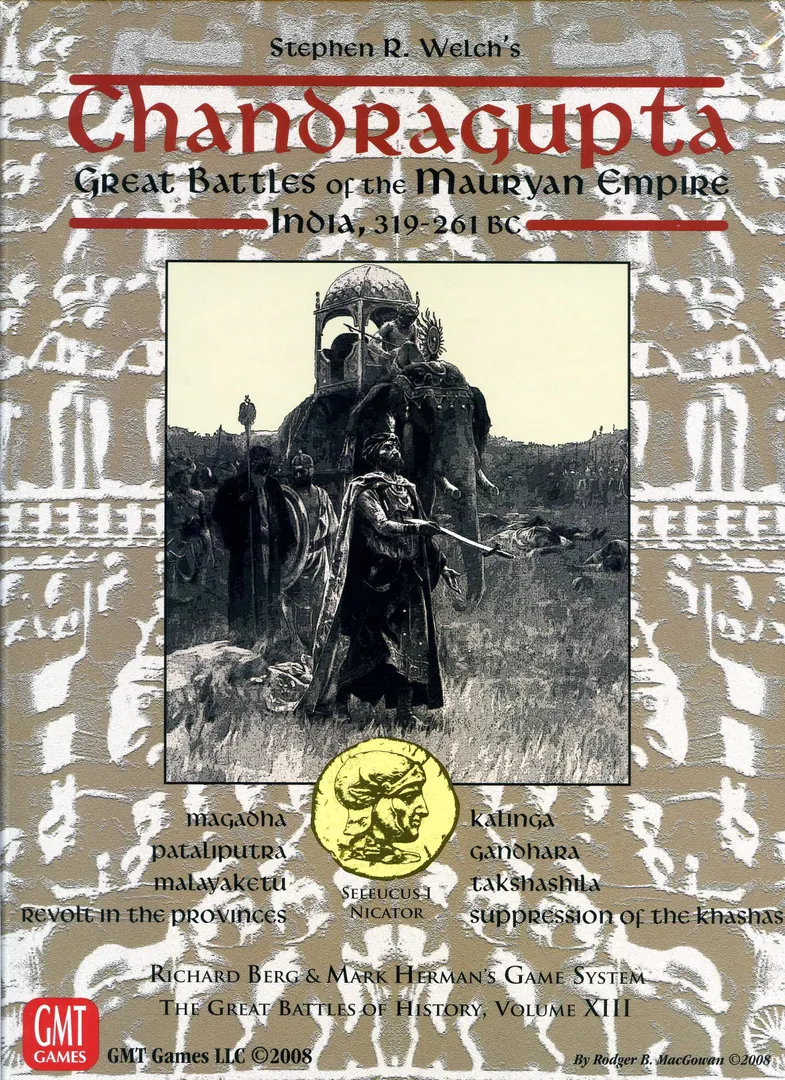
Chandragupta brings the art of war in ancient India to GMT’s “Great Battles of History” Series. Beginning with Chandragupta Maurya’s victories over the Nanda clan, the game follows the brief but rapid rise of the Mauryan dynasty, from Chandragupta’s expulsion of Seleucus from the Indus river valley to the conquest of the last independent kingdom on the subcontinent, Kalinga, by his grandson Ashoka. The Mauryan empire became the largest and most powerful in India’s history – a distinction that would remain unchallenged until the arrival of the Mughals some 1,700 years later. Chandragupta simulates the traditional “four-fold” division of the Indian military system, with the elephant corps reigning supreme, and the hordes of light infantry regarded as little more than fodder for chariots’ wheels and trampling pachyderms. Chariots still play a prominent role on the Indian battlefield of the era, but the cavalry, with its versatility and endurance, is a potent competitor. In Chandragupta, victory goes to the commander who can master the unique aspects of the differing Indian military “classes” – the professional, lifelong soldiers called Maulas, the mercenary levies, unpredictable tribal allies, and the militias of the powerful trade guilds. While Maulas and mercenaries are commanded under a single hierarchical command structure, the tribals and the trade guilds are led by independent chiefs. Units include cataphracted elephants, “heavy” four- (and sometimes eight-!) wheeled chariots, and even an “elCH” unit – yes, elephant-pulled chariots. Rules include Combined Chariot/Infantry and Elephant/Infantry lines, Dharmayudda or “just” warfare, Guild enmity, and Tribal loyalty. EL units can even breach camp walls and pull down city gates (if they don’t rampage first). Fans of GBoH will appreciate the exciting variety in Chandragupta’s scenarios, from huge set-piece battles on flat plains, to tribal suppressions, a night assault on a military camp, and street fighting in the city of Takshashila. Chandragupta is the 13th volume in the series. Battles: Pataliputra (319 BC) – Chandragupta’s mentor, the Brahmin Chanakya, brashly challenges the Nanda dynasty with a cadre of mercenaries. Maghada (317 BC) – Chandragupta again confronts the Nandas, who are this time led by the formidable general Bhadrasala. Mayalaketu (317 BC) – Chanakya attacks the turncoat general Mayalaketu and his rebel army in camp. Takshashila (316 BC) – the Thracian general Eudamus, allied to Indian king Ambhi, defends the city of Takshashila against Chandragupta’s assault. Gandhara (304 BC) – former officer of Alexander the Great, now “Master of Babylonia,” Seleucus I Nicator crosses the Indus river to invade Gandhara, and is confronted by the Mauryan army at the river’s banks. Revolt in the Provinces (275 BC) – Chandragupta’s grandson, Ashoka, brings a relief force to lift a rebel siege of Takshashila and rescue the aging Chanakya who is holed up in the city’s palace. Khashas (274 BC) – Chandragupta’s son, Bhindusara, puts down a confederation of the independent Khasha kings with an attack on their mountain strongholds. Kalinga (261 BC) – the most famous battle of the Mauryan era, Ashoka’s army attacks the kingdom of Kalinga in a huge – and bloody -- set-piece battle.
Laut Katalog unterstützt Chandragupta: Great Battles of the Mauryan Empire – India, 319-261 BC 2 Personen. Das ist die vom Verlag angegebene Spielerzahl, das Spiel ist also genau für diese Anzahl von Mitspielenden ausgelegt. Varianten für andere Gruppengrößen sind, sofern vorhanden, in der Anleitung deiner Ausgabe beschrieben; prüfe sie, bevor du eine andere Konfiguration aufbaust.
Die angegebene Spieldauer für Chandragupta: Great Battles of the Mauryan Empire – India, 319-261 BC beträgt 240 Minuten. Das ist die Schätzung des Verlags für eine vollständige Partie. Die tatsächliche Dauer hängt von der Gruppe, der Personenzahl und der Regelkenntnis ab: Erste Partien dauern meist länger, erfahrene Gruppen sind oft schneller fertig. Aufbau und Regelerklärung sind in dieser Schätzung nicht enthalten.
Im Katalog wird Chandragupta: Great Battles of the Mauryan Empire – India, 319-261 BC ab 12 Jahren empfohlen. Das ist die Empfehlung des Verlags und berücksichtigt Leseanforderungen, Regelkomplexität und Kleinteile, nicht nur das Thema. Jüngere Kinder können oft mit Hilfe eines Erwachsenen mitspielen; beachte die Altersangabe deiner Ausgabe und die Brettspielerfahrung deiner Gruppe.
Chandragupta: Great Battles of the Mauryan Empire – India, 319-261 BC hat bei BoardGameGeek eine Komplexitätswertung von 3,8 von 5 und gilt damit als schweres Spiel. Die Wertung zeigt, wie viel Regelwissen, Planung und Entscheidungen eine typische Partie verlangt. Schwerere Spiele brauchen bei der ersten Erklärung mehr Zeit, daher hilft vor dem Spieleabend eine Vorbereitungsanleitung.
Chandragupta: Great Battles of the Mauryan Empire – India, 319-261 BC gehört zu diesen Kategorien: Wargame und Ancient. Die wichtigsten Mechaniken sind Dice Rolling und Hexagon Grid. Kategorien beschreiben Thema und Setting eines Spiels, Mechaniken dagegen, was die Spielenden in ihrem Zug tatsächlich tun. Jede Mechanik führt zu einer Katalogseite mit ähnlichen Spielen, falls du etwas Vergleichbares suchst.
Als Autoren von Chandragupta: Great Battles of the Mauryan Empire – India, 319-261 BC sind angegeben: Richard H. Berg, Mark Herman, Alan J. Ray und Stephen R. Welch. Diese Angaben stammen aus den veröffentlichten Spieldaten und nennen die für das Spieldesign verantwortlichen Personen, nicht die Illustratoren oder Verlage. Die Autorenseiten auf MeepleRules sammeln weitere Titel derselben Autoren – praktisch, wenn dir ein Spiel gefällt und du ähnliche Spiele suchst.
Im Katalog ist Chandragupta: Great Battles of the Mauryan Empire – India, 319-261 BC als Grundspiel aufgeführt. Es lässt sich eigenständig mit dem Material aus der Schachtel spielen und benötigt keinen weiteren Titel. Erweiterungen, sofern es welche gibt, ergänzen neues Material oder neue Regeln und sind im Katalog separat mit einem Verweis auf dieses Grundspiel aufgeführt.