
- BGG-Rang
- BGG #8.942
- BGG-Bewertung
- 7,6
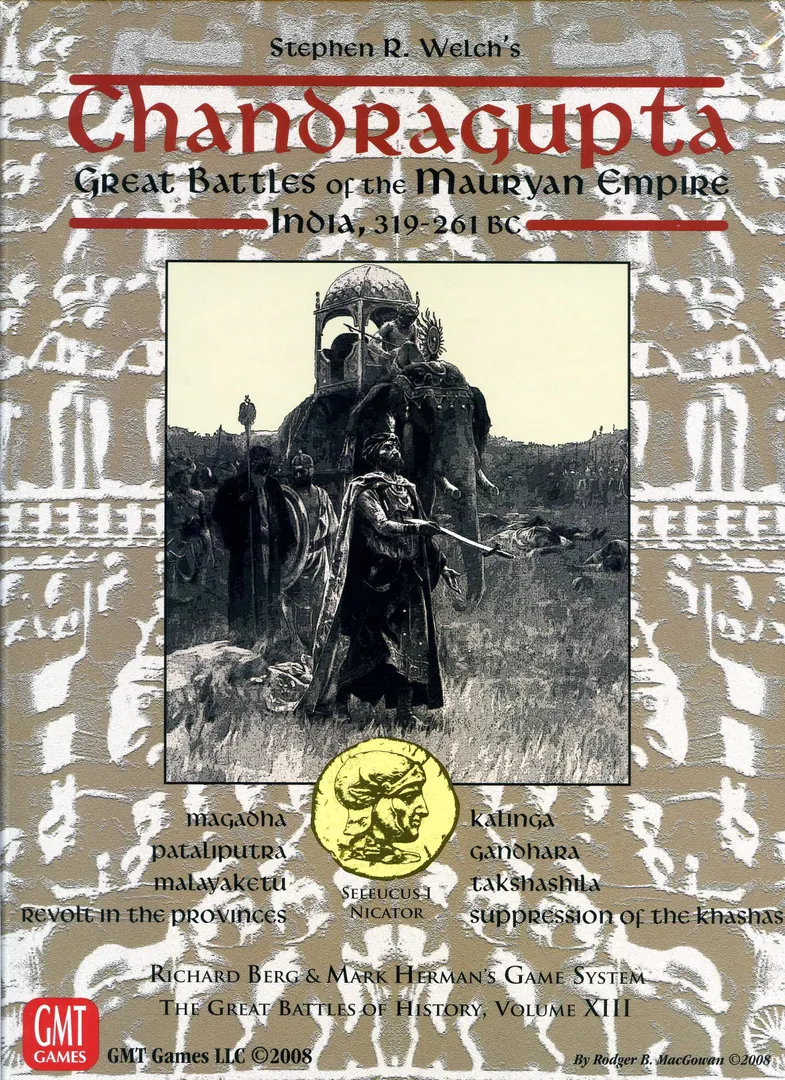
Chandragupta: Great Battles of the Mauryan Empire – India, 319-261 BC
- 2 Spieler
- 240 Min.
- Komplexität 3,8/5
- 2008

Erweiterung für Chariots of Fire: Warfare in the Bronze Age, 2300-1200 B.C.
Regelhilfe für Chariots of Fire: Chariots of the Gods
Verständliche Erklärungen zu Spielzügen, Karteneffekten und strittigen Situationen mit Verweisen auf offizielle Quellen und gespeichertem Fragenverlauf.
Was möchtest du wissen?
Antworten stammen aus dem offiziellen Regelheft, mit Seitenangabe zum Nachprüfen.
Chariots of Fire: Chariots of the Gods ist eine Erweiterung für Chariots of Fire: Warfare in the Bronze Age, 2300-1200 B.C. für 1–4 Personen. Entwickelt wurde es von Stephen R. Welch; die wichtigsten Mechaniken sind Dice Rolling, Hexagon Grid und Simulation.





Auf Englisch
Chariots of the Gods (CG) simulates tactical-level combat in the period of India’s ancient Vedic era. Covering a period extending from roughly 1700 to 800 BCE, the age of Vedic India was one of sweeping battles between great kingdoms for supremacy over northern India. This was the age of the chariot-knight, whose prowess with the compound bow from his speeding war-car inspired legends. Often the bravery of the charioteer, whose skill in commanding the vehicle safely through the chaos and danger of the ancient battlefield was no less legendary. Given the heroic nature of the age, the Chariots of Fire Heroes rules have been expanded to portray the fighting styles in the Vedic poems. All scenarios feature Heros and Heroic Challenges. Rather than Heroes engaging in personal combat only on foot, the Vedic heroes duel each other from a moving chariot wielding their bows. The Hero counter represents not only the Hero, but his Charioteer, and his Chattra (banner) all of which may be hit by his opponent. CG introduces three new unit types: Javelin Infantry: Javelin/light spear armed troops with no armor and no missile capability, fighting in loose formations. These units provide the shock power for most of the tribes. Dismounted Chariots: Noted on the reverse side of the CH-2 counter, these are the knights on foot rather than in their chariots. This mode is mostly useful for traversing rivers and other non-chariot favorable terrain. Lance Armed Cavalry: Early light cavalry armed with lances with limited Shock capability. There are special rules for river crossings, strongholds, and given the coalition type armies in the larger battles, rules for Tribal Flight. Battles included in the Module Hariyupiya River (ca. 1660), the Anu vs. the Vrcivans Invasion of the Purus (ca. 1540), the Puru-Bharata vs. the Turvasha-Yadu Battle of the Dasyus (ca. 1500), the Puru-Bharata vs. the Dasyus Khandava Expedition (ca. 1415) the Bharata vs. the Kikatas Parushni River (ca. 1400), Tritsu and Bharata vs. the Kings of the Puru Confederation Yamuna River (ca. 1400), Tritsu and Bharata vs. the Kings of the Puru Confederation The typical tribal army consists of mixture of Chariots, bow armed infantry, and javelin armed infantry with minimal shock capability. The Vrcivans, Dasyu, and Kikatas are infantry armies composed of Shock or Barbarian infantry along with bow armed infantry. The battles against the Daysu and Kikatas play out on rough terrain which tends to neutralize the Chariots mobility. The Vrcivans, on the other hand, need to force their way across a river and then contest the chariots in open terrain. The other three battles are set piece affairs occurring on mostly chariot friendly terrain showcasing the full capabilities of that weapons system and the dueling Heroes of legend. The Hariyupiya River battle is on the small side, while the Parushni is the largest, comparable to The CoF Battle of Senzar. The remainder are of medium size like Astarpa River in CoF . —description from the publisher
Laut Katalog unterstützt Chariots of Fire: Chariots of the Gods 1–4 Personen. Diese Spanne entspricht der vom Verlag angegebenen Spielerzahl, das Spiel lässt sich also für jede Gruppengröße innerhalb dieser Spanne aufbauen. Aufbau, einzelne Regeln und Wertungsdetails können je nach Personenzahl trotzdem abweichen; prüfe daher die genaue Konfiguration in der Anleitung deiner Ausgabe.
Chariots of Fire: Chariots of the Gods gehört zu diesen Kategorien: Wargame, Ancient und Expansion for Base-game. Die wichtigsten Mechaniken sind Dice Rolling, Hexagon Grid und Simulation. Kategorien beschreiben Thema und Setting eines Spiels, Mechaniken dagegen, was die Spielenden in ihrem Zug tatsächlich tun. Jede Mechanik führt zu einer Katalogseite mit ähnlichen Spielen, falls du etwas Vergleichbares suchst.
Als Autoren von Chariots of Fire: Chariots of the Gods sind angegeben: Stephen R. Welch. Diese Angaben stammen aus den veröffentlichten Spieldaten und nennen die für das Spieldesign verantwortlichen Personen, nicht die Illustratoren oder Verlage. Die Autorenseiten auf MeepleRules sammeln weitere Titel derselben Autoren – praktisch, wenn dir ein Spiel gefällt und du ähnliche Spiele suchst.
Im Katalog ist Chariots of Fire: Chariots of the Gods als Erweiterung zu Chariots of Fire: Warfare in the Bronze Age, 2300-1200 B.C. aufgeführt. Erweiterungen ergänzen das Grundspiel um neues Material, neue Regeln oder Szenarien und sind meist nicht eigenständig spielbar; du brauchst also Chariots of Fire: Warfare in the Bronze Age, 2300-1200 B.C., um sie zu nutzen. Prüfe, ob deine Ausgabe von Chariots of Fire: Warfare in the Bronze Age, 2300-1200 B.C. kompatibel ist, da manche Erweiterungen zwischen den Auflagen überarbeitet wurden.