
- BGG-Rang
- BGG #5.647
- BGG-Bewertung
- 8,3
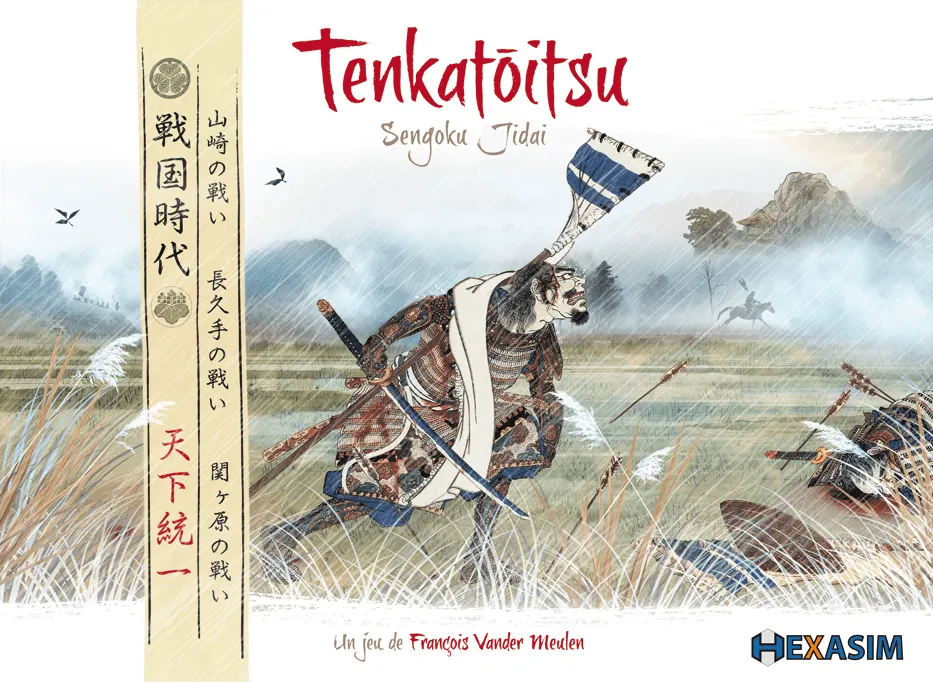
Tenkatoitsu
- 1–2 Spieler
- 180–420 Min.
- Komplexität 3,4/5
- 2016
2009
Regelhilfe für Kawanakajima 1561
Verständliche Erklärungen zu Spielzügen, Karteneffekten und strittigen Situationen mit Verweisen auf offizielle Quellen und gespeichertem Fragenverlauf.
Für 1 Person
Was möchtest du wissen?
Antworten stammen aus dem offiziellen Regelheft, mit Seitenangabe zum Nachprüfen.
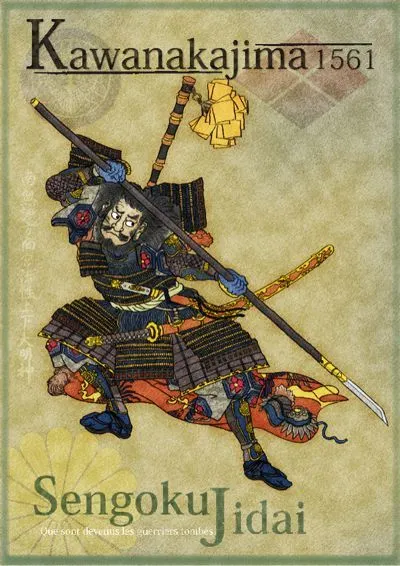
Kawanakajima 1561 ist ein Brettspiel aus dem Jahr 2009 für 1–2 Personen und mit 120–240 Minuten pro Partie. Entwickelt wurde es von François Vander Meulen; die wichtigsten Mechaniken sind Dice Rolling, Hexagon Grid und Simulation.




Auf Englisch
(from Hexasim website:) Kawanakajima 1561, simulates the fourth battle of Kawanakajima. This will be the first game in the series Sengoku Jidai, which will cover battles in 16th century Japan. The system is designed so players can finish a game in an evening, and has simple but dynamic mechanics. In the game, each player takes the role of a commander in chief. Each army consists of various clans, and the players have to choose an action for each of their clans. Each clan is represented by 1 to 3 units. The units have various abilities, summarized by the 4 factors: élan, mass, fire and the presence of a leader. Elan represents factors such as the unit's mobility, and its boldness in attack, and is also used to reflect the advantage that cavalry can have over infantry when attacking. The unit's mass represents its staying power, such as its ability to resist a cavalry charge or a rout. A unit's abilities are tied to the value of its four factors and the current mode of the clan that it belongs to. A clan can be placed in one of four modes: Attack, Defense, Move, and Rally. The owning clan's mode will affect a unit's ability to move or engage in combat. A game turn consists of alternating phases where a player can activate his units. The order in which activations will occur is tied to a chit pull system. The game system requires each player to plan carefully how to win. They must maneuver to gain numerical superiority, deploy in terrain that takes advantage of their clan's mode, and try to surprise his opponent by attacking troops that are not prepared. The system also places the players under the same historical limitations as the actual Japanese leaders. Japanese generals of this time prearranged their battle plans and coordinated their armies with a precise system of semaphore flags and sound signals. The game includes 2 scenarios: one depicting the historical battle, and a "what if?" hypothetical scenario. In the historical scenario, Takeda's army is divided in two contingents. One of the contingents is taken by surprise by Uesugi's army, and has to fight a holding action until the rest of the army can come to its aid. The hypothetical scenario explores what could have happened several days before the historical battle. In Kawanakajima 1561 a hex represents about 250 meters and a strength point corresponds to around 100 men. Game components: 1 map A1 (84cm*60cm) 228 game counters (88 5/8inch, 140 1/2inch) one rule book with scenarios Game play aids Cardboard jacket 4 dice
Laut Katalog unterstützt Kawanakajima 1561 1–2 Personen. Diese Spanne entspricht der vom Verlag angegebenen Spielerzahl, das Spiel lässt sich also für jede Gruppengröße innerhalb dieser Spanne aufbauen. Aufbau, einzelne Regeln und Wertungsdetails können je nach Personenzahl trotzdem abweichen; prüfe daher die genaue Konfiguration in der Anleitung deiner Ausgabe.
Die angegebene Spieldauer für Kawanakajima 1561 beträgt 120–240 Minuten. Das ist die Schätzung des Verlags für eine vollständige Partie. Die tatsächliche Dauer hängt von der Gruppe, der Personenzahl und der Regelkenntnis ab: Erste Partien dauern meist länger, erfahrene Gruppen sind oft schneller fertig. Aufbau und Regelerklärung sind in dieser Schätzung nicht enthalten.
Kawanakajima 1561 hat bei BoardGameGeek eine Komplexitätswertung von 2,8 von 5 und gilt damit als eher leichtes Spiel. Die Wertung zeigt, wie viel Regelwissen, Planung und Entscheidungen eine typische Partie verlangt. Schwerere Spiele brauchen bei der ersten Erklärung mehr Zeit, daher hilft vor dem Spieleabend eine Vorbereitungsanleitung.
Kawanakajima 1561 gehört zu diesen Kategorien: Wargame, Renaissance und Pike and Shot. Die wichtigsten Mechaniken sind Dice Rolling, Hexagon Grid und Simulation. Kategorien beschreiben Thema und Setting eines Spiels, Mechaniken dagegen, was die Spielenden in ihrem Zug tatsächlich tun. Jede Mechanik führt zu einer Katalogseite mit ähnlichen Spielen, falls du etwas Vergleichbares suchst.
Als Autoren von Kawanakajima 1561 sind angegeben: François Vander Meulen. Diese Angaben stammen aus den veröffentlichten Spieldaten und nennen die für das Spieldesign verantwortlichen Personen, nicht die Illustratoren oder Verlage. Die Autorenseiten auf MeepleRules sammeln weitere Titel derselben Autoren – praktisch, wenn dir ein Spiel gefällt und du ähnliche Spiele suchst.
Im Katalog ist Kawanakajima 1561 als Grundspiel aufgeführt. Es lässt sich eigenständig mit dem Material aus der Schachtel spielen und benötigt keinen weiteren Titel. Erweiterungen, sofern es welche gibt, ergänzen neues Material oder neue Regeln und sind im Katalog separat mit einem Verweis auf dieses Grundspiel aufgeführt.