
- BGG-Bewertung
- 7,2
Nations at War: White Star Rising – Airborne
- 2 Spieler
- 60 Min.
- Komplexität 2,0/5
- 2012
2010
Regelhilfe für Nations at War: White Star Rising
Verständliche Erklärungen zu Spielzügen, Karteneffekten und strittigen Situationen mit Verweisen auf offizielle Quellen und gespeichertem Fragenverlauf.
Für 2 Personen
Was möchtest du wissen?
Antworten stammen aus dem offiziellen Regelheft, mit Seitenangabe zum Nachprüfen.
Nations at War: White Star Rising ist ein Brettspiel aus dem Jahr 2010 für 2 Personen, mit 45–240 Minuten pro Partie und ab 16 Jahren. Entwickelt wurde es von Mark H. Walker; die wichtigsten Mechaniken sind Hexagon Grid und Chit-Pull System.
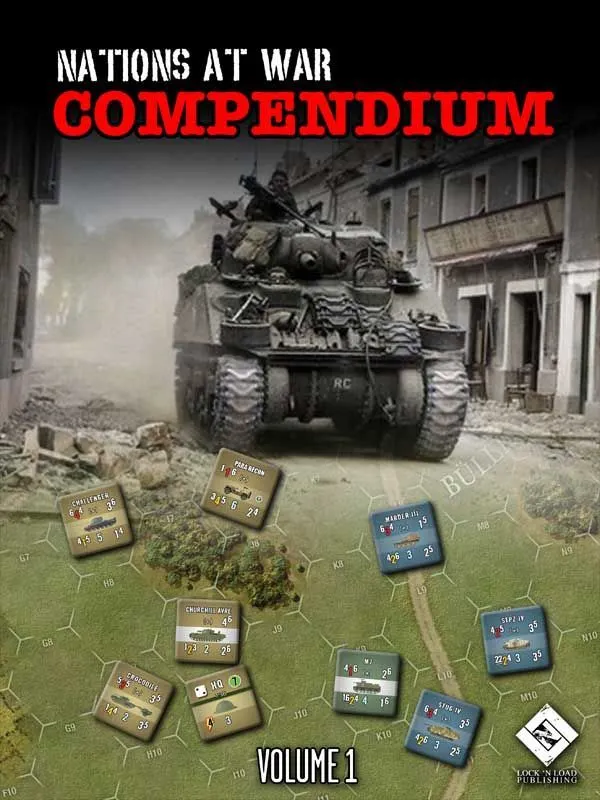



Auf Englisch
Publisher's blurb: "White Star Rising introduces Lock ‘n Load Publishing’s Nations at War (NAW) game system. Based on the popular World at War, NAW depicts platoon level combat in World War II. Here you’ll find everything you're looking for in a platoon-level game -- armor, artillery, infantry that serves as more than cannon fodder, command and control, air support, amphibious landings, and desperate close assaults that leave the victor in possession of the ground and the defeated in headlong retreat, all in eight pages of rules. That’s two less than the World at War system. "Units represent platoons of vehicles, such as M-10 Wolverines, M4A3E8 Easy Eight Shermans, and German Panthers, Tigers, and Mark IVs. Of course White Star Rising isn’t all about tanks. There’s plenty of infantry; paratroopers, line doggies, Fallschirmjaeger, and Volksgrenadiers. In the same vein as the World at War system, the infantry are capable of moving fast and hitting hard. White Star Rising also includes support weapons, such as heavy machine guns, flamethrowers, and satchel charges that infantry platoons can use to lethal effect. "The system throws typical turn-based gaming out the window. The platoons are grouped into formations (usually battalions and kampfgruppen) and led by a headquarters. Each unit of the formation must be within range of the HQ to activate with its formation. Although individual units might activate, and recon units can double their range from the HQ, you’ll want to keep those formations together. The formations are activated by chit draw, and better-trained, better-led units can activate more than once in a turn, moving, shooting, and fighting in each activation. On the flip side, there is no guarantee that a formation will activate even once. The cup into which the formation chits are placed is seeded with end turn chits. When the second end turn chit is drawn the turn ends. Doesn’t matter if a single formations has activated; the turn is over. It keeps you on your toes. "When attacking, each platoon rolls a number of dice equal to its firepower. Every die that equals or exceeds the “to hit” number (right superscript) hits the target. The target then rolls a number of dice equal to its armor factor plus terrain advantages. Each die that equals or exceeds its armor factor negates a hit. The first hit disrupts a unit, second reduces it, the third eliminates it. "Units may also close assault, entering the opponent’s hex to either deal a death blow or force him (or her) out of valuable terrain. Same procedure, but both units use their close assault value. The side that takes the most hits must retreat from the hex. Infantry is VERY good at this, especially against armor without its own infantry support. "Game includes rules for thin-skinned vehicles, support weapons (actual counters that represent heavy machine guns, flamethrowers, and satchel charges that add to an infantry platoon’s capabilities), air support, bunkers, wire, artillery, mines, overruns opportunity fire, line-of-sight rules that have been streamlined since their inception in World at War, transporting infantry--and all in eight pages of rules." Other Games in Series: Nations at War: White Star Rising Nations at War: Desert Heat Nations at War: Stalin's Triumph Nations at War: White Star Rising – Airborne Nations at War: White Star Rising – Operation Cobra Re-implements: World at War: Eisenbach Gap
Laut Katalog unterstützt Nations at War: White Star Rising 2 Personen. Das ist die vom Verlag angegebene Spielerzahl, das Spiel ist also genau für diese Anzahl von Mitspielenden ausgelegt. Varianten für andere Gruppengrößen sind, sofern vorhanden, in der Anleitung deiner Ausgabe beschrieben; prüfe sie, bevor du eine andere Konfiguration aufbaust.
Die angegebene Spieldauer für Nations at War: White Star Rising beträgt 45–240 Minuten. Das ist die Schätzung des Verlags für eine vollständige Partie. Die tatsächliche Dauer hängt von der Gruppe, der Personenzahl und der Regelkenntnis ab: Erste Partien dauern meist länger, erfahrene Gruppen sind oft schneller fertig. Aufbau und Regelerklärung sind in dieser Schätzung nicht enthalten.
Im Katalog wird Nations at War: White Star Rising ab 16 Jahren empfohlen. Das ist die Empfehlung des Verlags und berücksichtigt Leseanforderungen, Regelkomplexität und Kleinteile, nicht nur das Thema. Jüngere Kinder können oft mit Hilfe eines Erwachsenen mitspielen; beachte die Altersangabe deiner Ausgabe und die Brettspielerfahrung deiner Gruppe.
Nations at War: White Star Rising hat bei BoardGameGeek eine Komplexitätswertung von 2,6 von 5 und gilt damit als eher leichtes Spiel. Die Wertung zeigt, wie viel Regelwissen, Planung und Entscheidungen eine typische Partie verlangt. Schwerere Spiele brauchen bei der ersten Erklärung mehr Zeit, daher hilft vor dem Spieleabend eine Vorbereitungsanleitung.
Nations at War: White Star Rising gehört zu diesen Kategorien: Wargame und World War II. Die wichtigsten Mechaniken sind Hexagon Grid und Chit-Pull System. Kategorien beschreiben Thema und Setting eines Spiels, Mechaniken dagegen, was die Spielenden in ihrem Zug tatsächlich tun. Jede Mechanik führt zu einer Katalogseite mit ähnlichen Spielen, falls du etwas Vergleichbares suchst.
Als Autoren von Nations at War: White Star Rising sind angegeben: Mark H. Walker. Diese Angaben stammen aus den veröffentlichten Spieldaten und nennen die für das Spieldesign verantwortlichen Personen, nicht die Illustratoren oder Verlage. Die Autorenseiten auf MeepleRules sammeln weitere Titel derselben Autoren – praktisch, wenn dir ein Spiel gefällt und du ähnliche Spiele suchst.
Im Katalog ist Nations at War: White Star Rising als Grundspiel aufgeführt. Es lässt sich eigenständig mit dem Material aus der Schachtel spielen und benötigt keinen weiteren Titel. Erweiterungen, sofern es welche gibt, ergänzen neues Material oder neue Regeln und sind im Katalog separat mit einem Verweis auf dieses Grundspiel aufgeführt.