- BGG-Bewertung
- 5,6
Tawantinsuyu: Book of Challenges
- 3–4 Spieler
- 60–120 Min.
- 2022
2020
Regelhilfe für Tawantinsuyu: The Inca Empire
Verständliche Erklärungen zu Spielzügen, Karteneffekten und strittigen Situationen mit Verweisen auf offizielle Quellen und gespeichertem Fragenverlauf.
Für 1 Person
Was möchtest du wissen?
Antworten stammen aus dem offiziellen Regelheft, mit Seitenangabe zum Nachprüfen.
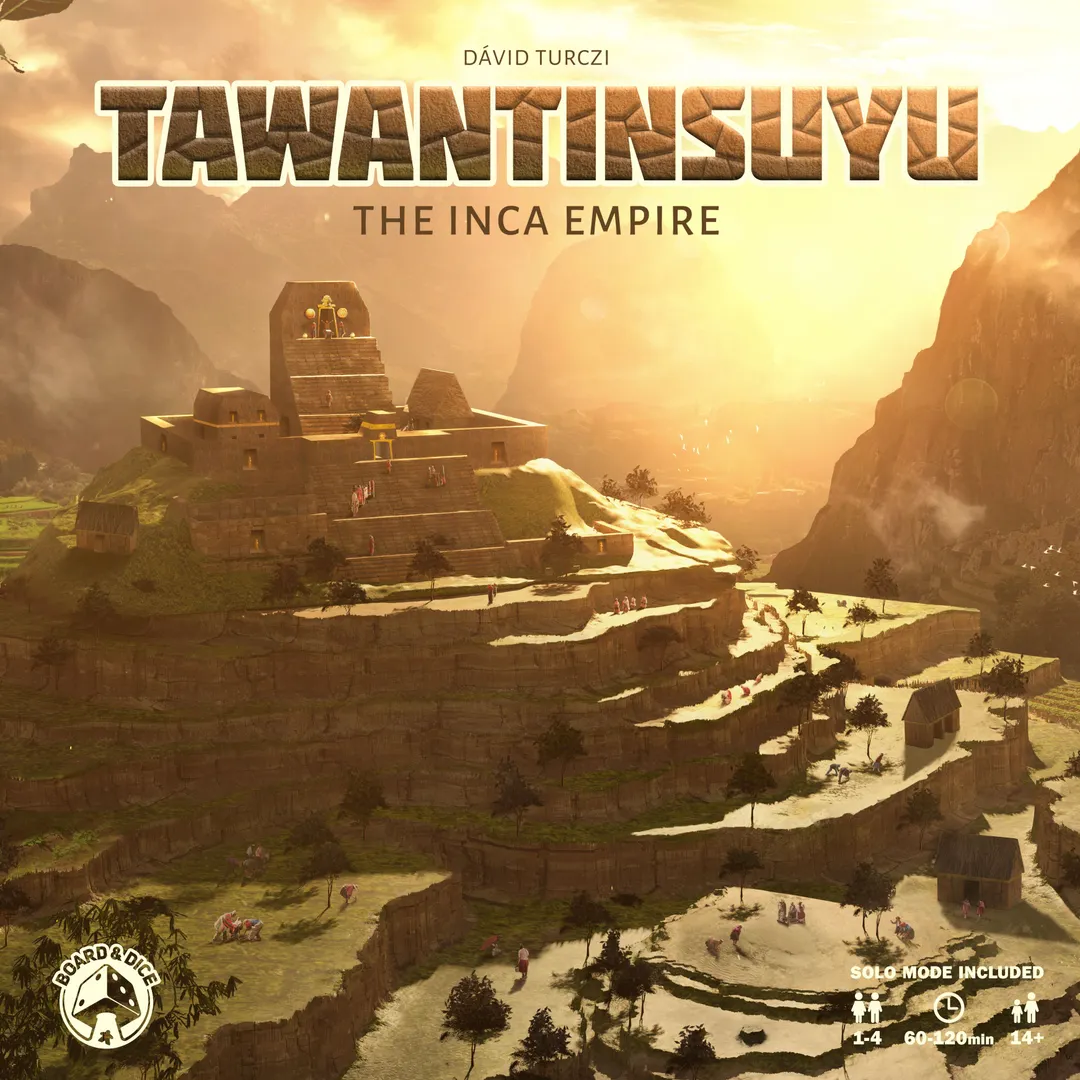
Tawantinsuyu: The Inca Empire ist ein Brettspiel aus dem Jahr 2020 für 1–4 Personen, mit 60–120 Minuten pro Partie und ab 14 Jahren. Entwickelt wurde es von Dávid Turczi; die wichtigsten Mechaniken sind Hand Management, Set Collection und Area Majority / Influence.

Auf Englisch
The great Sapa Inca Pachacuti turned to his offspring and ordered them to worship Inti, the Sun God, and to expand the Inca Empire as far as the llamas roam. With Chinchaysuyu, Antisuyu, Qullasuyu, and Kuntisuyu — the four regions of the new empire — now ripe for conquest, the time has come for Pachacuti's true successor to arise. Gather your people from the villages below and use their unique abilities to strategically place them where they can perform the greatest tasks for you. Climb the steps of the Sun Temple, reaping the rewards of your piety. Build structures that both nourish your people and provide you with benefits no other has at their disposal. Muster an army and conquer villages in the four realms of Tawantinsuyu. Prove yourself a worthy successor to Pachacuti and lead the Inca to glory! During Tawantinsuyu: The Inca Empire, players place workers onto various locations on the game board, performing actions, collecting resources (potatoes, corn, stone, and gold), constructing buildings and stairs, sculpt statues, expanding their military strength, and collecting weavings. The game board features a hill located within the old Inca capital of Cusco, the sides of which are terraced and divided into five sections. Atop the hill sits the Coricancha, The Golden Temple, the most important temple of the Inca Empire. Within the Coricancha, each player has a High Priest. On the terraced sections below exist a variety of worker placement locations, interconnected by paths and individually marked by symbols. On your turn, you must either place a worker onto a location outside the Coricancha OR choose two of the following: Recruit one worker. Take two god cards. Draw two army cards and keep one of them. Move your High Priest one or two steps clockwise within the Coricancha. When placing a worker, you must first discard a god card with a matching symbol or pay one gold. Once placed, the worker remains on the game board for the rest of the game! Each worker placement location is connected to exactly three action spaces. You must always perform at least one of these actions. However, for each adjacent worker (i.e., connected to your worker's location via direct path through one of the action spaces) that matches the type of worker just placed, you receive one additional action! While some locations will result in you being able to perform multiple actions, other actions and placements may be more desirable, especially since each of the five types of workers has a unique ability: Warrior: Remove one of the adjacent workers, placing it in your player area. Craftsman: Gain +1 action if placed onto a craftsman space. Architect: Gain +1 action if placed onto an architect space. Courier: Decreased placement cost; +1 action if it's the first worker placed within a given area. Priest: Take one god card; you may pay one potato to gain +1 action. All god cards feature one of the different symbols found on the worker placement locations. Before placing a worker, you must either discard a god card with a matching symbol or pay valuable gold resources. God cards also depict special abilities that can be activated only if you have previously built a matching statue! Army cards allow you to send one or more units to conquer villages in nearby regions. You must compete against the other players for control of each region as well as for valuable rewards that can be gained as a result of military conquest. The position of your High Priest within the Coricancha has a significant impact on your overall strategy, affecting your access to powerful actions and determining any potential resource costs when placing your workers. More specifically, when placing a worker, you must pay additional resources the farther your worker is from your High Priest, from nothing all the way up to eight potatoes or corn! Additionally, when moving your High Priest, you can activate powerful actions available only within the Coricancha: Produce: Gain all rewards from your production buildings. Worship: Sacrifice previously sculpted statues to gain permanent temple advancements. Offering: Pay resources to gain temple advancements. Conquer: Engage in military conquest of nearby villages. Rejuvenate: Refresh previously activated buildings and military units. Throughout the game, you score victory points whenever you construct stairs or sculpt statues. Gain bonus victory points whenever another player makes use of the stairs you have constructed. Score victory points from temple advancements and control of the four regions. The game ends when the worker pool has become exhausted, symbolizing the full incorporation of nearby regions and villages into the newly risen Inca Empire. You then score bonus victory points from reaching the top of the temple, from your woven tapestries, and from various buildings and resources you have accumulated. —description from publisher
Laut Katalog unterstützt Tawantinsuyu: The Inca Empire 1–4 Personen. Diese Spanne entspricht der vom Verlag angegebenen Spielerzahl, das Spiel lässt sich also für jede Gruppengröße innerhalb dieser Spanne aufbauen. Aufbau, einzelne Regeln und Wertungsdetails können je nach Personenzahl trotzdem abweichen; prüfe daher die genaue Konfiguration in der Anleitung deiner Ausgabe.
Die angegebene Spieldauer für Tawantinsuyu: The Inca Empire beträgt 60–120 Minuten. Das ist die Schätzung des Verlags für eine vollständige Partie. Die tatsächliche Dauer hängt von der Gruppe, der Personenzahl und der Regelkenntnis ab: Erste Partien dauern meist länger, erfahrene Gruppen sind oft schneller fertig. Aufbau und Regelerklärung sind in dieser Schätzung nicht enthalten.
Im Katalog wird Tawantinsuyu: The Inca Empire ab 14 Jahren empfohlen. Das ist die Empfehlung des Verlags und berücksichtigt Leseanforderungen, Regelkomplexität und Kleinteile, nicht nur das Thema. Jüngere Kinder können oft mit Hilfe eines Erwachsenen mitspielen; beachte die Altersangabe deiner Ausgabe und die Brettspielerfahrung deiner Gruppe.
Tawantinsuyu: The Inca Empire hat bei BoardGameGeek eine Komplexitätswertung von 4,1 von 5 und gilt damit als schweres Spiel. Die Wertung zeigt, wie viel Regelwissen, Planung und Entscheidungen eine typische Partie verlangt. Schwerere Spiele brauchen bei der ersten Erklärung mehr Zeit, daher hilft vor dem Spieleabend eine Vorbereitungsanleitung.
Tawantinsuyu: The Inca Empire gehört zu diesen Kategorien: Economic, Civilization und Renaissance. Die wichtigsten Mechaniken sind Hand Management, Set Collection und Area Majority / Influence. Kategorien beschreiben Thema und Setting eines Spiels, Mechaniken dagegen, was die Spielenden in ihrem Zug tatsächlich tun. Jede Mechanik führt zu einer Katalogseite mit ähnlichen Spielen, falls du etwas Vergleichbares suchst.
Als Autoren von Tawantinsuyu: The Inca Empire sind angegeben: Dávid Turczi. Diese Angaben stammen aus den veröffentlichten Spieldaten und nennen die für das Spieldesign verantwortlichen Personen, nicht die Illustratoren oder Verlage. Die Autorenseiten auf MeepleRules sammeln weitere Titel derselben Autoren – praktisch, wenn dir ein Spiel gefällt und du ähnliche Spiele suchst.
Im Katalog ist Tawantinsuyu: The Inca Empire als Grundspiel aufgeführt. Es lässt sich eigenständig mit dem Material aus der Schachtel spielen und benötigt keinen weiteren Titel. Erweiterungen, sofern es welche gibt, ergänzen neues Material oder neue Regeln und sind im Katalog separat mit einem Verweis auf dieses Grundspiel aufgeführt.