
- BGG rank
- BGG #444
- BGG rating
- 7.5
Ginkgopolis
- 1–5 players
- 45 min
- Complexity 2.9/5
- 2012
2002
Rules assistance for Alien City
Plain-language explanations of turns, card effects and disputed situations, with official source references and saved question history.
For 2 players
What would you like to know?
Answers come from the official rulebook, with the page to check.
Alien City is a board game released in 2002 for 2 players, 40 minutes per game, and ages 8 and up. It was designed by Michael Schoessow and its main mechanics are Tile Placement, Square Grid, and Modular Board.




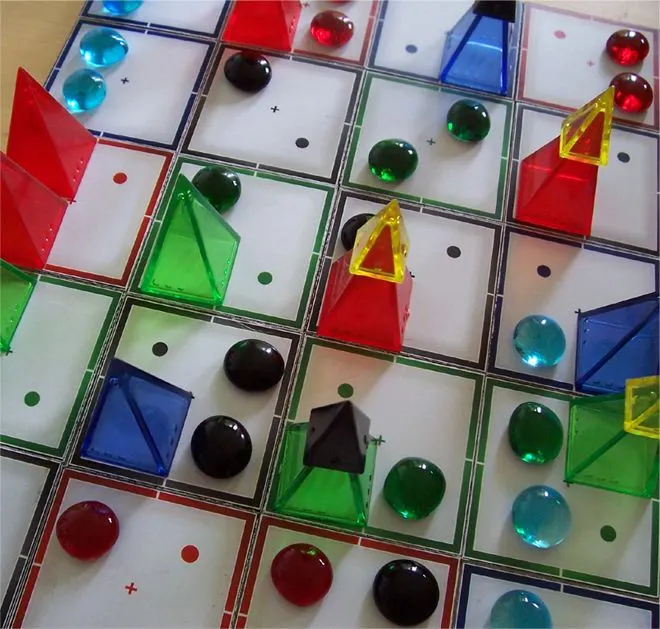
Alien City is a game that is set in the far future and concerns the building of a city on a newly colonized world. Society in this distant time is divided into four powerful guilds. These are the Energy Guild (symbolized by a red sun), the Synthesis Guild (symbolized by a blue fountain), the Control Guild (the most powerful guild of all, symbolized by a green crown), and the Builder's Guild (symbolized by a black tool---yes, that's how tools look in the far future). Cities in this future contain two types of structures, towers and domes. Towers are owned by the various guilds. These are the power plants (energy), factories (synthesis), and government facilities (control). Domes are smaller structures used to house the citizens. As with the towers, domes are always associated with a particular guild. Both towers and domes are color-coded to identify guild affiliation; red for energy, blue for synthesis, green for control, and black for builders. Each of the guilds wants its towers positioned close to the towers and domes of other guilds (their customers) and far away from its own other towers (to avoid competing with other towers of their own guild). Location, location, location! Some things never change, even in the distant future. The Builder's Guild is unique because there are no Builder's Guild towers, i.e., no black towers. Instead, the Builders are compensated for their efforts by being given the profits of some of the other guilds’ towers that the Builders choose as they construct the city. The players in this game are competing builders working to construct the city. At the same time, they are choosing towers for themselves that they hope will be profitable with many close customers and little competition. The choices must be made with care because each builder may only choose three. Red, blue, and green large Icehouse Pieces are used for the towers, and piecepack coins with the suit side up represent red, blue, green, and black domes. The land area of the city is defined by a 4x5 array of piecepack tiles, suit side up, with each tile representing four building sites. The game-play consists of the players alternating turns, placing a tower or dome each turn until either all available towers and domes have been placed or until there are no legal construction sites remaining within the city. Then scores are determined based upon the relative positions of the towers and domes.
Alien City supports 2 players according to the catalogue. This is the publisher’s listed player count, so the game is designed for exactly that number of participants. Variants for other group sizes, if any, are described in the rulebook of your edition, so check it before setting up a different configuration.
The listed playing time for Alien City is 40 minutes. This is the publisher’s estimate for a full game. The actual duration depends on the group, the player count and familiarity with the rules: first sessions usually run longer, while experienced groups often finish faster. Setup and teaching time are not included in this estimate.
The catalogue lists Alien City for ages 8 and up. This is the publisher’s recommendation and reflects reading demands, rule complexity and small components rather than theme alone. Younger players can often join with help from an adult, so check the age guidance on your edition and consider your group’s experience with board games.
Alien City has a complexity rating of 3.2 out of 5 from BoardGameGeek players, which makes it a medium-weight game. The rating reflects how much rules knowledge, planning and decision-making a typical game demands. Expect a longer first teach for heavier games, and use a preparation guide before game night.
Alien City belongs to these categories: Territory Building, Print & Play, and Abstract Strategy. Its main mechanics are Tile Placement, Square Grid, and Modular Board. Categories describe the theme and setting of a game, while mechanics describe what players actually do on their turns. Each mechanic links to a catalogue hub with similar games, which helps when you want something comparable.
The credited designers of Alien City are: Michael Schoessow. These credits come from the published game data and name the people responsible for the game’s design, not its illustrators or publishers. Designer pages on MeepleRules collect other titles by the same designers, which helps when you enjoy a game and want to find similar ones.
The catalogue lists Alien City as a base game. It can be played on its own with the components in the box and does not require any other title. Expansions, if any exist, add new content or rules on top of it and are listed separately in the catalogue with a link back to this base game.