
- BGG rank
- BGG #2,516
- BGG rating
- 6.8
The Hanging Gardens
- 2–4 players
- 45 min
- Complexity 1.9/5
- 2008
2008
Rules assistance for Amerigo
Plain-language explanations of turns, card effects and disputed situations, with official source references and saved question history.
What would you like to know?
Answers come from the official rulebook, with the page to check.
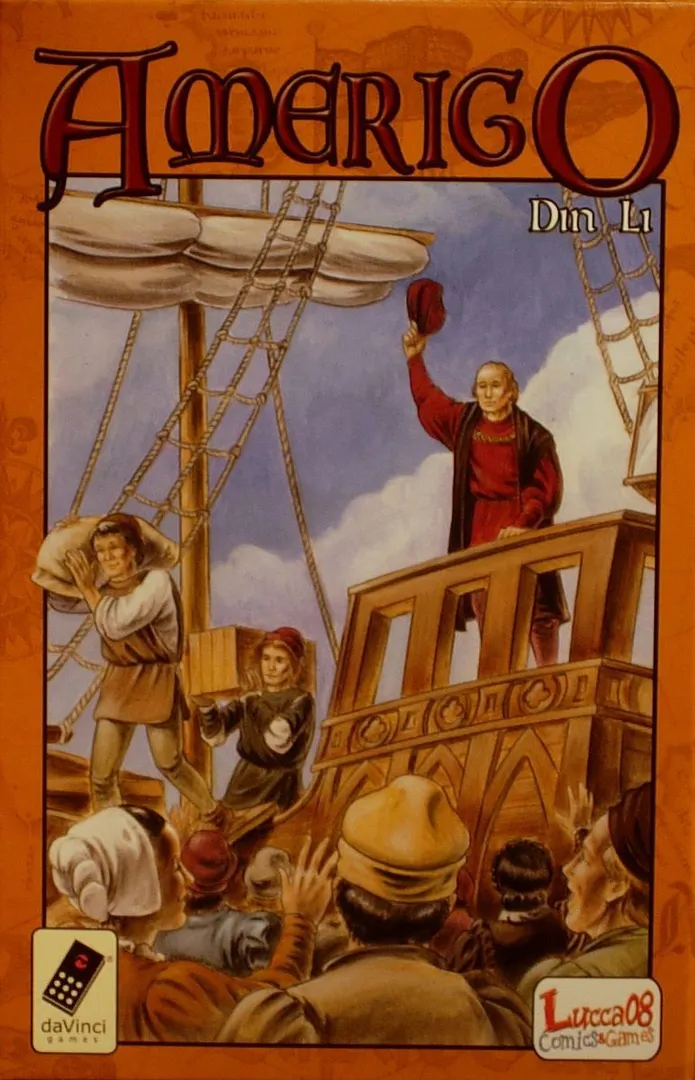
Amerigo is a board game released in 2008 for 2–4 players, 30 minutes per game, and ages 10 and up. It was designed by Din Li Tsan.




This game has been published by dV Giochi as a reward for winning the 2007/2008 edition of the Gioco Inedito – Best Unpublished game contest.Powered by Lucca comics & Games and dV Giochi, the contest aims to identify the best new card game design from all prototypes received and to reward it by publishing the game in a fully professional and high-quality format, overseen directly by dV Giochi. All prototypes submitted must conform to the technical and style requirements, fixed components and a given theme which changes every year. Everybody can join the contest and this is a great opportunity for emerging game designers to see their idea published. For more information: [email protected] www.luccacomicsandgames.com Winner of Gioco Inedito 2007 "Age of Exploration", now published under a new name Amerigo. Named after famous explorer Amerigo Vespucci. Winner of GAMES Magazine "Best New Family Card Game" award 2010. Description from BoardgameNews.com: "It's time to hit the waves once again for a round of nautical exploration. The title comes from Amerigo Vespucci, and like that famed explorer, you must travel the world to search for goods. (Unlike him, you won't have a couple of continents named after you.) The farther you explore, the more likely you are to find goods of better value, but you have to make it back to market if you plan to sell anything, so don't wander off too far." Game Summary Cards have a picture of a boat, 1-3 captain's wheels, and 1 of 5 goods types (in differing rarities in the deck). Start with a hand of ... 4? On your turn, either sail (start a voyage if you're not on one, or continue the current voyage) or market (if you're not on a voyage).To sail further, play a card with the ship moving to the right -- #wheels adds to distance of voyage. May play out of your hand, or from your score pile (play face down; counts as 3 wheels). OR, explore: rotate last card clockwise, draw cards from deck (2 x distance sailed, hand limit 12). After exploring, must sail home; cards played count 2xwheels -- home when you've played at least the distance of the voyage. Upon arriving home, draw bonus cards (hand limit still applies): - if voyage was longest distance of all current voyages, 1 card. - if voyage was 7 wheels, 1 card; 8 wheels, 2; 9+ wheels, 3. If Marketing, add cards from hand to display; max 12 cards on display. Sort by type of goods. OR, sell cards already on display: sell all possible. Rarest good (looking at all markets on table) worth 1 coin per card. Most popular worth 1 coin/2 cards. All others are common, and worth 1 coin/3 cards. If tied for rarest/popular, goods become common. Sold goods are flipped over to represent coins (added to your score pile) or discarded. Game ends immediately if, after the first time through the draw deck, all players are at home at the same time; or the 2nd time through the draw deck. Make final sales, with all cards left in hand and on display worth 1 coin/4 cards. Most money wins.
Amerigo supports 2–4 players according to the catalogue. This range comes from the publisher’s listed player count, so the game can be set up for any group size within it. Some setups, rules and scoring details may still vary by player count, so check your edition’s rulebook for the exact configuration.
The listed playing time for Amerigo is 30 minutes. This is the publisher’s estimate for a full game. The actual duration depends on the group, the player count and familiarity with the rules: first sessions usually run longer, while experienced groups often finish faster. Setup and teaching time are not included in this estimate.
The catalogue lists Amerigo for ages 10 and up. This is the publisher’s recommendation and reflects reading demands, rule complexity and small components rather than theme alone. Younger players can often join with help from an adult, so check the age guidance on your edition and consider your group’s experience with board games.
Amerigo has a complexity rating of 2.0 out of 5 from BoardGameGeek players, which makes it a medium-light game. The rating reflects how much rules knowledge, planning and decision-making a typical game demands. Expect a longer first teach for heavier games, and use a preparation guide before game night.
Amerigo belongs to these categories: Card Game and Exploration. Categories describe the theme, setting and style of a game rather than its rules. Filter the catalogue by the same category to find similar games when you enjoyed Amerigo and want something comparable for your next game night.
The credited designers of Amerigo are: Din Li Tsan. These credits come from the published game data and name the people responsible for the game’s design, not its illustrators or publishers. Designer pages on MeepleRules collect other titles by the same designers, which helps when you enjoy a game and want to find similar ones.
The catalogue lists Amerigo as a base game. It can be played on its own with the components in the box and does not require any other title. Expansions, if any exist, add new content or rules on top of it and are listed separately in the catalogue with a link back to this base game.