

- BGG rank
- BGG #11,041
- BGG rating
- 7.0
Warehouse 13: The Board Game
- 2–5 players
- 120–150 min
- Complexity 3.1/5
- 2019
2018
Rules assistance for Among Us
Plain-language explanations of turns, card effects and disputed situations, with official source references and saved question history.
What would you like to know?
Answers come from the official rulebook, with the page to check.
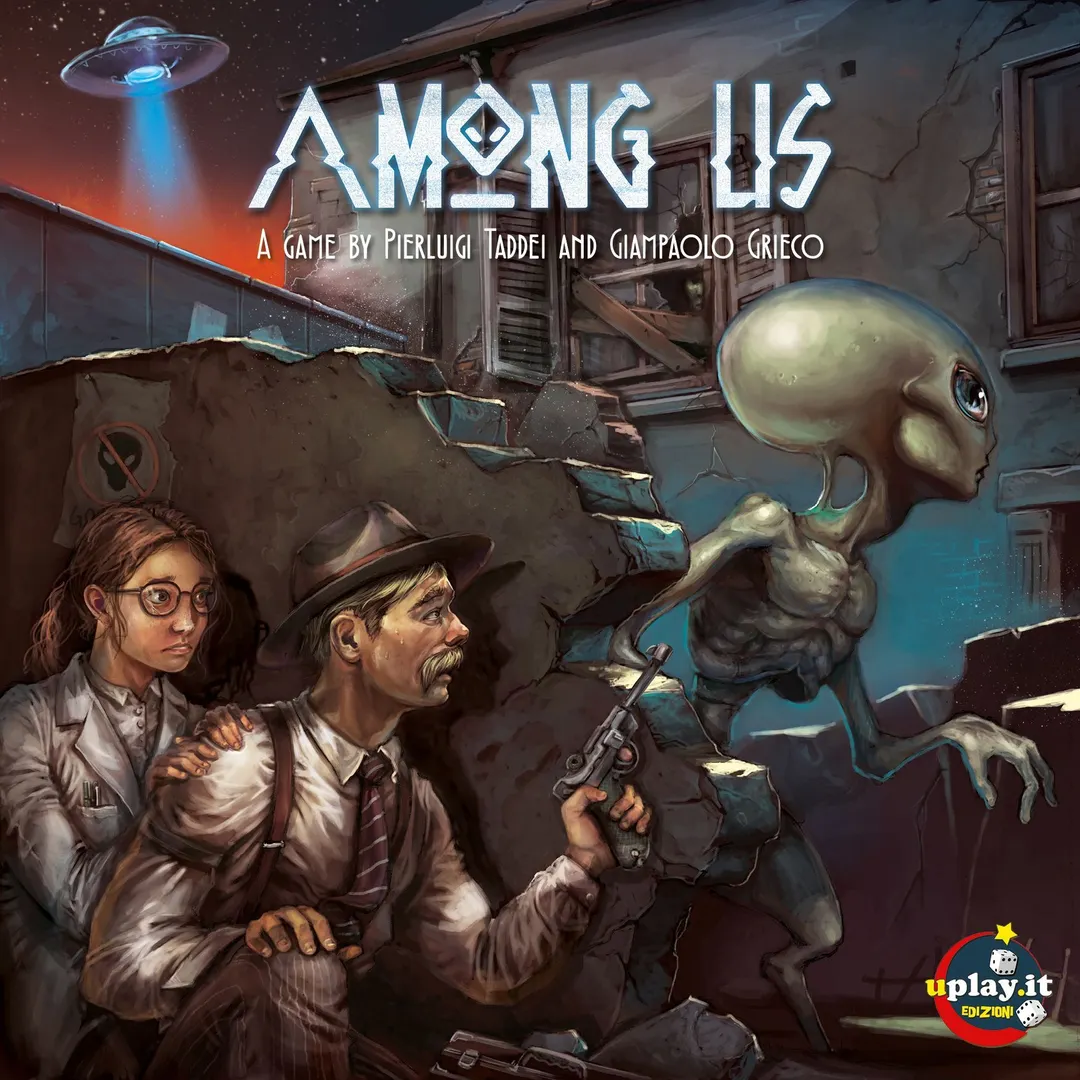
Among Us is a board game released in 2018 for 4–8 players, 60–90 minutes per game, and ages 10 and up. It was designed by Pierluigi Taddei and Giampaolo Grieco and its main mechanics are Variable Player Powers, Point to Point Movement, and Area Majority / Influence.





INTRODUCTION Aliens are among us! Coming from a distant planet they do not have peaceful intentions: they are ready to assimilate humanity to make us blue, small and flabby just like them. And since the day was not already awful enough, they want to start right from your city. They are plenty, smart and wicked, just like fag ash, but do not panic: as current lodger of planet Earth, we still have some aces in the hole to play. On our side, we have unshakable field agents, tough to the bones and loyal to the cause, although limited when it is time to take action. We can also count on a brilliant group of scientists: if these eggheads could just work together, they might indeed find a way to prevent the imminent invasion... too bad that at the first warning they fled and scatter to the ends of the city! They might be braniacs but definitely miss the guts. As part of the resistance, your mission is to coordinate the agents on the field and gather all the scientists before the aliens complete their plan of conquering the city. You shall send orders from your secret headquarter, but be aware: the enemy is looking for you, and if it manages to localize you, it would assimilate and bring you by its side with no hesitation! If that happens you will end up in the perfect situation to undermine all the effort of your former comrades.. the Earthlings! COURSE OF THE GAME The game is divided in three stages that repeat until the end of the game: 1. Event execution (carried out by the architect) 2. Players‘ turns (carried out by all players clockwise) 3. Consolidation (carried out by the architect) 1. Event execution The invasion is underway! At any moment an alien attack or a stroke of luck can completely change the situation... The architect turns over the top card of the events deck and execute its effects. Then, he discards the card. 2. Players‘ turns Each player will be able to command agents in the city or to plan the best strategy to pursue his/her goal. Beware, though: with each action there is the risk of being detected and assimilated by aliens! The alien players may choose to stay hidden until the end of the game or to reveal themselves (without showing their cards)to be in favor with other alien players at the price of exposing themselves to the opposing faction. During his/her turn a player may have to perform risky actions that require to draw a given number of assimilation cards. Once drawn, the cards must be kept secret and cannot be revealed to other players. By drawing at least one Assimilated! card a player becomes an alien. From this very moment on, his/her goal is to let the alien faction win the game! If the assimilation deck is empty the player can still perform his/her actions without drawing any card. An alien player drawing a Human card is still alien. Moreover, drawing two or more Assimilated! Cards does not change the situation. Once alien, alien forever! 3. Consolidation After all players have completed their turn, the field is prepared for the next stages. THE GOAL OF THE GAME The goal of the game is to save all the scientists on the map before the invasion is completed. To archive this objective you must keep out the aliens from the rescue. Keep your eyes on your neighbours, they may no longer be the friends you used to trust, not anymore.
Among Us supports 4–8 players according to the catalogue. This range comes from the publisher’s listed player count, so the game can be set up for any group size within it. Some setups, rules and scoring details may still vary by player count, so check your edition’s rulebook for the exact configuration.
The listed playing time for Among Us is 60–90 minutes. This is the publisher’s estimate for a full game. The actual duration depends on the group, the player count and familiarity with the rules: first sessions usually run longer, while experienced groups often finish faster. Setup and teaching time are not included in this estimate.
The catalogue lists Among Us for ages 10 and up. This is the publisher’s recommendation and reflects reading demands, rule complexity and small components rather than theme alone. Younger players can often join with help from an adult, so check the age guidance on your edition and consider your group’s experience with board games.
Among Us has a complexity rating of 2.5 out of 5 from BoardGameGeek players, which makes it a medium-light game. The rating reflects how much rules knowledge, planning and decision-making a typical game demands. Expect a longer first teach for heavier games, and use a preparation guide before game night.
Among Us belongs to these categories: Party Game, Deduction, and Dice. Its main mechanics are Variable Player Powers, Point to Point Movement, and Area Majority / Influence. Categories describe the theme and setting of a game, while mechanics describe what players actually do on their turns. Each mechanic links to a catalogue hub with similar games, which helps when you want something comparable.
The credited designers of Among Us are: Pierluigi Taddei and Giampaolo Grieco. These credits come from the published game data and name the people responsible for the game’s design, not its illustrators or publishers. Designer pages on MeepleRules collect other titles by the same designers, which helps when you enjoy a game and want to find similar ones.
The catalogue lists Among Us as a base game. It can be played on its own with the components in the box and does not require any other title. Expansions, if any exist, add new content or rules on top of it and are listed separately in the catalogue with a link back to this base game.