

- BGG rank
- BGG #7,655
- BGG rating
- 8.3
NATO: The Cold War Goes Hot – Designer Signature Edition
- 1–4 players
- 120–480 min
- Complexity 3.9/5
- 2021
2008
Rules assistance for An Loc: 1972 – The North Vietnamese Push Towards Saigon
Plain-language explanations of turns, card effects and disputed situations, with official source references and saved question history.
For 2 players
What would you like to know?
Answers come from the official rulebook, with the page to check.
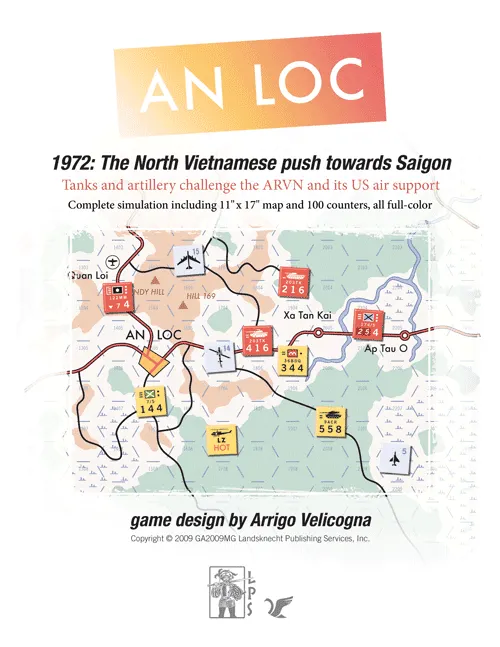
An Loc: 1972 – The North Vietnamese Push Towards Saigon is a board game released in 2008 for 2 players and 120 minutes per game. It was designed by Arrigo Velicogna and its main mechanics are Dice Rolling, Grid Movement, and Hexagon Grid.




An LPS bonus mini-game. April 1972; a Young US Army captain watched a stream of ARVN fugitives screaming "Thiet Giap!" ; "Tank!" in Vietnamese. He climbs on a roof top to see what is happening and spots a column of dark green T54 tanks advancing. The Battle of An Loc had just began. The Peoples Army of (North) Vietnam had launched its biggest offensive of the war. Hundred of tanks, artillery pieces and ten of thousands of trained and confident infantrymen launched a 4 prong attack on the Republic of Vietnam. From Cambodia 3 Divisions descend along the Ropute Nationale 13 toward Saigon. At the small town of An Loc a ragtag band of dispirited ARVN infantrymen, elite rangers and paratroopers stood fast. What was supposed to be a victorious blitzkrieg toward Saigon evolved in a protracted slugfest with B52, American airpower, airmobile assaults and tank charges. In the end the shattered remains of the 3 PAVN divisions run back toward Cambodia leaving only a shattered mass of ruins, but a defiant and victorious garrison. Using regiment and battalion sized units, airpower, artillery, tanks and an operation system that reward increasing the tempo of battle Thiet Giap simulates the battle for the Town of An Loc and the relief effort made by ARVN troops to break the siege. T54 tanks, B52, Paratroopers and sappers are included. One 11x17" map and <100 counters.
An Loc: 1972 – The North Vietnamese Push Towards Saigon supports 2 players according to the catalogue. This is the publisher’s listed player count, so the game is designed for exactly that number of participants. Variants for other group sizes, if any, are described in the rulebook of your edition, so check it before setting up a different configuration.
The listed playing time for An Loc: 1972 – The North Vietnamese Push Towards Saigon is 120 minutes. This is the publisher’s estimate for a full game. The actual duration depends on the group, the player count and familiarity with the rules: first sessions usually run longer, while experienced groups often finish faster. Setup and teaching time are not included in this estimate.
An Loc: 1972 – The North Vietnamese Push Towards Saigon has a complexity rating of 2.3 out of 5 from BoardGameGeek players, which makes it a medium-light game. The rating reflects how much rules knowledge, planning and decision-making a typical game demands. Expect a longer first teach for heavier games, and use a preparation guide before game night.
An Loc: 1972 – The North Vietnamese Push Towards Saigon belongs to these categories: Wargame, Modern Warfare, and Vietnam War. Its main mechanics are Dice Rolling, Grid Movement, and Hexagon Grid. Categories describe the theme and setting of a game, while mechanics describe what players actually do on their turns. Each mechanic links to a catalogue hub with similar games, which helps when you want something comparable.
The credited designers of An Loc: 1972 – The North Vietnamese Push Towards Saigon are: Arrigo Velicogna. These credits come from the published game data and name the people responsible for the game’s design, not its illustrators or publishers. Designer pages on MeepleRules collect other titles by the same designers, which helps when you enjoy a game and want to find similar ones.
The catalogue lists An Loc: 1972 – The North Vietnamese Push Towards Saigon as a base game. It can be played on its own with the components in the box and does not require any other title. Expansions, if any exist, add new content or rules on top of it and are listed separately in the catalogue with a link back to this base game.