
- BGG rank
- BGG #310
- BGG rating
- 7.8
Hallertau
- 1–4 players
- 50–140 min
- Complexity 3.3/5
- 2020
2022
Rules assistance for Atiwa
Plain-language explanations of turns, card effects and disputed situations, with official source references and saved question history.
For 1 player
What would you like to know?
Answers come from the official rulebook, with the page to check.
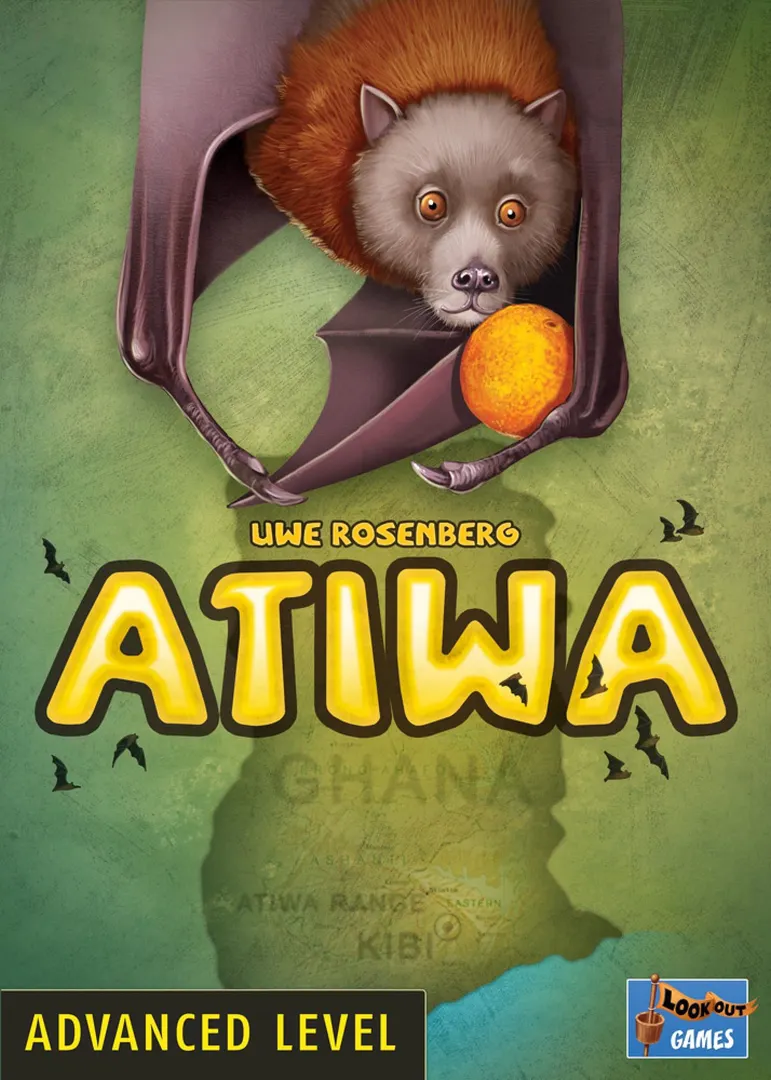
Atiwa is a board game released in 2022 for 1–4 players, 30–120 minutes per game, and ages 12 and up. It was designed by Uwe Rosenberg and its main mechanics are End Game Bonuses, Modular Board, and Worker Placement.
The Atiwa Range is a region of southeastern Ghana in Africa consisting of steep-sided hills with rather flat summits. A large portion of the range comprises an evergreen forest reserve, which is home to many endangered species. However, logging and hunting for bushmeat, as well as mining for gold and bauxite, are putting the reserve under a lot of pressure. Meanwhile, in the nearby town of Kibi, the mayor is causing a stir by giving shelter to a large number of fruit bats in his own garden. This man has recognized the great value the animals have in deforested regions of our planet: Fruit bats sleep during the day and take off at sunset in search of food, looking for suitable fruit trees up to sixty miles away. They excrete the seeds of the consumed fruit, disseminating them across large areas as they fly home. A single colony of 150,000 fruit bats can reforest an area of up to two thousand acres a year. Just like that mayor, in Atiwa, you know that fruit bats — once scorned and hunted as mere fruit thieves — are in fact incredibly useful animals, spreading seeds over large areas of the country. By doing so, they help to reforest fallow land and, in the medium term, improve harvests. This realization has led to a symbiotic co-operation between fruit bats and fruit farmers. The animals are kept as "pets" to increase the size of fruit farms more quickly. Tall trees are left as roosts, providing shelter for them rather than hunting them for their scant meat. However, if you have a lot of fruit bats, you need a lot of space... In the game, you will develop a small community near the Atiwa Range, creating housing for new families and sharing your newly gained knowledge on the negative effects of mining and the importance that the fruit bats have for the environment. You must acquire new land, manage your animals and resources, and make your community prosper. The player who best balances the needs of their community and the environment wins.
Atiwa supports 1–4 players according to the catalogue. This range comes from the publisher’s listed player count, so the game can be set up for any group size within it. Some setups, rules and scoring details may still vary by player count, so check your edition’s rulebook for the exact configuration.
The listed playing time for Atiwa is 30–120 minutes. This is the publisher’s estimate for a full game. The actual duration depends on the group, the player count and familiarity with the rules: first sessions usually run longer, while experienced groups often finish faster. Setup and teaching time are not included in this estimate.
The catalogue lists Atiwa for ages 12 and up. This is the publisher’s recommendation and reflects reading demands, rule complexity and small components rather than theme alone. Younger players can often join with help from an adult, so check the age guidance on your edition and consider your group’s experience with board games.
Atiwa has a complexity rating of 2.8 out of 5 from BoardGameGeek players, which makes it a medium-light game. The rating reflects how much rules knowledge, planning and decision-making a typical game demands. Expect a longer first teach for heavier games, and use a preparation guide before game night.
Atiwa belongs to these categories: Animals, Economic, and Territory Building. Its main mechanics are End Game Bonuses, Modular Board, and Worker Placement. Categories describe the theme and setting of a game, while mechanics describe what players actually do on their turns. Each mechanic links to a catalogue hub with similar games, which helps when you want something comparable.
The credited designers of Atiwa are: Uwe Rosenberg. These credits come from the published game data and name the people responsible for the game’s design, not its illustrators or publishers. Designer pages on MeepleRules collect other titles by the same designers, which helps when you enjoy a game and want to find similar ones.
The catalogue lists Atiwa as a base game. It can be played on its own with the components in the box and does not require any other title. Expansions, if any exist, add new content or rules on top of it and are listed separately in the catalogue with a link back to this base game.