
- BGG rank
- BGG #24,621
- BGG rating
- 5.8
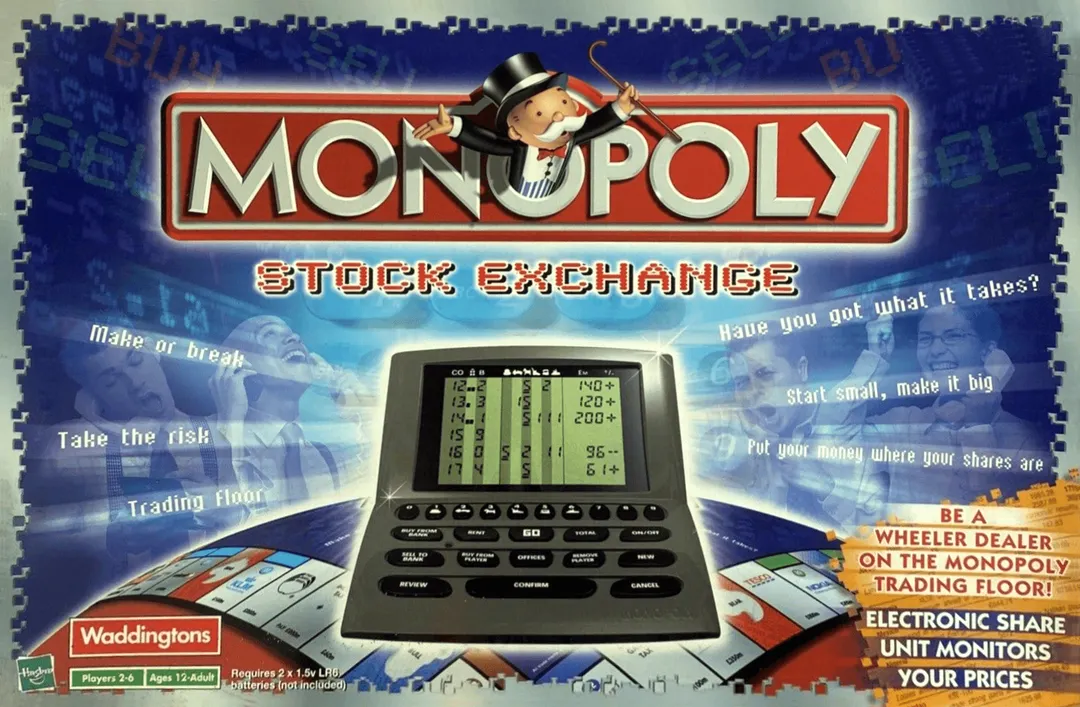
Monopoly: Stock Exchange
- 2–6 players
- 120 min
- Complexity 2.3/5
- 2001

1935
Rules assistance for Capitaly
Plain-language explanations of turns, card effects and disputed situations, with official source references and saved question history.
What would you like to know?
Answers come from the official rulebook, with the page to check.
Capitaly is a board game released in 1935 for 2–8 players, 60 minutes per game, and ages 8 and up. Its main mechanics are Set Collection, Trading, and Roll / Spin and Move.






This is Hungarian version of the monopoly game that, like Parker Brothers', must have been issued around 1935, because the currency Pengõ was in use in Hungary from 1927 till mid 1946. In addition the banknotes have a kind of "engines-pattern" that resembles that of Parker Brothers' but with 2 engines and 2 houses left and right from the circle-with-number-in-the-center. Everything indicates an imitation rather than a license of Parker Brothers. The lid of the box shows a slightly reduced copy of the oblong game board in the colors red, beige and black. The long sides always have 12 fields between the corners whereas the short ones have 7 spaces. Therefore the streets of the 3rd and 7th group are on 2 sides of the board. The first group is made up of districts of PEST, those of the 5th group of districts of BUDA, whereas all other spaces are streets of BUDAPEST. The back side of the pretty beige colored property deeds is unprinted. The streets have no prices on the game board, and the groups are marked by stripes, triangles, crosses and circles. There are but 3 stations which in addition are not situated in the middle of the sides. On the other hand there are also 3 public works, viz. besides the Electric- and Gas Works there is Telephone as well. There are 3 tax spaces. Really Hungarian is the reward of 500 P you get from each player on your name day (Névnap). The lid and the board's midfield shows an illustration of the New York skyline with the remark "statutory protected". In the center-area is only 1 space for cards being the 24 orange Chance-cards you have to pull arriving on a Wheel of Fortune space. Instead of "Just visiting in Jail" you are going to relax at the Margit Isle (in the middle of the river Donau). You are not sent to this place in the 3rd corner because there you'll join in a lottery. There you have to throw immediately once more. You'll receive 10-fold in Pengôs from the bank the number of pips thrown. Should you throw 12 you even get the first prize of 10,000 Pengôs. Instead of Free Parking you'll land in the Sanatorium. You may be sent to it as well by a Chance card, because "You are exhausted, you have to be treated - Go to the Sanatorium!". It is a kind of jail anyhow, because here again you have to omit 3 turns. In the inner box is an insert of black plastic containing 5 trays for the equipment. The 7 are printed in black on colored paper in the denominations 10 - 50 - 100 - 200 - 500 - 1000 and 5000 Pengô. The tokens consist of 6 colored round discs of timber. There are 32 beige houses of raw timber and 12 red hotels. One die is black and one red.
Capitaly supports 2–8 players according to the catalogue. This range comes from the publisher’s listed player count, so the game can be set up for any group size within it. Some setups, rules and scoring details may still vary by player count, so check your edition’s rulebook for the exact configuration.
The listed playing time for Capitaly is 60 minutes. This is the publisher’s estimate for a full game. The actual duration depends on the group, the player count and familiarity with the rules: first sessions usually run longer, while experienced groups often finish faster. Setup and teaching time are not included in this estimate.
The catalogue lists Capitaly for ages 8 and up. This is the publisher’s recommendation and reflects reading demands, rule complexity and small components rather than theme alone. Younger players can often join with help from an adult, so check the age guidance on your edition and consider your group’s experience with board games.
Capitaly has a complexity rating of 1.4 out of 5 from BoardGameGeek players, which makes it a light game. The rating reflects how much rules knowledge, planning and decision-making a typical game demands. Expect a longer first teach for heavier games, and use a preparation guide before game night.
Capitaly belongs to these categories: Economic and Negotiation. Its main mechanics are Set Collection, Trading, and Roll / Spin and Move. Categories describe the theme and setting of a game, while mechanics describe what players actually do on their turns. Each mechanic links to a catalogue hub with similar games, which helps when you want something comparable.
The catalogue lists Capitaly as a base game. It can be played on its own with the components in the box and does not require any other title. Expansions, if any exist, add new content or rules on top of it and are listed separately in the catalogue with a link back to this base game.