
- BGG rank
- BGG #17,329
- BGG rating
- 6.6
Pacru
- 2–4 players
- 45 min
- Complexity 3.3/5
- 2004
1120
Rules assistance for Chinese Dominoes
Plain-language explanations of turns, card effects and disputed situations, with official source references and saved question history.
What would you like to know?
Answers come from the official rulebook, with the page to check.
Chinese Dominoes is a board game released in 1120. Its main mechanics are Tile Placement.







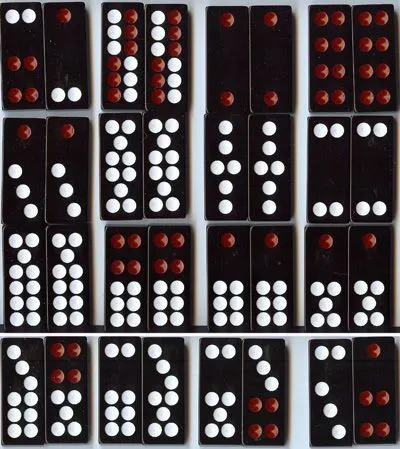
Chinese Dominoes Chinese Dominoes is a family of domino games played with "Chinese Dominoes" (or also called Asian Dominoes, as there are Chinese, Korean, Burmese, and Thai games played with these sets of Dominoes). Origins The Chinese name for 'Chinese Dominoes' is K'wat P'ai (meaning "bone tablets") or sometimes U P'ai ("Barbarian tablets) As with a number of other Chinese games these dominoes made their way to Korea. The Korean version of dominoes are called kol-hpai (meaning "bone tablets") or sometimes ho-hpai ("Barbarian tablets") - possibly linked to the attitude of the korean nobility towards the game. Components Chinese Dominoes differ from Western Dominoes in the number and distribution of the tiles, as well as the games that are traditionally played with them. A set consists of 32 tiles of a double-six pattern, distributed as follows: Two copies of 1-1, 1-3, 1-5, 1-6, 2-2, 3-3, 4-4, 4-6, 5-5, 5-6 and 6-6. One copy of 1-2, 1-4, 2-3, 2-4, 2-5, 2-6, 3-4, 3-5, 3-6 and 4-5. These differ from Western Dominoes in that they have no blanks. The tiles are made up of the 21 different combinations of two six-sided dice thrown, plus the 11 "duplicate copies" listed above. The pips for one and four are colored red. All other numbers are white, with the exception of six, which is half-and-half. These colors have significance in the Chinese games. Asian Dice have the one and four pips colored red as well. Pai Gow and Tien Gow (Sky Nine) are popular games played with Chinese Dominoes.
Chinese Dominoes has a complexity rating of 2.0 out of 5 from BoardGameGeek players, which makes it a medium-light game. The rating reflects how much rules knowledge, planning and decision-making a typical game demands. Expect a longer first teach for heavier games, and use a preparation guide before game night.
Chinese Dominoes belongs to these categories: Abstract Strategy and Game System. Its main mechanics are Tile Placement. Categories describe the theme and setting of a game, while mechanics describe what players actually do on their turns. Each mechanic links to a catalogue hub with similar games, which helps when you want something comparable.
The catalogue lists Chinese Dominoes as a base game. It can be played on its own with the components in the box and does not require any other title. Expansions, if any exist, add new content or rules on top of it and are listed separately in the catalogue with a link back to this base game.