

- BGG rank
- BGG #11,085
- BGG rating
- 9.0
The Dogs of War
- 2–4 players
- 180–600 min
- Complexity 4.1/5
- 2021
2022
Rules assistance for CO-OPS
Plain-language explanations of turns, card effects and disputed situations, with official source references and saved question history.
What would you like to know?
Answers come from the official rulebook, with the page to check.
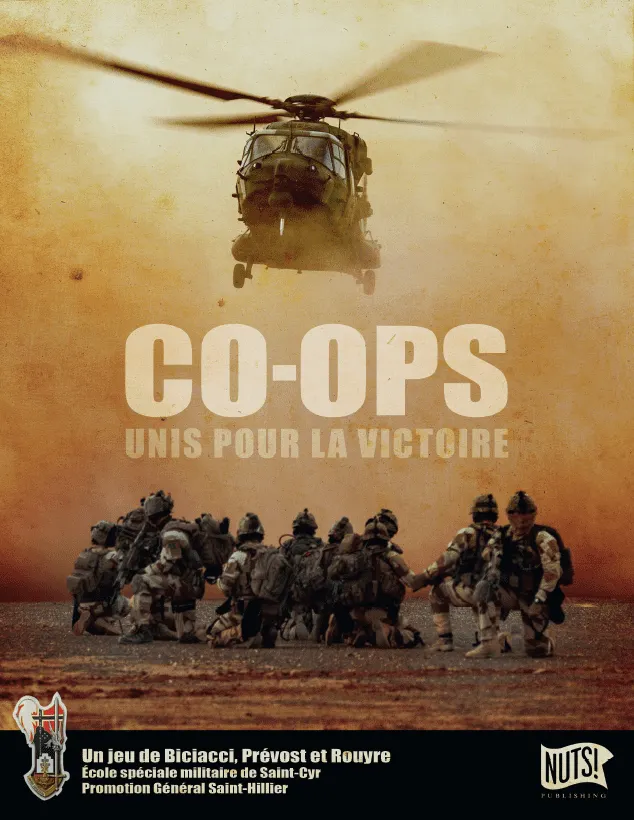
CO-OPS is a board game released in 2022 for 1–4 players, 60–120 minutes per game, and ages 14 and up. It was designed by Biciacci, Prévost, and Rouyre and its main mechanics are Variable Set-up, Cooperative Game, and Hexagon Grid.





CO-OPS was imagined by three graduates of the special military school of Saint-Cyr (General Saint-Hillier class, 2015-2018). Designed as part of the simulation courses to provide a training tool for future section leaders, the game emphasizes cooperation between players against an enemy played by the game itself. Each player takes the lead of an infantry platoon, a tank platoon or a helicopter squadron of the French Army and you will all need to cooperate to win the battle against armed terrorist groups; close coordination between the different arms is the key to victory. CO-OPS is based on simple mechanisms that can be explained in a few minutes, the depth of the game lies in the interactions between players. All players will have to get along and coordinate to conduct a complex joint operation, first to overcome the inevitable friction of battle and penetrate the fog of war... and then to triumph over the enemy. Start by choosing one of the 10 scenarios, which can be played alone or as part of the campaigns, but you may as well invent one from scratch thanks to the wide variety of units provided in the game box and the modular terrain tiles that allow you to compose an infinite number of geographical situations. Then, each player chooses the section they will command (infantry, cavalry, helicopters) and composes it at their convenience, thanks to a very simple budget system. Time for action, now! Every turn (about 15 minutes of real time), enemy units leave their bases and move automatically, via the squares of the game board (about 100 meters of real terrain), towards their objectives... or towards your closest units. When combat occurs, and it will, several parameters determine the chances of success for each side: detection capacity, weapon range, firepower, ability to take fire and of course the nature of the terrain. A simple dice roll determines the outcome of the battle, with fortune often smiling to the player who has given themselves the best chances. Each weapon has its own strengths and weaknesses, and by smartly combining them, you can increase the former while reducing the latter. The battle lasts for a long time, as a scenario can last up to 15 turns. Also, each player will have to regularly resupply their units, reinforce them to make up for losses, while keeping an eye on their morale level. —description from the publisher
CO-OPS supports 1–4 players according to the catalogue. This range comes from the publisher’s listed player count, so the game can be set up for any group size within it. Some setups, rules and scoring details may still vary by player count, so check your edition’s rulebook for the exact configuration.
The listed playing time for CO-OPS is 60–120 minutes. This is the publisher’s estimate for a full game. The actual duration depends on the group, the player count and familiarity with the rules: first sessions usually run longer, while experienced groups often finish faster. Setup and teaching time are not included in this estimate.
The catalogue lists CO-OPS for ages 14 and up. This is the publisher’s recommendation and reflects reading demands, rule complexity and small components rather than theme alone. Younger players can often join with help from an adult, so check the age guidance on your edition and consider your group’s experience with board games.
CO-OPS has a complexity rating of 2.2 out of 5 from BoardGameGeek players, which makes it a medium-light game. The rating reflects how much rules knowledge, planning and decision-making a typical game demands. Expect a longer first teach for heavier games, and use a preparation guide before game night.
CO-OPS belongs to these categories: Wargame and Modern Warfare. Its main mechanics are Variable Set-up, Cooperative Game, and Hexagon Grid. Categories describe the theme and setting of a game, while mechanics describe what players actually do on their turns. Each mechanic links to a catalogue hub with similar games, which helps when you want something comparable.
The credited designers of CO-OPS are: Biciacci, Prévost, and Rouyre. These credits come from the published game data and name the people responsible for the game’s design, not its illustrators or publishers. Designer pages on MeepleRules collect other titles by the same designers, which helps when you enjoy a game and want to find similar ones.
The catalogue lists CO-OPS as a base game. It can be played on its own with the components in the box and does not require any other title. Expansions, if any exist, add new content or rules on top of it and are listed separately in the catalogue with a link back to this base game.