

- BGG rank
- BGG #572
- BGG rating
- 8.1
Fire in the Lake
- 1–4 players
- 180 min
- Complexity 4.2/5
- 2014
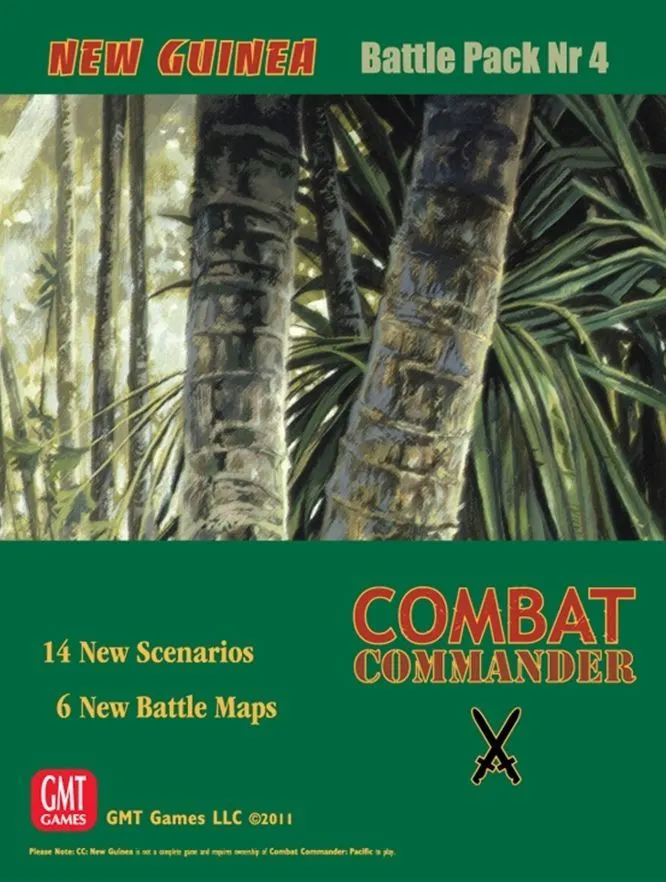
Rules assistance for Combat Commander: Battle Pack #4 – New Guinea
Plain-language explanations of turns, card effects and disputed situations, with official source references and saved question history.
What would you like to know?
Answers come from the official rulebook, with the page to check.
Combat Commander: Battle Pack #4 – New Guinea is an expansion for Combat Commander: Pacific released in 2011 for 2 players, 180 minutes per game, and ages 12 and up. It was designed by Mark Herman, John Foley, Bryan Collars, Volko Ruhnke, John H. Butterfield, Kai Jensen, and Andy Maly and its main mechanics are Variable Player Powers, Hexagon Grid, and Simulation.




Combat Commander: Battle Pack #4 - New Guinea is the fourth themed collection of scenarios for use with the Combat Commander series of games. The theme of this fourth Battle Pack shifts to the actions in New Guinea from January 1942 through July 1944, following the major campaign phases with characteristic actions. CC -New Guinea features fourteen new scenarios printed on cardstock as well as six new maps. Rules relevant to the characteristic fighting in the coastal jungle versus the highlands are included as needed for each scenario, without the need of an additional rule booklet. A number of unusual, creative special scenario rules cover the unique situations represented, including Air Supply, Barge Landing, Canebreak and Coastal Jungle, Emplaced M3 Tanks, Joint Allied Operations including the Papuan Infantry Battalion, Patrol Dogs, Swamp Holes and Swamp Forest. The new maps depict specific locations in New Guinea: the beachhead at the base of Mt Vulcan across from Rabaul, the village of Oivi, a high-mountain ridge overlooking Eora Creek, a strongpoint on the Soputa-Sanananda Road, the edge of the airstrip at Wau, and one of the crossings of the Driniumor River near the Afua Trail. The scenarios included in CC–New Guinea are: * M1 – “Rabaul Rousers” set at the base of Mt Vulcan on Simpson Bay across from the town of Rabaul, with a Japanese barge landing against Australian defenses at night, 23 January 1942; * M2 – “The Gloomy Forest” set at the village of Oivi, with Australians and Papuans of Maroubra Force facing the rapidly moving Yokohama Advance Party, 26 July 1942; * M3 – “Rebuked at Rabi”, set at Milne Bay, with an SNLF attack against Australian units, 3 September 1942; * M4 – “Templeton’s Crossing” set at a heavily-contested crossing of Eora Creek high in the Stanleys, 17 October 1942; * M5 – “Blind Man’s Bluff” set along one of the high ridges above the treacherous Eora Creek, with intermingled combatants, 28 October 1942; * M6 – “Breakout” set at Gorari after the fall of Kokoda to the Australians, with a desperate banzai action, 11 November 1942; * M7 – “The Butcher’s Bill” set on the Soputa-Sanananda Road, with US forces entering the conflict in horrific swamp forest, 10 December 1942; * M8 – “Closing Outer Camp” set at Buna station, with Australian units using M3 tanks to eradicate the defenders, 18 December 1942; * M9 – “Wau Me Worry” set at the Wau air strip (with active landing operations during the action), with Australian defenders facing a desperate attack, 31 January 1943; * M10 – “Bulolo River Bridge” set outside the outpost at Wau, with patrols of both sides (including Japanese Patrol Dogs) attempting to use the same bridge at cross-purposes, 30 January 1943; * M11 – “Shattered Bobdubi” set during the advance upon Salamua, with Australian units driving upon a Japanese base camp set in the kunai-covered heights of the interior, 30 June 1943; * M12 – “Scarlet Beach” set at the mouth of the Song River near Finschhafen, with a Japanese barge landing at night against combined Australian and US defenders, 17 October 1943; * M13 – “Bad Dreams” set on the Driniumor River, featuring the heroic stand of an unknown US BAR operator facing a hastily prepared Japanese night charge, 10 July 1944; and * M14 – “Encirclement of Troop C” set on the Driniumor River, featuring a Troop of US Cavalry trying to stave off being surrounded by Japanese units that had surprised them by walking casually into their positions, 21 July 1944. NOTE: CC–New Guinea is not a complete game and requires ownership of Combat Commander: Pacific to play. Designed by John Foley Developed by Kai Jensen Additional scenario designs in this fourth Pack are courtesy of John Butterfield, Bryan Collars, Mark Herman, Andrew Maly and Volko Ruhnke.
Combat Commander: Battle Pack #4 – New Guinea supports 2 players according to the catalogue. This is the publisher’s listed player count, so the game is designed for exactly that number of participants. Variants for other group sizes, if any, are described in the rulebook of your edition, so check it before setting up a different configuration.
The listed playing time for Combat Commander: Battle Pack #4 – New Guinea is 180 minutes. This is the publisher’s estimate for a full game. The actual duration depends on the group, the player count and familiarity with the rules: first sessions usually run longer, while experienced groups often finish faster. Setup and teaching time are not included in this estimate.
The catalogue lists Combat Commander: Battle Pack #4 – New Guinea for ages 12 and up. This is the publisher’s recommendation and reflects reading demands, rule complexity and small components rather than theme alone. Younger players can often join with help from an adult, so check the age guidance on your edition and consider your group’s experience with board games.
Combat Commander: Battle Pack #4 – New Guinea has a complexity rating of 3.0 out of 5 from BoardGameGeek players, which makes it a medium-weight game. The rating reflects how much rules knowledge, planning and decision-making a typical game demands. Expect a longer first teach for heavier games, and use a preparation guide before game night.
Combat Commander: Battle Pack #4 – New Guinea belongs to these categories: Wargame, World War II, and Expansion for Base-game. Its main mechanics are Variable Player Powers, Hexagon Grid, and Simulation. Categories describe the theme and setting of a game, while mechanics describe what players actually do on their turns. Each mechanic links to a catalogue hub with similar games, which helps when you want something comparable.
The credited designers of Combat Commander: Battle Pack #4 – New Guinea are: Mark Herman, John Foley, Bryan Collars, Volko Ruhnke, John H. Butterfield, Kai Jensen, and Andy Maly. These credits come from the published game data and name the people responsible for the game’s design, not its illustrators or publishers. Designer pages on MeepleRules collect other titles by the same designers, which helps when you enjoy a game and want to find similar ones.
The catalogue lists Combat Commander: Battle Pack #4 – New Guinea as an expansion for Combat Commander: Pacific. Expansions add new content, rules or scenarios to the base game and usually cannot be played on their own, so you need Combat Commander: Pacific to use it. Check that your edition of Combat Commander: Pacific is compatible, as some expansions were revised between editions.