- BGG rating
- 8.4
Combat Commander: Battle Pack #4 – New Guinea
- 2 players
- 180 min
- Complexity 3.0/5
- 2011
2008
Rules assistance for Combat Commander: Pacific
Plain-language explanations of turns, card effects and disputed situations, with official source references and saved question history.
For 2 players
What would you like to know?
Answers come from the official rulebook, with the page to check.
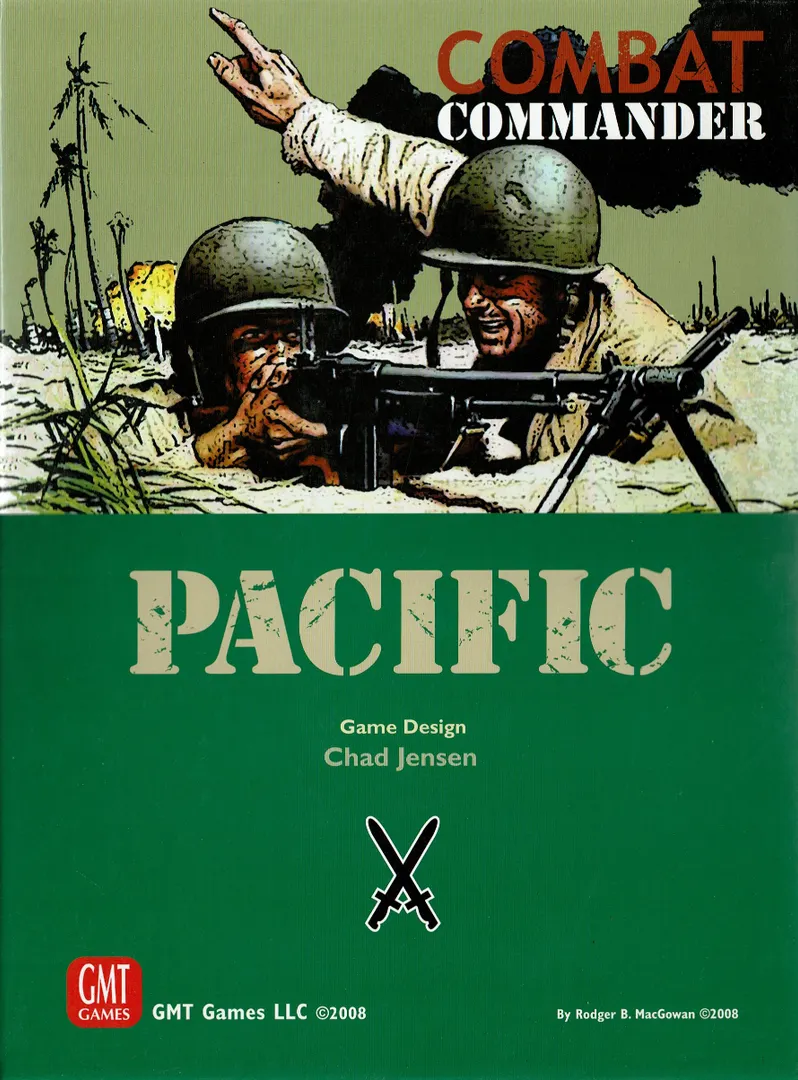
Combat Commander: Pacific is a board game released in 2008 for 2 players, 180 minutes per game, and ages 12 and up. It was designed by Chad Jensen, John Foley, and Kai Jensen and its main mechanics are Hexagon Grid, Simulation, and Line of Sight.









Combat Commander:Pacific is a card-driven board game covering tactical infantry combat in the Pacific Theater of World War II. CC:P's main theme is the addition of three new factions to the Combat Commander family: Imperial Japan the Pacific US - with a strong emphasis on the US Marine Corps the Pacific Commonwealth - focusing on Indian and ANZAC forces CC:P is a stand alone game in the card-driven Combat Commander game series. While utilizing Combat Commander: Europe's basic rules, CC:P includes numerous rule tweaks and additions in order to more accurately portray tactical warfare as experienced by the participants in and around the Pacific and Indian Oceans. This slightly ramps up the complexity of the Combat Commander series while at the same time imparting a bit more depth and realism. Just a few of the additions include: Banzai attacks; BARs and Thompson SMGs; Beach landings & river crossings; Hidden movement; Caves; Scouts; Aircraft; Bayonets; Mortar spotting; Treetop snipers; Reconnoitering. SCALE: Each hex of a Combat Commander map is roughly 100 feet across (about 30 meters). Each complete Player Turn abstractly represents several seconds of real time. Each complete Game Turn abstractly represents several minutes of real time. UNITS: Due in part to the unique composition of late-war USMC squads and the imbedding of specialized weapon teams within IJA squads, the units in the game are represented by 4-6 man Teams and 8-13 man Squads. Radios — and individual weapons larger than a rifle — are represented by their own counters. Individual Aircraft are also represented with their own counters. VICTORY: Players attempt to achieve victory by moving their combat units across the game map to attack their opponent’s combat units and occupy as many objectives as possible. The degree to which a player succeeds or fails is measured by a scenario’s specific Objective chits, the destruction of enemy units, and the exiting of friendly units off the opponent’s board edge. GAME FLOW: A game of Combat Commander is divided into several Time segments. There is no sequence of play to follow, however: each Time segment is divided into a variable number of Player Turns, each of which may consist of one or more Fate Card "Orders" conducted by the active player. Fate Card "Actions" may generally be conducted by either player at any time. "Events" and die roll "Triggers" — both good and bad — will occur at random intervals to add a bit of chaos and uncertainty to each player’s perfect plan. CC:P includes twelve maps featuring terrain specific to the PTO. CC:P's playbook includes: twelve scenarios. Pacific version of the Random Scenario Generator utilizing the new maps and nationalities. This random scenario system provides an almost unending variety of map configurations, force structures, and combat situations. section detailing the differences between CC:P and Combat Commander's first two volumes in order that players familiar with those earlier games can jump right into their first scenario with minimal rules reading. examples of play. Design & Development notes as well as numerous play hints. Components: 352x large counters (5/8") 280x small counters (1/2") 220x 2.5 x 3.5 cards 6x 2-sided 17 x 22 maps (twelve maps in total) 3x 2-sided 8.5 x 11 nation-specific player aid sheets 2x 1-sided 8.5 x 11 generic player aid sheets 1x 32-page Rulebook 1x 32-page Playbook 1x Track Display NOTE: Combat Commander:Pacific is a stand-alone game. You do NOT need to own any other Combat Commander game in order to play it, though familiarity with the system would be a plus.
Combat Commander: Pacific supports 2 players according to the catalogue. This is the publisher’s listed player count, so the game is designed for exactly that number of participants. Variants for other group sizes, if any, are described in the rulebook of your edition, so check it before setting up a different configuration.
The listed playing time for Combat Commander: Pacific is 180 minutes. This is the publisher’s estimate for a full game. The actual duration depends on the group, the player count and familiarity with the rules: first sessions usually run longer, while experienced groups often finish faster. Setup and teaching time are not included in this estimate.
The catalogue lists Combat Commander: Pacific for ages 12 and up. This is the publisher’s recommendation and reflects reading demands, rule complexity and small components rather than theme alone. Younger players can often join with help from an adult, so check the age guidance on your edition and consider your group’s experience with board games.
Combat Commander: Pacific has a complexity rating of 3.3 out of 5 from BoardGameGeek players, which makes it a medium-weight game. The rating reflects how much rules knowledge, planning and decision-making a typical game demands. Expect a longer first teach for heavier games, and use a preparation guide before game night.
Combat Commander: Pacific belongs to these categories: Wargame and World War II. Its main mechanics are Hexagon Grid, Simulation, and Line of Sight. Categories describe the theme and setting of a game, while mechanics describe what players actually do on their turns. Each mechanic links to a catalogue hub with similar games, which helps when you want something comparable.
The credited designers of Combat Commander: Pacific are: Chad Jensen, John Foley, and Kai Jensen. These credits come from the published game data and name the people responsible for the game’s design, not its illustrators or publishers. Designer pages on MeepleRules collect other titles by the same designers, which helps when you enjoy a game and want to find similar ones.
The catalogue lists Combat Commander: Pacific as a base game. It can be played on its own with the components in the box and does not require any other title. Expansions, if any exist, add new content or rules on top of it and are listed separately in the catalogue with a link back to this base game.