

- BGG rank
- BGG #2,271
- BGG rating
- 6.8
The Great Heartland Hauling Co.
- 2–4 players
- 30 min
- Complexity 1.8/5
- 2013
2007
Rules assistance for Darjeeling
Plain-language explanations of turns, card effects and disputed situations, with official source references and saved question history.
For 2 players
What would you like to know?
Answers come from the official rulebook, with the page to check.
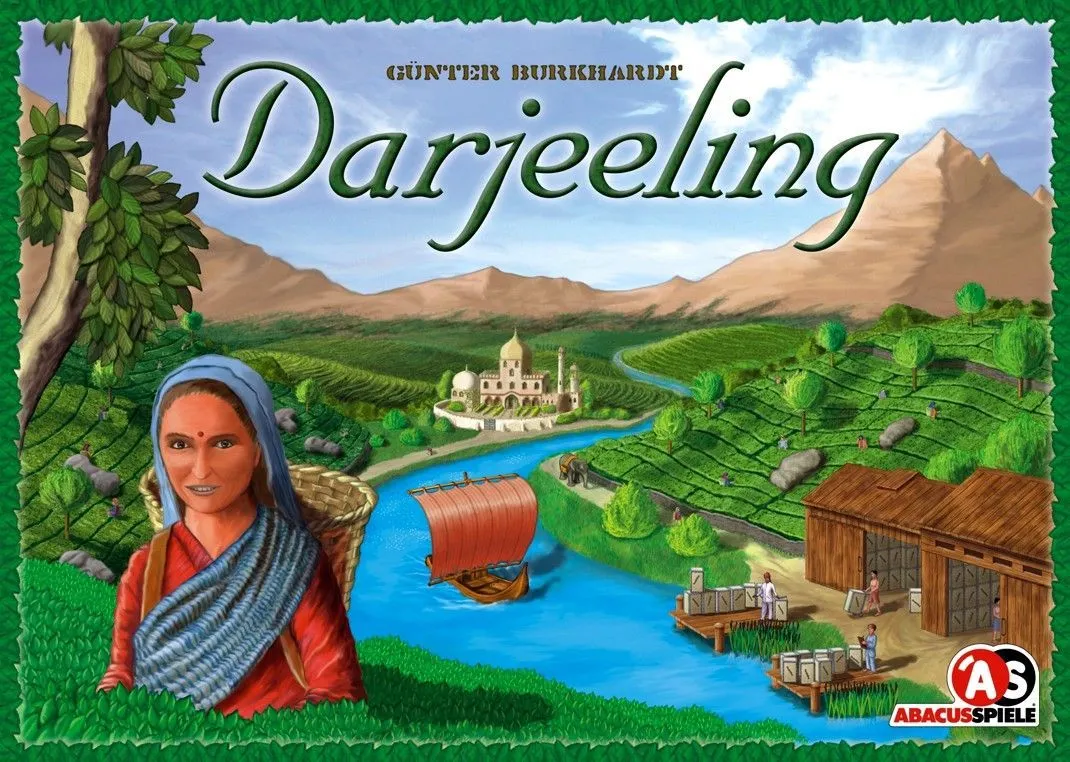
Darjeeling is a board game released in 2007 for 2–5 players, 60 minutes per game, and ages 12 and up. It was designed by Günter Burkhardt and its main mechanics are Race, Set Collection, and Variable Set-up.




Darjeeling has two main board areas. The first is an array of squares representing one, two or three half-crates of tea in four different varieties (colors). Each player has a marker which moves about in the array, picking up tea at the rate of one square per turn. There are simple rules governing movement in this array and the players compete for the desirable squares. Eventually, several times per game, each player has enough squares of a single color to fit them together so that the half-crates all make whole crates. Now he can make a tea shipment. This pays off in victory points in three different ways. First, there is a "demand" award of up to 6 VP depending on how long it has been since anyone shipped this variety. Second, if the shipment was of at least four crates, there is a flat bonus of 1 VP per crate. Third and most pivotally, there are VP that will be awarded at the beginning of the player's next and subsequent turns. Each tea shipment is represented with cubes of the player's color (not the tea variety color) on a sort of barge. The new shipment of tea is always placed, in the other of the two main board areas, at the top of a column of all the recent shipments (the number of total shipments varying with the number of players in the game), so that as more shipments are made, the old shipments drift farther down the column and eventually out of play. At the beginning of your turn, you look to see where your shipments are in this column, and they pay out VP with better multipliers the higher they still are in the column. This constitutes the driving force of the game, as nobody else wants to see your shipment at the top of the column for several turns in a row. Players thus have an incentive to make a shipment even if they haven't yet assembled a large number of crates. It's a race to 100 points. A runaway leader can easily take over if the rest of the table is not vigilant, so the best games of Darjeeling are those among vigilant players.
Darjeeling supports 2–5 players according to the catalogue. This range comes from the publisher’s listed player count, so the game can be set up for any group size within it. Some setups, rules and scoring details may still vary by player count, so check your edition’s rulebook for the exact configuration.
The listed playing time for Darjeeling is 60 minutes. This is the publisher’s estimate for a full game. The actual duration depends on the group, the player count and familiarity with the rules: first sessions usually run longer, while experienced groups often finish faster. Setup and teaching time are not included in this estimate.
The catalogue lists Darjeeling for ages 12 and up. This is the publisher’s recommendation and reflects reading demands, rule complexity and small components rather than theme alone. Younger players can often join with help from an adult, so check the age guidance on your edition and consider your group’s experience with board games.
Darjeeling has a complexity rating of 2.2 out of 5 from BoardGameGeek players, which makes it a medium-light game. The rating reflects how much rules knowledge, planning and decision-making a typical game demands. Expect a longer first teach for heavier games, and use a preparation guide before game night.
Darjeeling belongs to these categories: Economic and Farming. Its main mechanics are Race, Set Collection, and Variable Set-up. Categories describe the theme and setting of a game, while mechanics describe what players actually do on their turns. Each mechanic links to a catalogue hub with similar games, which helps when you want something comparable.
The credited designers of Darjeeling are: Günter Burkhardt. These credits come from the published game data and name the people responsible for the game’s design, not its illustrators or publishers. Designer pages on MeepleRules collect other titles by the same designers, which helps when you enjoy a game and want to find similar ones.
The catalogue lists Darjeeling as a base game. It can be played on its own with the components in the box and does not require any other title. Expansions, if any exist, add new content or rules on top of it and are listed separately in the catalogue with a link back to this base game.