
- BGG rank
- BGG #23,533
- BGG rating
- 6.1
A Thunder Upon the Land: The Battles of Narva and Poltava
- 1–2 players
- 240 min
- Complexity 2.8/5
- 2013
2012
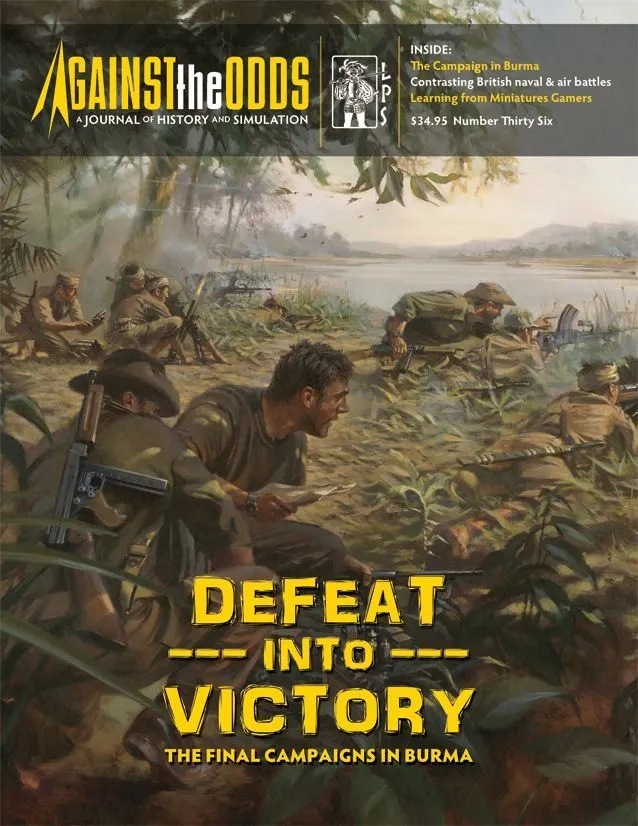
Rules assistance for Defeat Into Victory: The Final Campaigns in Burma
Plain-language explanations of turns, card effects and disputed situations, with official source references and saved question history.
For 2 players
What would you like to know?
Answers come from the official rulebook, with the page to check.
Defeat Into Victory: The Final Campaigns in Burma is a board game released in 2012 for 2 players, 180 minutes per game, and ages 12 and up. It was designed by Paul Rohrbaugh and Lembit Tohver and its main mechanics are Dice Rolling, Grid Movement, and Hexagon Grid.
Publisher's blurb: "The opportunities following the swift Japanese subjugation of Burma in early January 1942 were not exploited. For their chastened opponents, Allied operations in this theater of the war were limited to raids and small-scale offensives as war efforts in North Africa and Europe, as well as the South Pacific, drew higher priorities for resources and personnel. For much of 1943 and early 1944 the fighting in Burma was relegated to WWII's backwater by both sides. With the end of the monsoon season in 1944 the strategic situation had changed. Not only were Japanese fortunes declining precipitously elsewhere, but the build-up in Allied forces along the Burma/India border did not go unnoticed. Determined to pre-empt any Allied attack, the Japanese launched an offensive of their own in May, the largest they ever launched outside of China, against the Allied positions in and around Imphal and Kohima. The battles that raged among the jungles and mountainous hillsides of the Indian and Burma frontier, and the subsequent Allied victory that followed in July, marked a fundamental and permanent shift in the war. The Allied offensive in March 1945 was one marked by extensive planning and preparation, as well bold and daring maneuvers that not only took the Commonwealth and Indian forces across the Irrawaddy River to Rangoon, but crushed the defending Imperial Japanese Burma Area Army. Defeat into Victory, by designer Paul Rohrbaugh, covers this neglected aspect of WWII history using a very interactive and easy to play design. The game has one 22" by 34" hex map that stretches from Dimapur in the north to Rangoon in the south. A countersheet with 280 half-inch units (mostly brigade and regiments in size) and approximately 16 pages of rules and charts round out the package. The game uses a chit-pull activation system. Rules cover supply (a crucial aspect in terrain that was among the most inhospitable of the war), various types of combat (fire, maneuver and assault), as well as morale and leadership. Rules also include random events (that simulate the effects of battles and decisions by higher-ups elsewhere), weather, Japanese suicide tank attacks (human combat destruction squads) and changing war goals. The air campaign is also simulated (in much more detail than generic "air points"). Scenarios include the initial Japanese offensive against Imphal and Kohima, two on the Allied 1945 offensive, as well as the Campaign Game. Tough decisions will have to be made by both sides as they allocate precious resources among their formations, determine their enemy's intentions and balance their plans, as well as attack and defend. "
Defeat Into Victory: The Final Campaigns in Burma supports 2 players according to the catalogue. This is the publisher’s listed player count, so the game is designed for exactly that number of participants. Variants for other group sizes, if any, are described in the rulebook of your edition, so check it before setting up a different configuration.
The listed playing time for Defeat Into Victory: The Final Campaigns in Burma is 180 minutes. This is the publisher’s estimate for a full game. The actual duration depends on the group, the player count and familiarity with the rules: first sessions usually run longer, while experienced groups often finish faster. Setup and teaching time are not included in this estimate.
The catalogue lists Defeat Into Victory: The Final Campaigns in Burma for ages 12 and up. This is the publisher’s recommendation and reflects reading demands, rule complexity and small components rather than theme alone. Younger players can often join with help from an adult, so check the age guidance on your edition and consider your group’s experience with board games.
Defeat Into Victory: The Final Campaigns in Burma has a complexity rating of 3.5 out of 5 from BoardGameGeek players, which makes it a medium-weight game. The rating reflects how much rules knowledge, planning and decision-making a typical game demands. Expect a longer first teach for heavier games, and use a preparation guide before game night.
Defeat Into Victory: The Final Campaigns in Burma belongs to these categories: Wargame and World War II. Its main mechanics are Dice Rolling, Grid Movement, and Hexagon Grid. Categories describe the theme and setting of a game, while mechanics describe what players actually do on their turns. Each mechanic links to a catalogue hub with similar games, which helps when you want something comparable.
The credited designers of Defeat Into Victory: The Final Campaigns in Burma are: Paul Rohrbaugh and Lembit Tohver. These credits come from the published game data and name the people responsible for the game’s design, not its illustrators or publishers. Designer pages on MeepleRules collect other titles by the same designers, which helps when you enjoy a game and want to find similar ones.
The catalogue lists Defeat Into Victory: The Final Campaigns in Burma as a base game. It can be played on its own with the components in the box and does not require any other title. Expansions, if any exist, add new content or rules on top of it and are listed separately in the catalogue with a link back to this base game.