

- BGG rank
- BGG #25,458
- BGG rating
- 6.2
Defeat Into Victory: The Final Campaigns in Burma
- 2 players
- 180 min
- Complexity 3.5/5
- 2012
2011
Rules assistance for Bradley's D-Day
Plain-language explanations of turns, card effects and disputed situations, with official source references and saved question history.
What would you like to know?
Answers come from the official rulebook, with the page to check.
Bradley's D-Day is a board game released in 2011 for 1–2 players, 240 minutes per game, and ages 12 and up. It was designed by John Prados and Lembit Tohver and its main mechanics are Dice Rolling, Hexagon Grid, and Simulation.




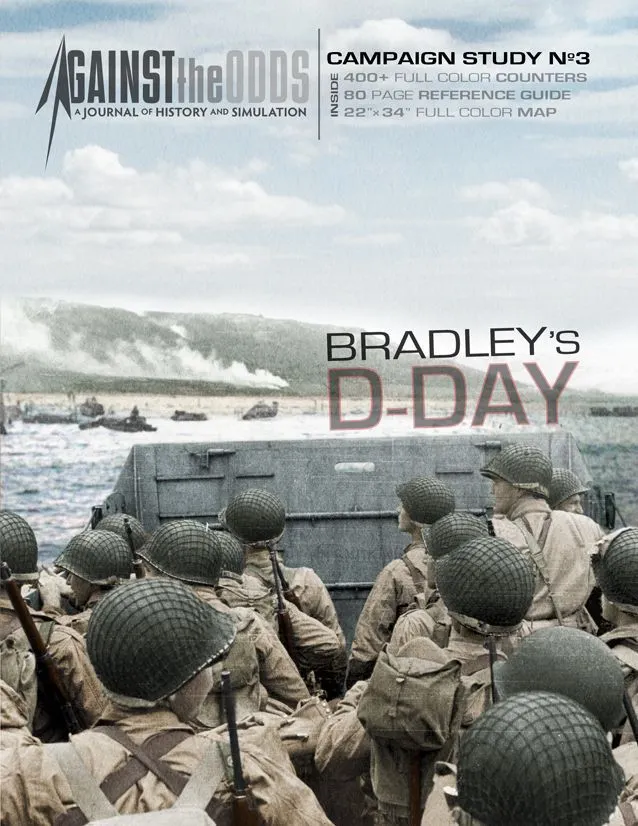
Bradley’s D-Day, is the third game in the Campaign Study Series. It is a two-player tactical/operational simulation of the combat action on the American Sector during the first two days of the Normandy invasion, 6-7 June 1944. The game looks at the American efforts all along the right flank of the Normandy landings. While Utah seemed relatively easy, it was there, at Omaha Beach, where the Germans came closest to derailing the greatest sea-borne invasion of all time. Behind both beaches, two famous airborne divisions were scattered all over the countryside, and fought by twos and twenties to accomplish a semblance of their missions. Call it the “Longest Two Days,” because that is the time-period covered in the game. Forty-eight hours of some of the most critical action in American history. The key units are all here, including engineers with special abilities, DD-tanks, parachute and glider landings, and even railroad coastal artillery. One defining feature of the game is unit deployment; a unit can be deployed in one of two modes: Movement Mode allows for the greatest movement but the weakest combat (which is not to say those units can’t fight) and Combat Mode, which allows the strongest fighting abilities (but still some movement for most units). "Bradley’s D-Day" offers an intriguing scale, a moderate level of complexity, and an ease of play that will make this game either a fine addition to your Overlord collection, or a good first start for those who have not already focused on this campaign. Game Scale: Turn: 2 hours of daylight or 4 hours of nightime Hex 800 meters Units: Company/Battalion Game Equipment One 22" x 34" full color map Two counter sheets (320 1/2" counters) One 20 page rule book One Terrain Effects Chart No dice (game owners need to supply two six-sided die)
Bradley's D-Day supports 1–2 players according to the catalogue. This range comes from the publisher’s listed player count, so the game can be set up for any group size within it. Some setups, rules and scoring details may still vary by player count, so check your edition’s rulebook for the exact configuration.
The listed playing time for Bradley's D-Day is 240 minutes. This is the publisher’s estimate for a full game. The actual duration depends on the group, the player count and familiarity with the rules: first sessions usually run longer, while experienced groups often finish faster. Setup and teaching time are not included in this estimate.
The catalogue lists Bradley's D-Day for ages 12 and up. This is the publisher’s recommendation and reflects reading demands, rule complexity and small components rather than theme alone. Younger players can often join with help from an adult, so check the age guidance on your edition and consider your group’s experience with board games.
Bradley's D-Day has a complexity rating of 3.3 out of 5 from BoardGameGeek players, which makes it a medium-weight game. The rating reflects how much rules knowledge, planning and decision-making a typical game demands. Expect a longer first teach for heavier games, and use a preparation guide before game night.
Bradley's D-Day belongs to these categories: Wargame and World War II. Its main mechanics are Dice Rolling, Hexagon Grid, and Simulation. Categories describe the theme and setting of a game, while mechanics describe what players actually do on their turns. Each mechanic links to a catalogue hub with similar games, which helps when you want something comparable.
The credited designers of Bradley's D-Day are: John Prados and Lembit Tohver. These credits come from the published game data and name the people responsible for the game’s design, not its illustrators or publishers. Designer pages on MeepleRules collect other titles by the same designers, which helps when you enjoy a game and want to find similar ones.
The catalogue lists Bradley's D-Day as a base game. It can be played on its own with the components in the box and does not require any other title. Expansions, if any exist, add new content or rules on top of it and are listed separately in the catalogue with a link back to this base game.