

- BGG rank
- BGG #15,457
- BGG rating
- 6.0
Senseï
- 2 players
- 15 min
- Complexity 1.7/5
- 2016
2004
Rules assistance for Diaballik
Plain-language explanations of turns, card effects and disputed situations, with official source references and saved question history.
For 2 players
What would you like to know?
Answers come from the official rulebook, with the page to check.
Diaballik is a board game released in 2004 for 2 players, 20 minutes per game, and ages 8 and up. It was designed by Philippe Lefrancois and its main mechanics are Point to Point Movement and Grid Movement.


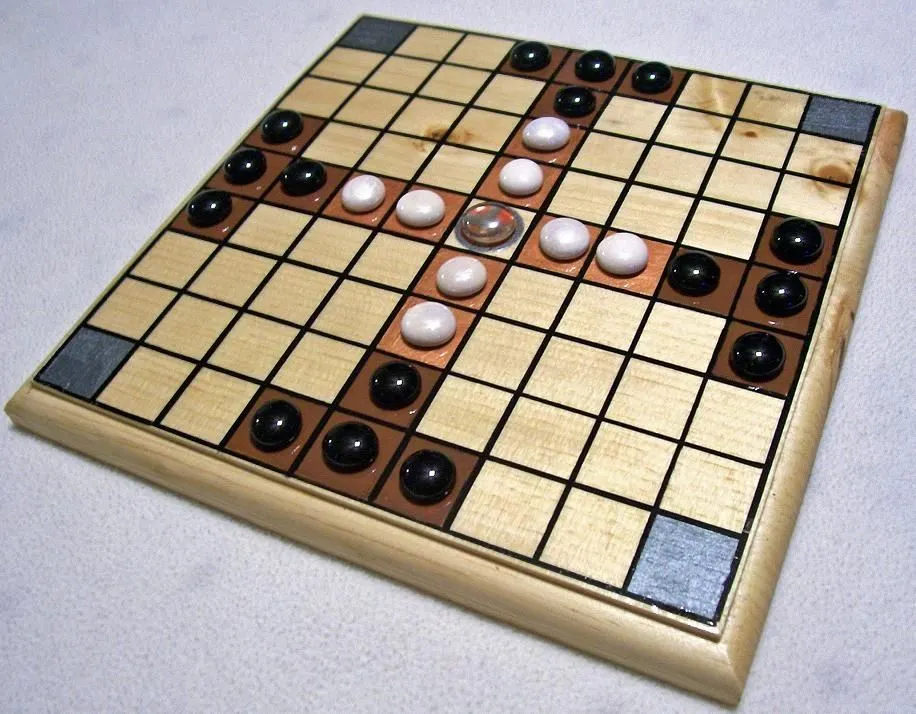
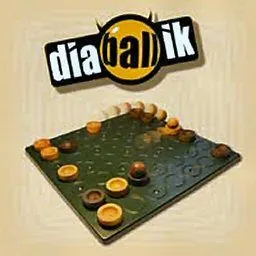
Diaballik is an abstract strategy game for 2 players. The game attempts to simulate a sport whereby 2 teams are simultaneously trying to get their ball to the opposite teams starting goal line. The board depicts a 7×7 grid. Each player starts with 7 ball holders along their edge of the board and their ball in the middle holder. Players subsequently take turns completing the following actions: Moving an empty ball holder orthogonally (up to 2 times); and/or Making a ball "pass" by moving the ball from on holder to another along lateral (horizontal) or diagonal line. Pass are not limited in length as long as no opponent pieces are in the way. First person to send their teams ball to a holder on the opponents starting line wins. It's worth noting that an impenetrable wall of ball holders results in an automatic loss to the player who created the wall. Nominated for the 2006 As d'Or Game of the Year. Online Play Boîte à jeux (turn-based) Available on iPad (via iTunes Apps Store) since the june 21st 2011 (2 players local game, or 1 player vs AI) Strategiespiel nach den Prinzipien von Mannschaftssportarten, mit Bewegung und Pässen. Ziel des Spiels ist es seine Kugel auf die Startlinie des Gegners zu bringen. Um dies zu erreichen muss jeder Spieler Angriffe und Verteidigungen spielen. Hinter einem einfachen Mechanismus verbirgt sich ein dynamisches Strategiespiel, welches bis zum letzten Augenblick spannend bleibt, da überraschende Wendungen immer möglich sind. Giseh Verlag
Diaballik supports 2 players according to the catalogue. This is the publisher’s listed player count, so the game is designed for exactly that number of participants. Variants for other group sizes, if any, are described in the rulebook of your edition, so check it before setting up a different configuration.
The listed playing time for Diaballik is 20 minutes. This is the publisher’s estimate for a full game. The actual duration depends on the group, the player count and familiarity with the rules: first sessions usually run longer, while experienced groups often finish faster. Setup and teaching time are not included in this estimate.
The catalogue lists Diaballik for ages 8 and up. This is the publisher’s recommendation and reflects reading demands, rule complexity and small components rather than theme alone. Younger players can often join with help from an adult, so check the age guidance on your edition and consider your group’s experience with board games.
Diaballik has a complexity rating of 2.1 out of 5 from BoardGameGeek players, which makes it a medium-light game. The rating reflects how much rules knowledge, planning and decision-making a typical game demands. Expect a longer first teach for heavier games, and use a preparation guide before game night.
Diaballik belongs to these categories: Abstract Strategy and Sports. Its main mechanics are Point to Point Movement and Grid Movement. Categories describe the theme and setting of a game, while mechanics describe what players actually do on their turns. Each mechanic links to a catalogue hub with similar games, which helps when you want something comparable.
The credited designers of Diaballik are: Philippe Lefrancois. These credits come from the published game data and name the people responsible for the game’s design, not its illustrators or publishers. Designer pages on MeepleRules collect other titles by the same designers, which helps when you enjoy a game and want to find similar ones.
The catalogue lists Diaballik as a base game. It can be played on its own with the components in the box and does not require any other title. Expansions, if any exist, add new content or rules on top of it and are listed separately in the catalogue with a link back to this base game.