

- BGG rank
- BGG #15,123
- BGG rating
- 6.9
Tuppfehler
- 2–6 players
- 25 min
- Complexity 1.0/5
- 2020
1984
Rules assistance for Die Kette von Saba
Plain-language explanations of turns, card effects and disputed situations, with official source references and saved question history.
For 3 players
What would you like to know?
Answers come from the official rulebook, with the page to check.
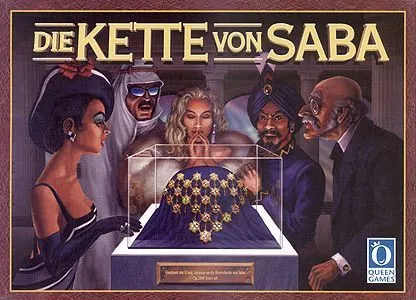
Die Kette von Saba is a board game released in 1984 for 3–7 players, 60 minutes per game, and ages 8 and up. It was designed by Martin Ebel and its main mechanics are Auction / Bidding and Tile Placement.









extrapolated from session report: The theme of the game is based on the legendary necklace of Saba, which went to the grave with its owner upon her death. Sadly, dastardly grave robbers plundered the tomb and the valuable gems which comprised the necklace were scattered across the globe. Now, a wealthy sheik is anxious to reassemble the necklace and present it as a gift to his lovely bride. Players are charged with the task of assisting the sheik, attempting to purchase the many gems at auction and then reassemble the necklace in the proper fashion. The board depicts the frame of the necklace, with space for its 36 missing gems. In total, there are 44 gems in the deck, many of which will ultimately prove to be forgeries. Depending upon the number of players, each player receives from 3 - 7 gems to begin the game, along with $20,000. Four gems are revealed from the remainder of the deck and positioned into the frame. The game is played in two major phases. During the first phase, players alternate placing a gem up for auction, ala Modern Art. The auctioneer receives the funds from the high bidder, who receives the gem. The winner has the option of keeping the gem, or placing it into the frame. If placed in the frame, the gem earns $2,000 for other gems it touches and those radiating from it in straight lines, including itself. During phase 2, the reward is reduced to only $1,000 per gem. Following an auction, the auctioneer has the opportunity to purchase another gem from the deck for $2,000. Phase 1 ends when the gem deck expires. Phase 2 then begins with players reconstructing the necklace. In turn, each player places a gem into the frame and earns funds as described above. The twist in the game are the rules which must be followed in reconstructing the necklace. The main rules are: The necklace must be symmetrical, with left and right halves containing the same jewels in the same places. All cards appear twice in the game, so what appears on the left side must appear in the same position on the right side. The only exception to this is the center column. Any duplicate pieces are considered forgeries and are worthless. Pieces of jewelry containing the same type of gem must be placed in uniform columns. Thus, the first gem placed in a column dictates what kind of gem must appear in that same column. The number of gems on a card can only be one greater than the number of gems on the cards directly above it. Once the first gem is placed in a column, it 'locks' that column AND the corresponding symmetrical column. Only gems which meet the above rules can subsequently be placed there. The game ends once the necklace is completed. The player with the most money is victorious.
Die Kette von Saba supports 3–7 players according to the catalogue. This range comes from the publisher’s listed player count, so the game can be set up for any group size within it. Some setups, rules and scoring details may still vary by player count, so check your edition’s rulebook for the exact configuration.
The listed playing time for Die Kette von Saba is 60 minutes. This is the publisher’s estimate for a full game. The actual duration depends on the group, the player count and familiarity with the rules: first sessions usually run longer, while experienced groups often finish faster. Setup and teaching time are not included in this estimate.
The catalogue lists Die Kette von Saba for ages 8 and up. This is the publisher’s recommendation and reflects reading demands, rule complexity and small components rather than theme alone. Younger players can often join with help from an adult, so check the age guidance on your edition and consider your group’s experience with board games.
Die Kette von Saba has a complexity rating of 1.4 out of 5 from BoardGameGeek players, which makes it a light game. The rating reflects how much rules knowledge, planning and decision-making a typical game demands. Expect a longer first teach for heavier games, and use a preparation guide before game night.
Die Kette von Saba belongs to these categories: Economic. Its main mechanics are Auction / Bidding and Tile Placement. Categories describe the theme and setting of a game, while mechanics describe what players actually do on their turns. Each mechanic links to a catalogue hub with similar games, which helps when you want something comparable.
The credited designers of Die Kette von Saba are: Martin Ebel. These credits come from the published game data and name the people responsible for the game’s design, not its illustrators or publishers. Designer pages on MeepleRules collect other titles by the same designers, which helps when you enjoy a game and want to find similar ones.
The catalogue lists Die Kette von Saba as a base game. It can be played on its own with the components in the box and does not require any other title. Expansions, if any exist, add new content or rules on top of it and are listed separately in the catalogue with a link back to this base game.