
- BGG rank
- BGG #3,699
- BGG rating
- 7.0
Hickory Dickory
- 1–4 players
- 60–120 min
- Complexity 2.7/5
- 2023
2025
Rules assistance for Enthrone
Plain-language explanations of turns, card effects and disputed situations, with official source references and saved question history.
For 2 players
What would you like to know?
Answers come from the official rulebook, with the page to check.
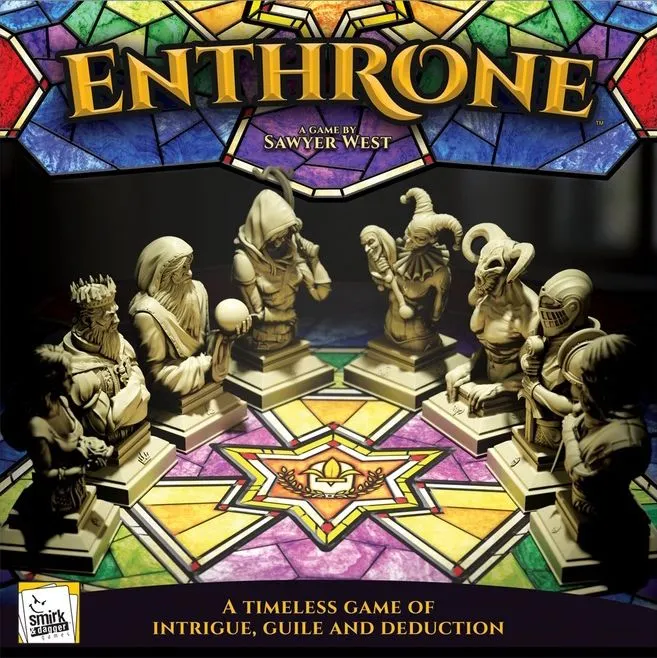
Enthrone is a board game released in 2025 for 2 players, 15–30 minutes per game, and ages 10 and up. It was designed by Sawyer West and its main mechanics are Deduction and Action Queue.

An ages-old game of intrigue, guile and deduction for two players. You are the silent hand. One of 8 unwitting pawns will be your key to securing ultimate power. But your rival hides their own machinations to challenge you. Can you deduce their identity and eliminate them? Remove three key political targets? Or simply waltz in undetected and seize the throne? ENTHRONE is an abstract, two-player deduction game. The roughly octagonal, diecut board is ringed by 8 beautifully crafted figures, busts representing the potential heir to the throne; the reigning King, the Priestess, the Knight, the Jester, the Demon, the Assassin, the Archer and the Wizard. Each player is dealt three identity cards, each showing one of the above pawns. You will choose one whom you intend to Enthrone. You also know the other two identities you did not choose - are not the identity of your opponent. They have the same knowledge - and two identities are left forever unknown by any player. You win if you can advance your pawn to the throne space at the center of the board. OR you can win by deducing who your opponent is and capturing and eliminating their pawn. OR you can have the three target identities listed on the bottom of your card eliminated from the game (by you or your opponent's handiwork). But the magic of the game is which pieces can be activated each turn - and what they are capable of, based on their position on the tile track. Hex Tiles on the bottom three positions are locked and cannot be moved. The top five can move by placing the tile on the bottom of the Hex tiles and pushing all tiles above it up one notch. Tiles in the top two spaces are the only ones capable of capturing and eliminating a piece. Tiles in the top three positions are the only once who can be moved to the Throne space (so long as it is YOUR pawn). Manipulating and strategizing how to move and position these tiles to suit your agenda is critical. Keeping your identity secret, while unveiling your opponents is the tension. An abstract strategy game like no other - and absolutely stunning on the table. A game fit for Kings - or those who would enthrone them. —description from the publisher
Enthrone supports 2 players according to the catalogue. This is the publisher’s listed player count, so the game is designed for exactly that number of participants. Variants for other group sizes, if any, are described in the rulebook of your edition, so check it before setting up a different configuration.
The listed playing time for Enthrone is 15–30 minutes. This is the publisher’s estimate for a full game. The actual duration depends on the group, the player count and familiarity with the rules: first sessions usually run longer, while experienced groups often finish faster. Setup and teaching time are not included in this estimate.
The catalogue lists Enthrone for ages 10 and up. This is the publisher’s recommendation and reflects reading demands, rule complexity and small components rather than theme alone. Younger players can often join with help from an adult, so check the age guidance on your edition and consider your group’s experience with board games.
Enthrone has a complexity rating of 1.8 out of 5 from BoardGameGeek players, which makes it a light game. The rating reflects how much rules knowledge, planning and decision-making a typical game demands. Expect a longer first teach for heavier games, and use a preparation guide before game night.
Enthrone belongs to these categories: Fantasy, Deduction, and Abstract Strategy. Its main mechanics are Deduction and Action Queue. Categories describe the theme and setting of a game, while mechanics describe what players actually do on their turns. Each mechanic links to a catalogue hub with similar games, which helps when you want something comparable.
The credited designers of Enthrone are: Sawyer West. These credits come from the published game data and name the people responsible for the game’s design, not its illustrators or publishers. Designer pages on MeepleRules collect other titles by the same designers, which helps when you enjoy a game and want to find similar ones.
The catalogue lists Enthrone as a base game. It can be played on its own with the components in the box and does not require any other title. Expansions, if any exist, add new content or rules on top of it and are listed separately in the catalogue with a link back to this base game.