

- BGG rank
- BGG #26,747
- BGG rating
- 5.7
Fanhunter: Las Montañas de la Locura – Electric Boogaloo
- 1–5 players
- 30 min
- Complexity 1.3/5
- 2013
2010
Rules assistance for Frenetic Village
Plain-language explanations of turns, card effects and disputed situations, with official source references and saved question history.
What would you like to know?
Answers come from the official rulebook, with the page to check.
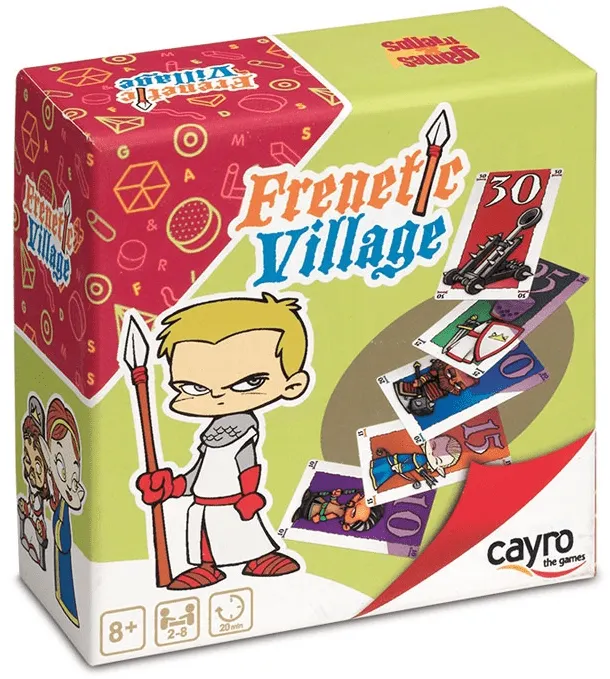
Frenetic Village is a board game released in 2010 for 2–8 players, 20 minutes per game, and ages 8 and up. It was designed by Ignacio Sánchez Usera and Jorge Piñan and its main mechanics are Open Drafting.





INTRODUCTION: Table Land is populated by humans, dwarfs, elves, orcs and barbarians. It is a world in permanent war for the control of the territory. Play and become a true Lord of Tierra Mesa by beating your rivals. AIM OF THE GAME: The aim of the game is to achieve, before the other players, a combination of 5 cards with the same value, or to form an army with 5 consecutive cards of the same race or where each value accords a different race (Unbeatable Run). You will become Lord of Table Land in several ways: 1. Gathering together an army of 5 consecutive cards (run) of the same race. 2. Gathering together 5 cards of the same value (archers, princesses, catapults…) 3. And finally, the Unbeatable Run; you can get an army alliance gathering 5 consecutive cards of a different race each. The winner is the player who gathers one of these combinations. BEFORE THE GAME: - Shuffle the cards. - Hand out 5 cards to each player. - Allocate the deck of cards facing down, in the middle of Table Land. - The first game starts with the player who owns most hairs in his ears, continuing then, in a clockwise direction. The following games are started by the winner of the previous game. Once all the cards have been distributed to the players the game stars. The player that starts the game draws one card from the central deck, looks at it, and gets rid of the card which is not convenient for him. Each player should always have 5 cards. Each player discards should be placed on Table Land, ALWAYS in front of the player, creating a deck where the last discarded card is shown. This way there should be as many discarded decks as players. When a player gets rid of a card and puts it on its deck facing up, any interested player can take it. How? The interested player should cover it with its hand. The fastest player covering the deck is the one that gets the card. This player should then discard one of his cards. Then, the game continues in a clockwise direction starting from him. This way the game continues until one of the players gathers 5 cards with the same value or 5 consecutive cards of the same race or the Unbeatable Run. The player should let the other players know during his turn by placing the discard card facing down and by showing his 5 wining cards, he gains the victory by beating his rivals. WINING COMBINATIONS: Option 1 – Whoever wins 5 games is the winner of the whole game. Option 2 – After each game all card points must be counted, except those from the winner, being 100 points those from the action cards. The player with fewer points after 5 games is the winner. Option 3 – After each game only the winner’s points must be counted, in this situation the value (each value corresponds to a different race) of the Unbeatable Run is three times the addition of the values. The game finishes when one of the players reaches 1000 points or a previously agreed quantity. These are not the only possibilities, players can agree on other options for victory. ACTION CARDS: This game has a series of action cards which are used for the interaction between players to threaten their rivals: Skull (2 cards): If a player places this card on the other player’s deck it means that all his troops have been killed. He must place all his cards, facing down, beneath the central deck and draw 5 new cards. card swap (1 card): If a player places this card in another player’s deck, both players must swap one card. hand swap (1 card): Placing this card in another player’s discard deck means that you swap your hand of cards with that player. steal 2 cards for the deck (2 cards): Placing this card on to other player’s discard deck means that the player who has placed the card (the attacking card) randomly takes 2 cards from the other player’s hand, and then this player must immediately pick up two new cards from the central deck. The 2 cards that have been taken from the player’s hand must be placed beneath the central deck without looking at them. steal 3 cards for the deck (1 card): Placing this card in another player’s discard deck means that the player who has placed the card (the assailant) randomly takes 3 cards from his rival’s hand. Then, the rival should draw 3 new cards from the central deck. The cards taken from his hand must be placed beneath the central deck without looking at them. steal a card (3 cards): Placing this card in another player’s discard deck means that the player who has placed the card (the assailant) randomly takes 1 card from his rival’s hand, and keeps it. Now the victim has 4 cards, therefore he must pick up a new card to have 5. The assailant has now 6 cards therefore he must discard one of them to have 5 again to continue the battle. Potion (2 cards): the joker substitutes any other card concerning value and race. It can NOT be used as action card. One player can have on its hand up to two jokers. FAQs: - Which discard cards can I pick up? You can only pick up the last card that has been placed at the top of the discard deck from the player that’s on its turn. - After an action card who continues? The player next to the player who has discarded the Action Card, always clockwise. - Do runs or the Unbeatable Run have to start from number 5? Runs do not have to start from 5, as long as they are always consecutive numbers. - What should it be done if the extension of Tierra Mesa cannot be cover and a player does not reach their rivals discard decks? Instead of hunting the card with the hand you should scream Guar!!! The one that screams it first takes the card. - Can I draw one card from any discard deck while other player is drawing a card from the central deck? When a player picks up a card from the central deck the possibility of taking a card from a discard deck is blocked. - If I take a card from a discard deck, can the card that appears underneath be taken later on? NO. Those cards were previously played, therefore, you should pay attention!! - What should it be done when the central deck finishes? All discard decks from all the players must be gathered together to form a new central deck. The cards must be shuffle before placing them on the middle of Tierra Mesa. - If two players place their hands on a discard deck, who takes the card? Either the one that has more fingers placed on it, or the most aggressive one.
Frenetic Village supports 2–8 players according to the catalogue. This range comes from the publisher’s listed player count, so the game can be set up for any group size within it. Some setups, rules and scoring details may still vary by player count, so check your edition’s rulebook for the exact configuration.
The listed playing time for Frenetic Village is 20 minutes. This is the publisher’s estimate for a full game. The actual duration depends on the group, the player count and familiarity with the rules: first sessions usually run longer, while experienced groups often finish faster. Setup and teaching time are not included in this estimate.
The catalogue lists Frenetic Village for ages 8 and up. This is the publisher’s recommendation and reflects reading demands, rule complexity and small components rather than theme alone. Younger players can often join with help from an adult, so check the age guidance on your edition and consider your group’s experience with board games.
Frenetic Village has a complexity rating of 1.3 out of 5 from BoardGameGeek players, which makes it a light game. The rating reflects how much rules knowledge, planning and decision-making a typical game demands. Expect a longer first teach for heavier games, and use a preparation guide before game night.
Frenetic Village belongs to these categories: Card Game, Fantasy, and Party Game. Its main mechanics are Open Drafting. Categories describe the theme and setting of a game, while mechanics describe what players actually do on their turns. Each mechanic links to a catalogue hub with similar games, which helps when you want something comparable.
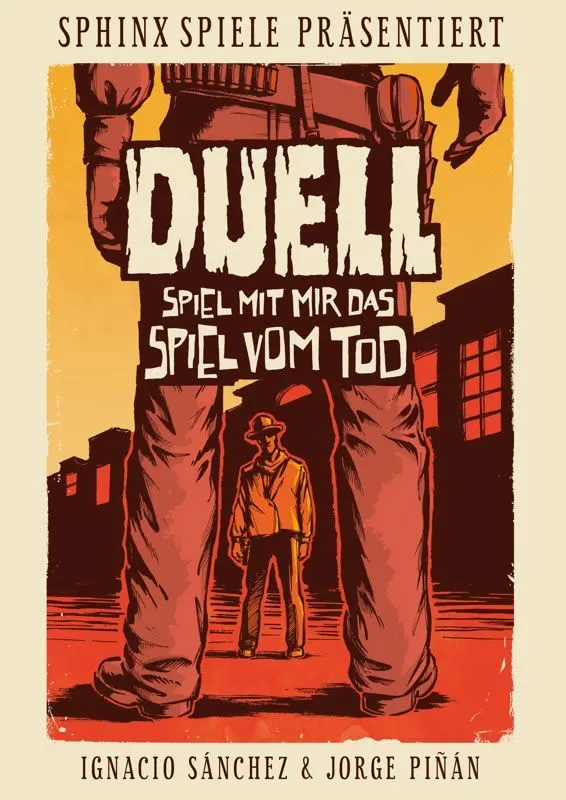
The credited designers of Frenetic Village are: Ignacio Sánchez Usera and Jorge Piñan. These credits come from the published game data and name the people responsible for the game’s design, not its illustrators or publishers. Designer pages on MeepleRules collect other titles by the same designers, which helps when you enjoy a game and want to find similar ones.
The catalogue lists Frenetic Village as a base game. It can be played on its own with the components in the box and does not require any other title. Expansions, if any exist, add new content or rules on top of it and are listed separately in the catalogue with a link back to this base game.