

- BGG rank
- BGG #716
- BGG rating
- 7.9
Blood Bowl: Living Rulebook
- 2 players
- 120 min
- Complexity 3.2/5
- 2004
Rules assistance for Galileo's Truth: Time and Inquiry
Plain-language explanations of turns, card effects and disputed situations, with official source references and saved question history.
What would you like to know?
Answers come from the official rulebook, with the page to check.
Galileo's Truth: Time and Inquiry is an expansion for Galileo's Truth released in 2027 for 1–4 players, 30–120 minutes per game, and ages 14 and up.










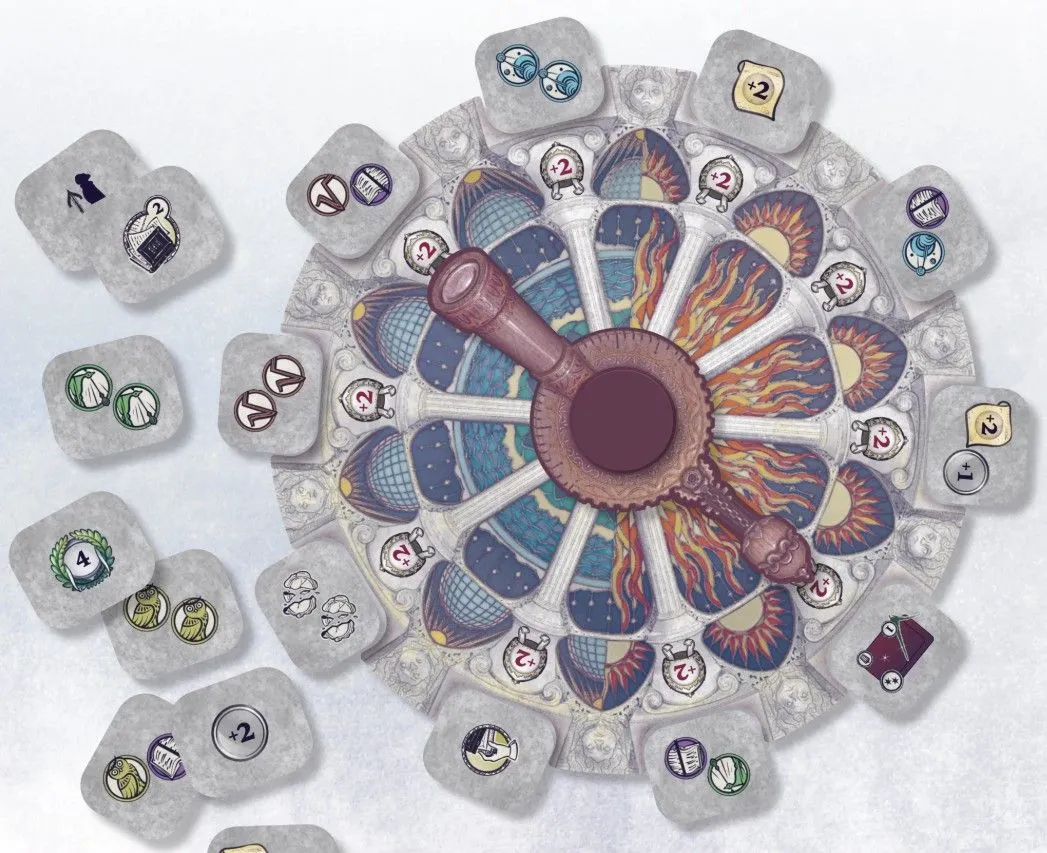
While Copernican eyes look to the heavens searching for a new truth, Ptolemaic minds cling to the heavy certainties of the Earth, anchored by gravity and dogma. In this clash of cosmic forces, every discovery is a double-edged sword. Peer through the lens or balance the weight. But beware, for every step closer to the truth turns the wheel of suspicion a little further. How it Works: The Hall of Knowledge This expansion introduces a dynamic Rondel mechanism featuring a dual-ended Dial (The Telescope and The Pendulum) and a central Hall of Knowledge filled with randomized Discovery Tiles. Once per turn, you may trigger the Hall of Knowledge. When activated, you increase your Suspicion by 2 and rotate the central Dial one step clockwise (before or after activating the Discovery Tile). The rewards you claim depend entirely on your current philosophical stance: If your Principle Coin is Copernican-side up, you resolve the powerful icons pointed at by The Telescope. If your Principle Coin is Ptolemaic-side up, you trigger the alternative benefits pointed at by The Pendulum. It’s a tight, highly thematic tug-of-war where timing your activation, and alignment, can completely alter your engine!
Galileo's Truth: Time and Inquiry supports 1–4 players according to the catalogue. This range comes from the publisher’s listed player count, so the game can be set up for any group size within it. Some setups, rules and scoring details may still vary by player count, so check your edition’s rulebook for the exact configuration.
The listed playing time for Galileo's Truth: Time and Inquiry is 30–120 minutes. This is the publisher’s estimate for a full game. The actual duration depends on the group, the player count and familiarity with the rules: first sessions usually run longer, while experienced groups often finish faster. Setup and teaching time are not included in this estimate.
The catalogue lists Galileo's Truth: Time and Inquiry for ages 14 and up. This is the publisher’s recommendation and reflects reading demands, rule complexity and small components rather than theme alone. Younger players can often join with help from an adult, so check the age guidance on your edition and consider your group’s experience with board games.
Galileo's Truth: Time and Inquiry belongs to these categories: Expansion for Base-game. Categories describe the theme, setting and style of a game rather than its rules. Filter the catalogue by the same category to find similar games when you enjoyed Galileo's Truth: Time and Inquiry and want something comparable for your next game night.
The catalogue lists Galileo's Truth: Time and Inquiry as an expansion for Galileo's Truth. Expansions add new content, rules or scenarios to the base game and usually cannot be played on their own, so you need Galileo's Truth to use it. Check that your edition of Galileo's Truth is compatible, as some expansions were revised between editions.