
- BGG rank
- BGG #8,386
- BGG rating
- 6.1
Setup
- 2–4 players
- 20–25 min
- Complexity 1.2/5
- 2023
2016
Rules assistance for Honeycombs
Plain-language explanations of turns, card effects and disputed situations, with official source references and saved question history.
What would you like to know?
Answers come from the official rulebook, with the page to check.
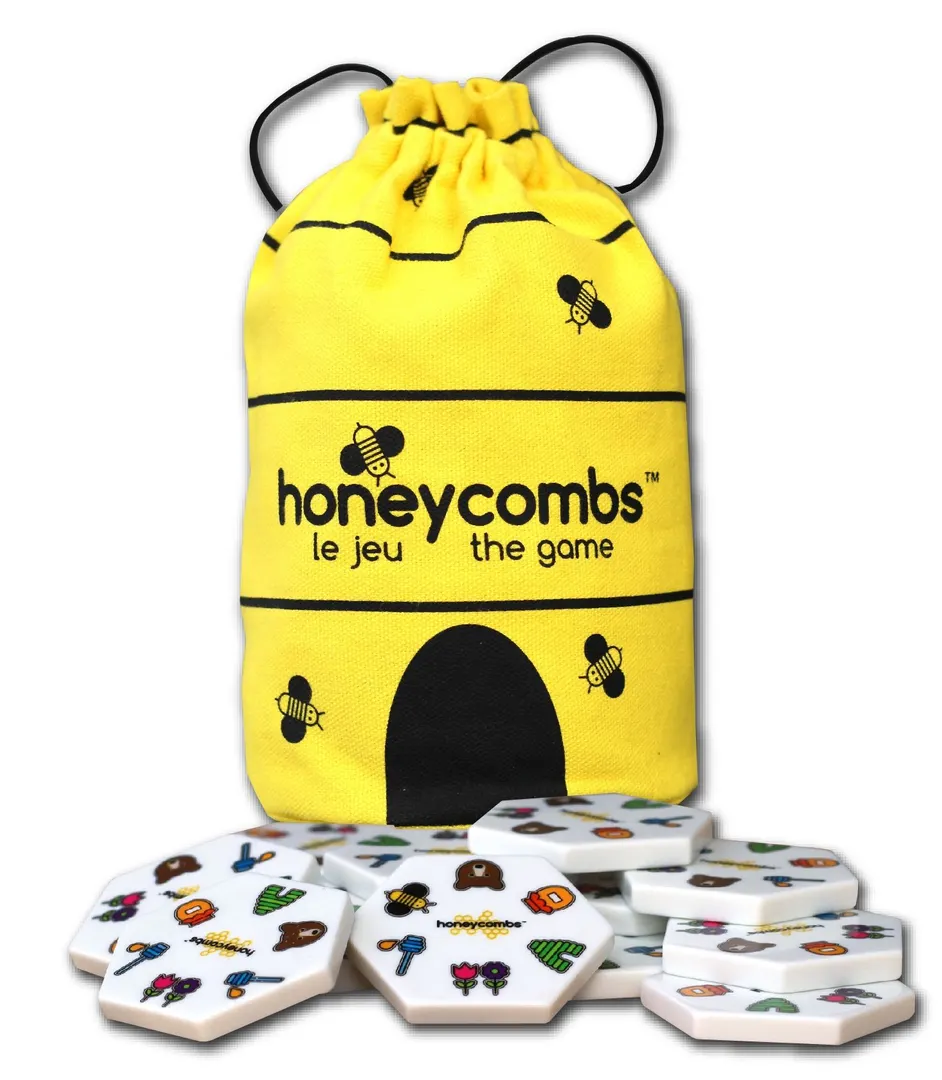
Honeycombs is a board game released in 2016 for 1–8 players, 15–30 minutes per game, and ages 6 and up. It was designed by Dave Clarke (IV) and its main mechanics are Hand Management, Tile Placement, and Cooperative Game.




The object of honeycombs™ is to connect your tiles together by matching their symbols. The more matches you make the more points you earn. The honeybee is wild and can be connected with any symbol. Honeycombs™ has three unique ways to play, each varying in speed and competitiveness. Choose the one that suits your mood. Version A – Worker Bee Fast-paced competition between opponents (2-4 players / 2-4 teams of 2) 1. Divide tiles evenly among all players/teams. 2 players = 26 tiles each, 3 players = 17 tiles each, 4 players = 13 tiles each 2. Each player places their tiles face-down in front of themselves. 3. On the word ‘go’ players turn over their tiles and connect as many matching symbols as possible. It’s a race to complete your honeycomb before your opponents complete theirs. 4. The first player to connect all their tiles together yells “HONEYCOMBS”. This signifies the end of the round and all other players must immediately stop. 5. Players quickly check the honeycomb of the player nearest to them to see if anyone has broken rules 1 and/or 2 (see rules 1 "Single Match" & 2 below). If so, deduct points accordingly. However, if the player finishing first is in violation of the rules, the round resumes until someone finishes with a mistake free honeycomb. 6. Next, each player calculates their points for the round - (See Scoring) and tells the scorekeeper. The scorekeeper keeps a running tally of everyone’s points. 7. Return all tiles to the bag to prepare for another round. 8. The player with the most points after 3 rounds is crowned Queen Bee. Version B – One Big Honeycomb A leisurely competition, one turn at a time (2-4 players / 2-4 teams of 2) 1. Players take turns to build one big honeycomb while collecting individual points. 2. Draw one tile and place it face up in the center of the table. 3. Each player draws three tiles from the bag. 4. Moving clockwise, players choose one of their three tiles and connects it to the honeycomb. One point is earned for every match made and it is added the player’s total. 5. After each turn, players draw one tile from the bag to replenish their hand. 6. When all 52 tiles have been connected to the honeycomb, the game is over and the player with the most points is the champion. 7. Some tiles have special powers which are indicated in the center of the tile. To maximize their value, be strategic in how you use them. They are only active in Version B- One Big Honeycomb. Special Power Tiles. Double Points: When playing a tile marked with the Double Points symbol "2X", all points earned are doubled. Steal: When playing a tile marked with the Steal symbol (picture of a masked robber) you have the power to steal another player’s turn. Before a player lays their tile, yell “STEAL” to indicate you are stealing their turn. Lay your ‘Steal’ tile and collect your points. Replenish your hand to 3 tiles. Continue with the next scheduled player. Extra Turn: After taking your normal turn, you can play the Extra Turn tile (tile marked with a symbol of an arrow in a circle) right away. It is a bonus turn and does not affect your next turn. Replenish your hand to 3 tiles Wild Tile: When playing the tile with the "bee" symbol in the center of the tile the player chooses 1 symbol on this tile to become wild. It can now be matched with any symbol. *note: this is not to be confused with the wild bee on the perimeter of the tile. Version C – Honeycombs Puzzle Work together to build a creative honeycomb 1. All tiles are placed face up on the table as you would with a puzzle. 2. Players work together to build one honeycomb. The object of this game is to make as many connections as possible. 3. Tiles can be moved around at any time, by any player. 4. Work at your own pace as everyone contributes at the same time. 5. When all tiles are connected to the players’ satisfaction the game is over. 6. This is a non-competitive version; count the total points and record your score if you want. Rules Rule 1: Single Match (Applies to Worker Bee Version Only) When a round is finished, only one tile in a players honeycomb can have a single match. A single match is a one that is isolated (the symbols on either side of it are not matched). This means you cannot string tiles together in a train to finish quickly. Rule 2: Mismatched Connection If a mismatched connection is discovered when the round ends, the player must remove the tile with the mismatch without receiving any points for it. For example, a player may need to remove a tile and forfeits 2 points even though 1 of the connections was a match. Scoring 1 match = 1 point 1 core connection = 5 points Unused tile = minus 1 point (Worker Bee Version Only) How to Score 1. Count your core connection points first 2. Count your matches. To ensure accuracy when counting, points should be tallied while you disassemble your honeycomb. As you remove each tile, count the number of matches it has. (see picture below) 3. Minus your negative points. Core Connection A core connection is a tile that has matched all 6 sides. In the One Big Honeycomb version, the player who placed the 6th and final tile earns the core connection bonus of 5 points. This bonus is in addition to the points received from the connection(s) themselves.
Honeycombs supports 1–8 players according to the catalogue. This range comes from the publisher’s listed player count, so the game can be set up for any group size within it. Some setups, rules and scoring details may still vary by player count, so check your edition’s rulebook for the exact configuration.
The listed playing time for Honeycombs is 15–30 minutes. This is the publisher’s estimate for a full game. The actual duration depends on the group, the player count and familiarity with the rules: first sessions usually run longer, while experienced groups often finish faster. Setup and teaching time are not included in this estimate.
The catalogue lists Honeycombs for ages 6 and up. This is the publisher’s recommendation and reflects reading demands, rule complexity and small components rather than theme alone. Younger players can often join with help from an adult, so check the age guidance on your edition and consider your group’s experience with board games.
Honeycombs has a complexity rating of 1.6 out of 5 from BoardGameGeek players, which makes it a light game. The rating reflects how much rules knowledge, planning and decision-making a typical game demands. Expect a longer first teach for heavier games, and use a preparation guide before game night.
Honeycombs belongs to these categories: Children's Game, Abstract Strategy, and Puzzle. Its main mechanics are Hand Management, Tile Placement, and Cooperative Game. Categories describe the theme and setting of a game, while mechanics describe what players actually do on their turns. Each mechanic links to a catalogue hub with similar games, which helps when you want something comparable.
The credited designers of Honeycombs are: Dave Clarke (IV). These credits come from the published game data and name the people responsible for the game’s design, not its illustrators or publishers. Designer pages on MeepleRules collect other titles by the same designers, which helps when you enjoy a game and want to find similar ones.
The catalogue lists Honeycombs as a base game. It can be played on its own with the components in the box and does not require any other title. Expansions, if any exist, add new content or rules on top of it and are listed separately in the catalogue with a link back to this base game.