

- BGG rank
- BGG #1,716
- BGG rating
- 7.7
V-Sabotage
- 1–4 players
- 30–180 min
- Complexity 2.7/5
- 2016
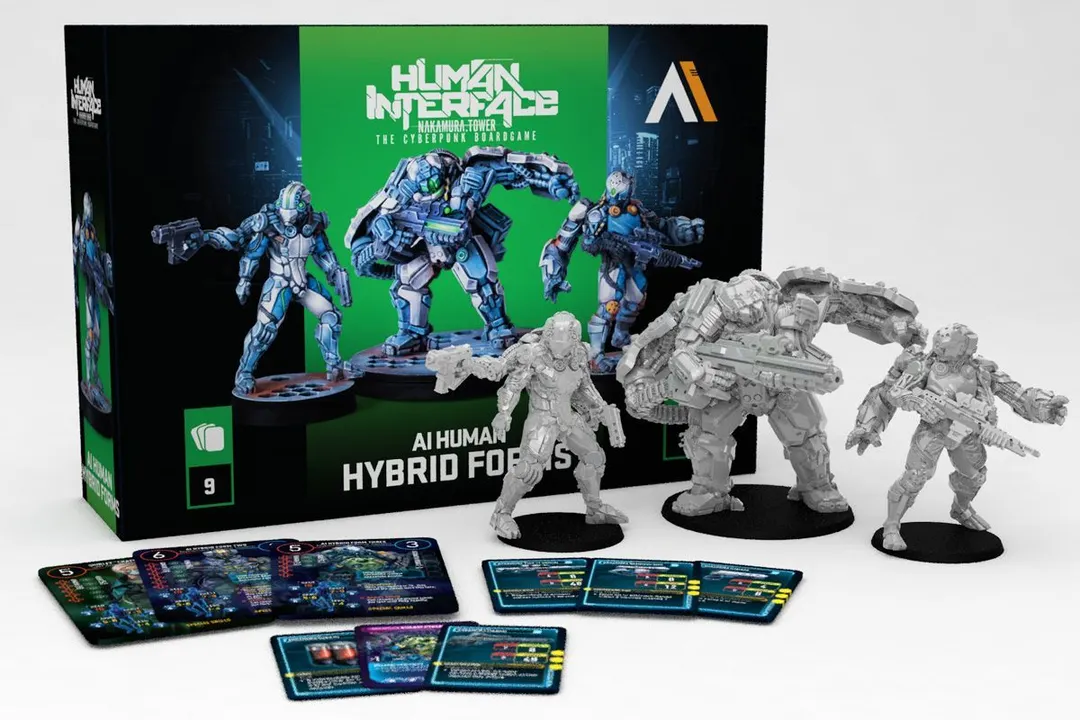
Expansion for Human Interface: Nakamura Tower
2016
Rules assistance for Human Interface: Nakamura Tower – AI Human Hybrid Forms
Plain-language explanations of turns, card effects and disputed situations, with official source references and saved question history.
What would you like to know?
Answers come from the official rulebook, with the page to check.
Human Interface: Nakamura Tower – AI Human Hybrid Forms is an expansion for Human Interface: Nakamura Tower released in 2016 for 1–6 players, 60–180 minutes per game, and ages 12 and up. Its main mechanics are Area Movement, Point to Point Movement, and Cooperative Game.





It was a secret project. And utterly failed one. The assumptions were ok... hmm at least for such morons, with dreams on armies taking over countries, somewhere at the end of the third world. The research and trials took almost 2 years. In the meantime the progress in robotics and nanomaterials completely changed the reality. The genetics and cloning were back. We couldn’t manage to breed a stable hybrid. The mechanic part was either rejected or didn’t accept the orders from the interface. The whole thing was too big, too heavy, not enough... let’s say... sublime. Yes, you are right, the marketing nowadays is important even for partly illegal military project for government. I really don’t know why the objects weren’t destroyed just after the project was closed. The whole lab was hidden somewhere in the bowels of the tower. Probably it was easier to keep it in secret than to destroy it. Or not... I think it is more likely, that our board was hoping to sell it to someone else anyway... or use it somehow. And they got what they deserved... She has used them! She woke them up, after she destroyed her own security. Probably the drones were not enough for her. She had to have something even more frightening... And the rest... well you know that better than me. THE TESTIMONIES OF A SECRET INFORMER, ALIAS “SERPIO” DURING THE INVESTIGATION AFTER THE INCIDENT IN NAKAMURA TOWER.
Human Interface: Nakamura Tower – AI Human Hybrid Forms supports 1–6 players according to the catalogue. This range comes from the publisher’s listed player count, so the game can be set up for any group size within it. Some setups, rules and scoring details may still vary by player count, so check your edition’s rulebook for the exact configuration.
The listed playing time for Human Interface: Nakamura Tower – AI Human Hybrid Forms is 60–180 minutes. This is the publisher’s estimate for a full game. The actual duration depends on the group, the player count and familiarity with the rules: first sessions usually run longer, while experienced groups often finish faster. Setup and teaching time are not included in this estimate.
The catalogue lists Human Interface: Nakamura Tower – AI Human Hybrid Forms for ages 12 and up. This is the publisher’s recommendation and reflects reading demands, rule complexity and small components rather than theme alone. Younger players can often join with help from an adult, so check the age guidance on your edition and consider your group’s experience with board games.
Human Interface: Nakamura Tower – AI Human Hybrid Forms belongs to these categories: Wargame, Miniatures, and Science Fiction. Its main mechanics are Area Movement, Point to Point Movement, and Cooperative Game. Categories describe the theme and setting of a game, while mechanics describe what players actually do on their turns. Each mechanic links to a catalogue hub with similar games, which helps when you want something comparable.
The catalogue lists Human Interface: Nakamura Tower – AI Human Hybrid Forms as an expansion for Human Interface: Nakamura Tower. Expansions add new content, rules or scenarios to the base game and usually cannot be played on their own, so you need Human Interface: Nakamura Tower to use it. Check that your edition of Human Interface: Nakamura Tower is compatible, as some expansions were revised between editions.