

- BGG rank
- BGG #226
- BGG rating
- 7.5
Memoir '44
- 2–4 players
- 30–45 min
- Complexity 2.3/5
- 2004
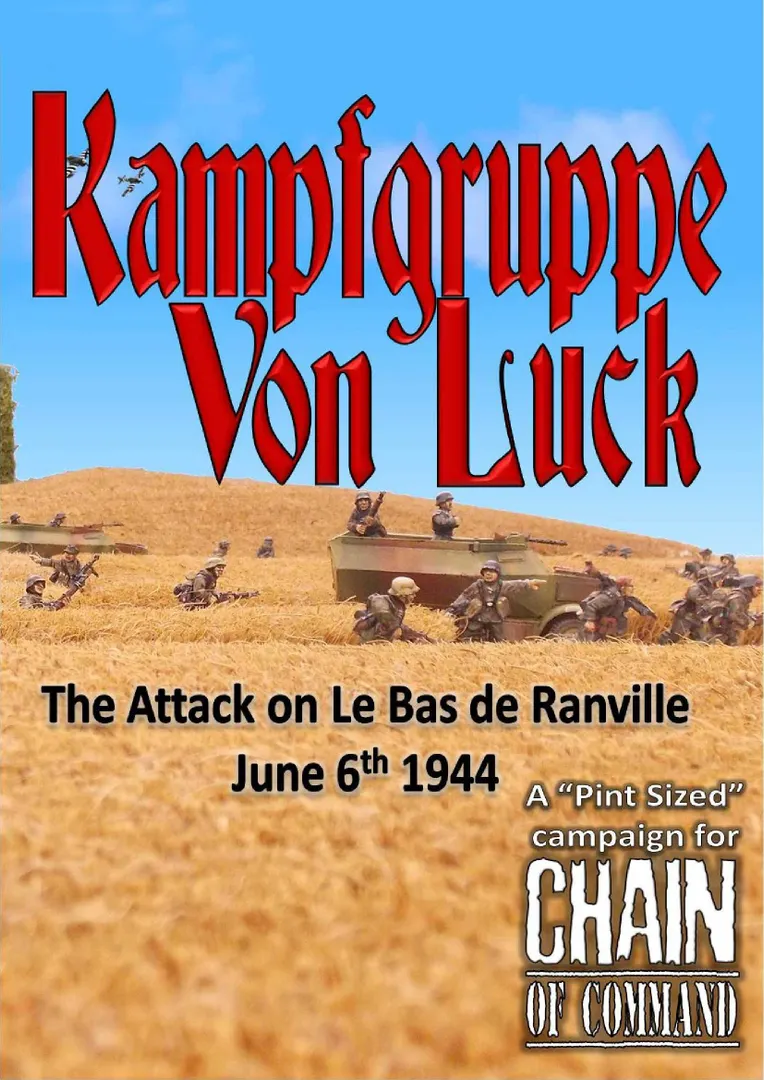
Expansion for Chain of Command
2015
Rules assistance for Kampfgruppe Von Luck: The Attack on Le Bas de Ranville June 6th 1944 – A Pint Sized Campaign for Chain of Command
Plain-language explanations of turns, card effects and disputed situations, with official source references and saved question history.
What would you like to know?
Answers come from the official rulebook, with the page to check.
Kampfgruppe Von Luck: The Attack on Le Bas de Ranville June 6th 1944 – A Pint Sized Campaign for Chain of Command is an expansion for Chain of Command released in 2015 for 2–3 players. It was designed by Richard Clarke (III).




Kampfgruppe von Luck is the second Pint-Sized campaign for Chain of Command. It is designed to be played using the campaign handbook At the Sharp End. Thirty pages long, it contains an overview of the British airbrorne landings and the response of 21 Panzer Division on D-Day before then going on to present a mini-campaign covering the first counter-attack by Kampfgruppe von Luck, striking for the bridges on the Orne. The campaign is a total of five game tables with the duration running between five and eight games. Briefings are provided for both sides, along with measurable objectives, period maps, force and support option listings and everything you need to play this campaign through to its conclusion. Like all Pint-Sized campaigns, it is available for the price of a pint in the local pub of the publisher.
Kampfgruppe Von Luck: The Attack on Le Bas de Ranville June 6th 1944 – A Pint Sized Campaign for Chain of Command supports 2–3 players according to the catalogue. This range comes from the publisher’s listed player count, so the game can be set up for any group size within it. Some setups, rules and scoring details may still vary by player count, so check your edition’s rulebook for the exact configuration.
Kampfgruppe Von Luck: The Attack on Le Bas de Ranville June 6th 1944 – A Pint Sized Campaign for Chain of Command belongs to these categories: Wargame, Miniatures, and World War II. Categories describe the theme, setting and style of a game rather than its rules. Filter the catalogue by the same category to find similar games when you enjoyed Kampfgruppe Von Luck: The Attack on Le Bas de Ranville June 6th 1944 – A Pint Sized Campaign for Chain of Command and want something comparable for your next game night.
The credited designers of Kampfgruppe Von Luck: The Attack on Le Bas de Ranville June 6th 1944 – A Pint Sized Campaign for Chain of Command are: Richard Clarke (III). These credits come from the published game data and name the people responsible for the game’s design, not its illustrators or publishers. Designer pages on MeepleRules collect other titles by the same designers, which helps when you enjoy a game and want to find similar ones.
The catalogue lists Kampfgruppe Von Luck: The Attack on Le Bas de Ranville June 6th 1944 – A Pint Sized Campaign for Chain of Command as an expansion for Chain of Command. Expansions add new content, rules or scenarios to the base game and usually cannot be played on their own, so you need Chain of Command to use it. Check that your edition of Chain of Command is compatible, as some expansions were revised between editions.