
- BGG rank
- BGG #10,901
- BGG rating
- 7.8
All is lost save Honour: Campaigns of the Italian Wars 1494-1530 – Vol.1
- 2 players
- 120–180 min
- Complexity 3.4/5
- 2006
2017
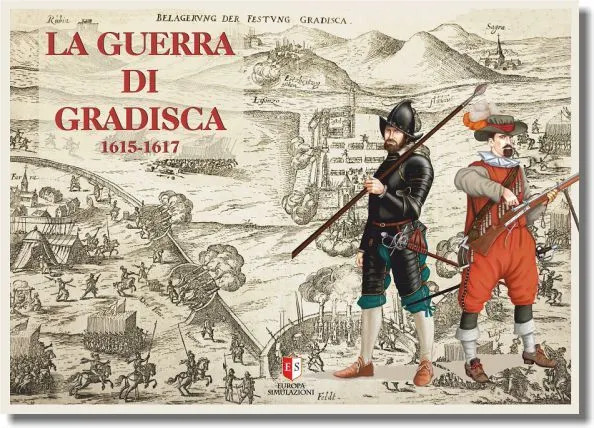
Rules assistance for La Guerra di Gradisca 1615-1617
Plain-language explanations of turns, card effects and disputed situations, with official source references and saved question history.
For 2 players
What would you like to know?
Answers come from the official rulebook, with the page to check.
La Guerra di Gradisca 1615-1617 is a board game released in 2017 for 2 players, 120–240 minutes per game, and ages 14 and up. It was designed by Nicola Contardi and its main mechanics are Hand Management, Simulation, and Chit-Pull System.




In the early 17th century the Republic of Venice had predominance in the Adriatic Sea, which for centuries had been subject to its jurisdiction and called the Gulf of Venice, but the Archduke of Austria, a Habsburg who ruled with great autonomy Styria, Carinthia, Carniola, part of the Friuli and many other imperial possessions, did not miss a chance to challenge it. When the raids of the Uskoks, corsars of Catholic faith in service of the Habsburgs, from the Kvarner Gulf to the Venetian routes became more insistent, Venice reacted by triggering a long and bloody war on its eastern borders and in Istria with the idea of putting an end to the raids, defeat the Austrian challenge and to regain the fortress once founded and then lost, Gradisca. Saint Mark's lion roared still ... The War of Gradisca 1615-1617 is a simulation game of that ancient conflict, which saw the confrontation of two powers of the era in a political and military context that anticipated the long period of the Thirty Years War. The game mechanic allows activating units in an unpredictable sequence, enabling uncertainty about campaign outcomes and replayability. Cards introduce political and historical events and allow the development of custom strategies. —description from the publisher
La Guerra di Gradisca 1615-1617 supports 2 players according to the catalogue. This is the publisher’s listed player count, so the game is designed for exactly that number of participants. Variants for other group sizes, if any, are described in the rulebook of your edition, so check it before setting up a different configuration.
The listed playing time for La Guerra di Gradisca 1615-1617 is 120–240 minutes. This is the publisher’s estimate for a full game. The actual duration depends on the group, the player count and familiarity with the rules: first sessions usually run longer, while experienced groups often finish faster. Setup and teaching time are not included in this estimate.
The catalogue lists La Guerra di Gradisca 1615-1617 for ages 14 and up. This is the publisher’s recommendation and reflects reading demands, rule complexity and small components rather than theme alone. Younger players can often join with help from an adult, so check the age guidance on your edition and consider your group’s experience with board games.
La Guerra di Gradisca 1615-1617 has a complexity rating of 2.3 out of 5 from BoardGameGeek players, which makes it a medium-light game. The rating reflects how much rules knowledge, planning and decision-making a typical game demands. Expect a longer first teach for heavier games, and use a preparation guide before game night.
La Guerra di Gradisca 1615-1617 belongs to these categories: Wargame and Pike and Shot. Its main mechanics are Hand Management, Simulation, and Chit-Pull System. Categories describe the theme and setting of a game, while mechanics describe what players actually do on their turns. Each mechanic links to a catalogue hub with similar games, which helps when you want something comparable.
The credited designers of La Guerra di Gradisca 1615-1617 are: Nicola Contardi. These credits come from the published game data and name the people responsible for the game’s design, not its illustrators or publishers. Designer pages on MeepleRules collect other titles by the same designers, which helps when you enjoy a game and want to find similar ones.
The catalogue lists La Guerra di Gradisca 1615-1617 as a base game. It can be played on its own with the components in the box and does not require any other title. Expansions, if any exist, add new content or rules on top of it and are listed separately in the catalogue with a link back to this base game.