
- BGG rank
- BGG #5,647
- BGG rating
- 8.3
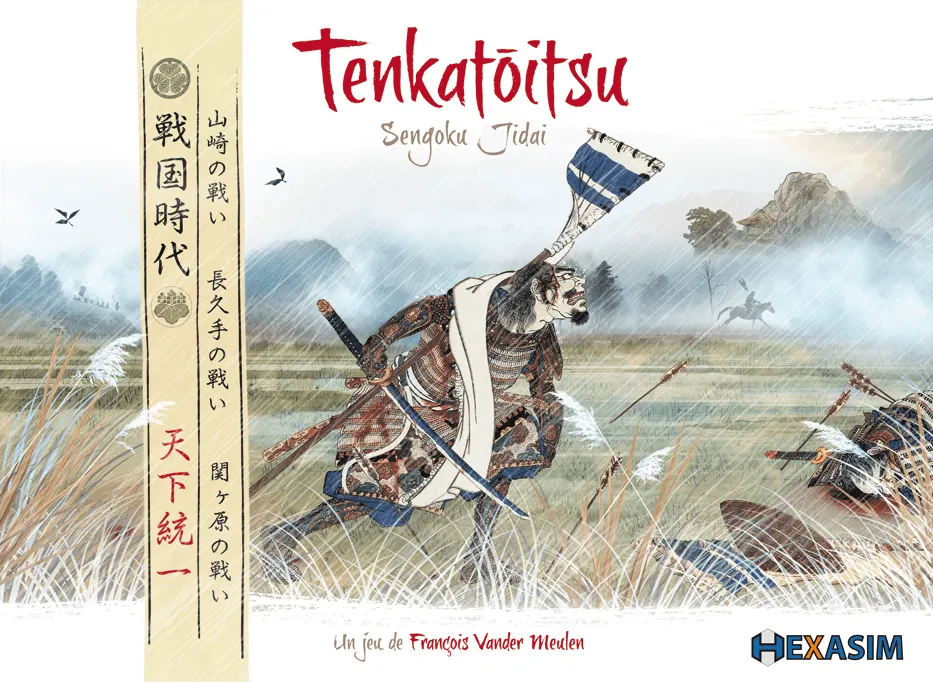
Tenkatoitsu
- 1–2 players
- 180–420 min
- Complexity 3.4/5
- 2016
2009
Rules assistance for Kawanakajima 1561
Plain-language explanations of turns, card effects and disputed situations, with official source references and saved question history.
For 1 player
What would you like to know?
Answers come from the official rulebook, with the page to check.
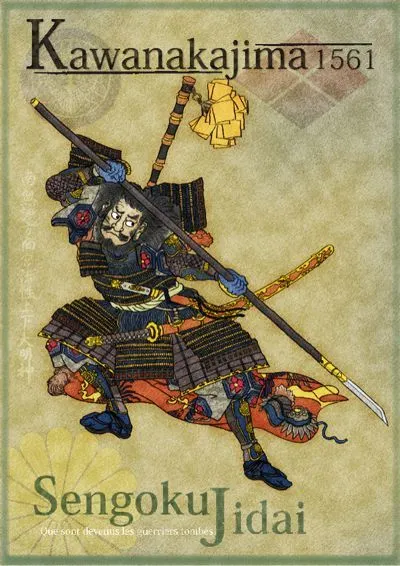
Kawanakajima 1561 is a board game released in 2009 for 1–2 players and 120–240 minutes per game. It was designed by François Vander Meulen and its main mechanics are Dice Rolling, Hexagon Grid, and Simulation.






(from Hexasim website:) Kawanakajima 1561, simulates the fourth battle of Kawanakajima. This will be the first game in the series Sengoku Jidai, which will cover battles in 16th century Japan. The system is designed so players can finish a game in an evening, and has simple but dynamic mechanics. In the game, each player takes the role of a commander in chief. Each army consists of various clans, and the players have to choose an action for each of their clans. Each clan is represented by 1 to 3 units. The units have various abilities, summarized by the 4 factors: élan, mass, fire and the presence of a leader. Elan represents factors such as the unit's mobility, and its boldness in attack, and is also used to reflect the advantage that cavalry can have over infantry when attacking. The unit's mass represents its staying power, such as its ability to resist a cavalry charge or a rout. A unit's abilities are tied to the value of its four factors and the current mode of the clan that it belongs to. A clan can be placed in one of four modes: Attack, Defense, Move, and Rally. The owning clan's mode will affect a unit's ability to move or engage in combat. A game turn consists of alternating phases where a player can activate his units. The order in which activations will occur is tied to a chit pull system. The game system requires each player to plan carefully how to win. They must maneuver to gain numerical superiority, deploy in terrain that takes advantage of their clan's mode, and try to surprise his opponent by attacking troops that are not prepared. The system also places the players under the same historical limitations as the actual Japanese leaders. Japanese generals of this time prearranged their battle plans and coordinated their armies with a precise system of semaphore flags and sound signals. The game includes 2 scenarios: one depicting the historical battle, and a "what if?" hypothetical scenario. In the historical scenario, Takeda's army is divided in two contingents. One of the contingents is taken by surprise by Uesugi's army, and has to fight a holding action until the rest of the army can come to its aid. The hypothetical scenario explores what could have happened several days before the historical battle. In Kawanakajima 1561 a hex represents about 250 meters and a strength point corresponds to around 100 men. Game components: 1 map A1 (84cm*60cm) 228 game counters (88 5/8inch, 140 1/2inch) one rule book with scenarios Game play aids Cardboard jacket 4 dice
Kawanakajima 1561 supports 1–2 players according to the catalogue. This range comes from the publisher’s listed player count, so the game can be set up for any group size within it. Some setups, rules and scoring details may still vary by player count, so check your edition’s rulebook for the exact configuration.
The listed playing time for Kawanakajima 1561 is 120–240 minutes. This is the publisher’s estimate for a full game. The actual duration depends on the group, the player count and familiarity with the rules: first sessions usually run longer, while experienced groups often finish faster. Setup and teaching time are not included in this estimate.
Kawanakajima 1561 has a complexity rating of 2.8 out of 5 from BoardGameGeek players, which makes it a medium-light game. The rating reflects how much rules knowledge, planning and decision-making a typical game demands. Expect a longer first teach for heavier games, and use a preparation guide before game night.
Kawanakajima 1561 belongs to these categories: Wargame, Renaissance, and Pike and Shot. Its main mechanics are Dice Rolling, Hexagon Grid, and Simulation. Categories describe the theme and setting of a game, while mechanics describe what players actually do on their turns. Each mechanic links to a catalogue hub with similar games, which helps when you want something comparable.
The credited designers of Kawanakajima 1561 are: François Vander Meulen. These credits come from the published game data and name the people responsible for the game’s design, not its illustrators or publishers. Designer pages on MeepleRules collect other titles by the same designers, which helps when you enjoy a game and want to find similar ones.
The catalogue lists Kawanakajima 1561 as a base game. It can be played on its own with the components in the box and does not require any other title. Expansions, if any exist, add new content or rules on top of it and are listed separately in the catalogue with a link back to this base game.