
- BGG rating
- 6.5
Agincourt
- 2 players
- 60 min
- Complexity 2.4/5
- 2003
2005
Rules assistance for Men of Iron
Plain-language explanations of turns, card effects and disputed situations, with official source references and saved question history.
For 1 player
What would you like to know?
Answers come from the official rulebook, with the page to check.
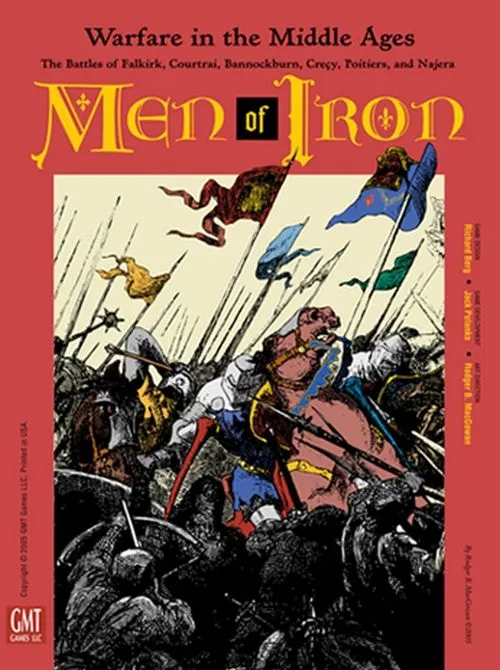
Men of Iron is a board game released in 2005 for 1–2 players, 180 minutes per game, and ages 12 and up. It was designed by Richard H. Berg and its main mechanics are Dice Rolling and Hexagon Grid.







(from GMT website:) Men of Iron covers the re-emergence of infantry in the early 14th century, along with a more perceptive understanding of the value of combined-arms warfare especially with good use of defensive terrain. The scenarios highlight the key elements that made these battles so fascinating: the defensive power of the longbow, especially when used in coordination with dismounted, or even mounted, men-at-arms. Given the right deployments and forces, the inability to take advantage of the marvelous abilities of the vaunted knights, the finest mounted force in Europe, became something of a surprise to many "experts." Men of Iron is designed for quick learning and easy play. Game rules are short, there are no "turns" - play is Continual, with ample opportunities to steal play from your opponent - and combat resolution is a single dieroll. Playing time is about 1 hour per battle. Really! Men of Iron is also GMT's gift to the gamer who enjoys playing solitaire - the system is designed for both individual and face-to-face play without any loss in insight or Fun - to see what happened in these famous battles and why. The battles included in Men of Iron are: Falkirk - Scotland, 22 July 1298 - Wallace's great disaster, despite his massive schiltron. Good infantry is fine, but it needs support. The ultimate solitaire scenario. Courtrai - Flanders, 11 July 1302 - The Battle of the Golden Spurs The Flemish shock the elite French army with one the earliest displays of the power of solid infantry using defensive positions. Bannockburn - Scotland, 23-24 June 1314 - Robert the Bruce's famous triumph over a numerically superior but literally bogged down English army. Crecy - France, 26 August 1346 - The first great battle of the 100 Years War. It showed that infantry, supported by archers, could defeat the best knights in Europe. Poitiers - France, 19 September 1356 - The French fight dismounted this time and almost win. But the longbow, and solid English infantry prevail again. Najera - Castile, 3 April 1367 - The Black Prince goes to Spain with a marvelous combined arms force to further English plans of "expansion". The units feature longbows, crossbows, men-at-arms (mounted, dismounted, and unhorsed), hobilars, genitors, nasty Scots with axes, and even a couple of bombards! And the commanders! The great English King, Edward III and his son, The Black Prince, Wallace and The Bruce, Captal de Buch, and a host of kings. Each and every one a Man of Iron. Components: 3 counter sheets (700 total) Two 22x32 inch mapsheets (six game-maps) Battle Booklet 3 Play Aid Cards Rule Book Two ten-sided die DESIGNER Richard Berg DEVELOPER Jack Polonka MAP ART Knut Grunitz COUNTERS Rodger B. MacGowan, Mark Simonitch, & Mike Lemick
Men of Iron supports 1–2 players according to the catalogue. This range comes from the publisher’s listed player count, so the game can be set up for any group size within it. Some setups, rules and scoring details may still vary by player count, so check your edition’s rulebook for the exact configuration.
The listed playing time for Men of Iron is 180 minutes. This is the publisher’s estimate for a full game. The actual duration depends on the group, the player count and familiarity with the rules: first sessions usually run longer, while experienced groups often finish faster. Setup and teaching time are not included in this estimate.
The catalogue lists Men of Iron for ages 12 and up. This is the publisher’s recommendation and reflects reading demands, rule complexity and small components rather than theme alone. Younger players can often join with help from an adult, so check the age guidance on your edition and consider your group’s experience with board games.
Men of Iron has a complexity rating of 2.8 out of 5 from BoardGameGeek players, which makes it a medium-light game. The rating reflects how much rules knowledge, planning and decision-making a typical game demands. Expect a longer first teach for heavier games, and use a preparation guide before game night.
Men of Iron belongs to these categories: Wargame and Medieval. Its main mechanics are Dice Rolling and Hexagon Grid. Categories describe the theme and setting of a game, while mechanics describe what players actually do on their turns. Each mechanic links to a catalogue hub with similar games, which helps when you want something comparable.
The credited designers of Men of Iron are: Richard H. Berg. These credits come from the published game data and name the people responsible for the game’s design, not its illustrators or publishers. Designer pages on MeepleRules collect other titles by the same designers, which helps when you enjoy a game and want to find similar ones.
The catalogue lists Men of Iron as a base game. It can be played on its own with the components in the box and does not require any other title. Expansions, if any exist, add new content or rules on top of it and are listed separately in the catalogue with a link back to this base game.