
- BGG rating
- 8.4
Battles For the Shenandoah: A Death Valley Expansion
- 1–2 players
- Complexity 3.8/5
- 2022

2019
Rules assistance for Death Valley: Battles for the Shenandoah
Plain-language explanations of turns, card effects and disputed situations, with official source references and saved question history.
For 1 player
What would you like to know?
Answers come from the official rulebook, with the page to check.
Death Valley: Battles for the Shenandoah is a board game released in 2019 for 1–2 players and 300–1200 minutes per game. It was designed by Richard H. Berg and Greg Laubach and its main mechanics are Dice Rolling, Grid Movement, and Hexagon Grid.





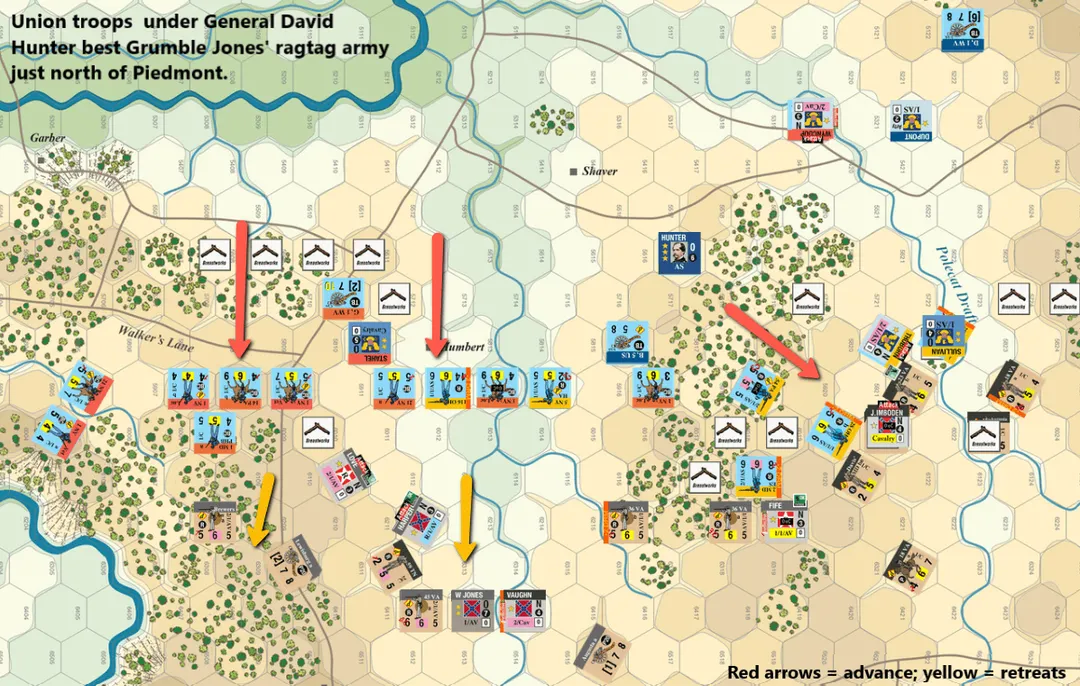
Death Valley: Battles for the Shenandoah is the seventh installment of the Great Battles of the American Civil War (GBACW) series, published by GMT Games. Death Valley: Battles for the Shenandoah contains eight battle games with multiple scenarios. They range from division level contests on half sized maps to two map battles between armies. Experienced players will be able to play many of the scenarios in one sitting. The rules compare the development of the cavalry, and the changes in infantry and artillery organization and tactics in 1862 and 1864. Three Battles of the Shenandoah Valley Campaign of 1862 In a campaign still studied in military academies, Confederate General Thomas J. (Stonewall) Jackson engaged and defeated the Union forces pursuing him. Greatly outnumbered and at times facing three Union armies, Jackson defeated them all within ten weeks, at one point completely freeing the Shenandoah Valley of Union forces. Three battles from Jackson’s 1862 Valley Campaign are featured. Kernstown, March 23, 1862 Winchester, May 25, 1862 Cross Keys and Port Republic, June 8-9, 1862 Five Battles of the Shenandoah Valley Campaigns of 1864 New Market, May 15, 1864 2nd Kernstown, July 24, 1864 3rd Winchester, September 19, 1864 Fisher's Hill, September 22, 1864 Cedar Creek, October 19, 1864 The Great Battles of the American Civil War Series: This series is one of the hobby’s longest-lived design concepts, springing from the legendary regimental level Gettysburg game – Terrible Swift Sword (SPI) – designed by Richard Berg in 1976. Under GMT, the rules system has remained stable, but has shown remarkable flexibility to allow each game to smoothly incorporate additional rules to reflect the historical battles. The series relies on interactive chit-pull mechanics to simulate the oftentimes-chaotic nature of the 19th Century battlefield at the regimental level. Changes have been made to the series rules for Death Valley in order to enhance their clarity and simulation value. Veteran players will find the revised rules to be very familiar, with the main differences being in the user-friendliness of the rulebook, as well as how the game "feels", especially for players versed in Civil War tactics. Components: 1960 counters Three 22" x 34" double-sided maps Two 17" x 22" double-sided maps One GBACW series rules booklet Two Battle booklets Sixteen Activation and Turn Record charts Two Player Aid Cards One Terrain Effects Chart One 2nd Disorder Chart Two 10-sided dice TIME SCALE: Each Turn = 1 Hour MAP SCALE: 145 Yards Per Hex with 25-Foot Elevations UNIT SCALE: 50 Men or 1 Cannon per Strength Point description from GMT website
Death Valley: Battles for the Shenandoah supports 1–2 players according to the catalogue. This range comes from the publisher’s listed player count, so the game can be set up for any group size within it. Some setups, rules and scoring details may still vary by player count, so check your edition’s rulebook for the exact configuration.
The listed playing time for Death Valley: Battles for the Shenandoah is 300–1200 minutes. This is the publisher’s estimate for a full game. The actual duration depends on the group, the player count and familiarity with the rules: first sessions usually run longer, while experienced groups often finish faster. Setup and teaching time are not included in this estimate.
Death Valley: Battles for the Shenandoah has a complexity rating of 4.3 out of 5 from BoardGameGeek players, which makes it a heavy game. The rating reflects how much rules knowledge, planning and decision-making a typical game demands. Expect a longer first teach for heavier games, and use a preparation guide before game night.
Death Valley: Battles for the Shenandoah belongs to these categories: Wargame, Civil War, and Post-Napoleonic. Its main mechanics are Dice Rolling, Grid Movement, and Hexagon Grid. Categories describe the theme and setting of a game, while mechanics describe what players actually do on their turns. Each mechanic links to a catalogue hub with similar games, which helps when you want something comparable.
The credited designers of Death Valley: Battles for the Shenandoah are: Richard H. Berg and Greg Laubach. These credits come from the published game data and name the people responsible for the game’s design, not its illustrators or publishers. Designer pages on MeepleRules collect other titles by the same designers, which helps when you enjoy a game and want to find similar ones.
The catalogue lists Death Valley: Battles for the Shenandoah as a base game. It can be played on its own with the components in the box and does not require any other title. Expansions, if any exist, add new content or rules on top of it and are listed separately in the catalogue with a link back to this base game.