
- BGG rank
- BGG #8,812
- BGG rating
- 8.4
La Der des Ders: The War to End War
- 1–2 players
- 60–120 min
- Complexity 2.6/5
- 2025
2015
Rules assistance for No Man's Land: Trench Warfare 1914-1918
Plain-language explanations of turns, card effects and disputed situations, with official source references and saved question history.
For 1 player
What would you like to know?
Answers come from the official rulebook, with the page to check.
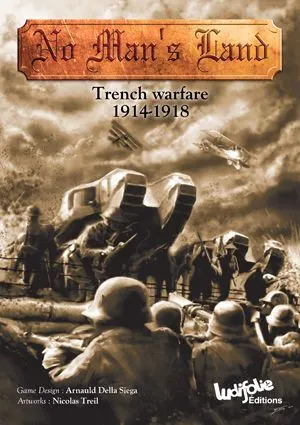
No Man's Land: Trench Warfare 1914-1918 is a board game released in 2015 for 1–2 players, 30–90 minutes per game, and ages 12 and up. It was designed by Arnauld Della Siega and its main mechanics are Dice Rolling, Grid Movement, and Hexagon Grid.
By the end of 1914 the armies have dug in. Like a scar spreading across the face of Europe, trench-lines extend from the North Sea to the Swiss border. In the mud and cold, amongst rats and the smell of rotting corpses, millions of men will go over the top to capture the enemy trench and break through the front. The 11 scenarios of No Man’s Land will allow you to follow the evolution of WW1 trench warfare from many different perspectives: army organization, new tactics and weapons. You’ll learn to master artillery barrages, poison gas, flamethrowers, shock troops, tanks… while overhead the dawn of aviation will provide precious help. No matter the blood shed, only victory matters! Scale : 1 hex. = 50 m 1 counter = section to half-platoon, MG with its crew, tank, Playing Time : about 90 minutes Complexity : moderate The game contains: 1 double sided A2 Map (42x60 cm) - 324 die-cut counters and markers - 1 booklet of rules and 11 scenarios - 1 Player Aid. It is available in English and French edition.
No Man's Land: Trench Warfare 1914-1918 supports 1–2 players according to the catalogue. This range comes from the publisher’s listed player count, so the game can be set up for any group size within it. Some setups, rules and scoring details may still vary by player count, so check your edition’s rulebook for the exact configuration.
The listed playing time for No Man's Land: Trench Warfare 1914-1918 is 30–90 minutes. This is the publisher’s estimate for a full game. The actual duration depends on the group, the player count and familiarity with the rules: first sessions usually run longer, while experienced groups often finish faster. Setup and teaching time are not included in this estimate.
The catalogue lists No Man's Land: Trench Warfare 1914-1918 for ages 12 and up. This is the publisher’s recommendation and reflects reading demands, rule complexity and small components rather than theme alone. Younger players can often join with help from an adult, so check the age guidance on your edition and consider your group’s experience with board games.
No Man's Land: Trench Warfare 1914-1918 has a complexity rating of 3.0 out of 5 from BoardGameGeek players, which makes it a medium-weight game. The rating reflects how much rules knowledge, planning and decision-making a typical game demands. Expect a longer first teach for heavier games, and use a preparation guide before game night.
No Man's Land: Trench Warfare 1914-1918 belongs to these categories: Wargame and World War I. Its main mechanics are Dice Rolling, Grid Movement, and Hexagon Grid. Categories describe the theme and setting of a game, while mechanics describe what players actually do on their turns. Each mechanic links to a catalogue hub with similar games, which helps when you want something comparable.
The credited designers of No Man's Land: Trench Warfare 1914-1918 are: Arnauld Della Siega. These credits come from the published game data and name the people responsible for the game’s design, not its illustrators or publishers. Designer pages on MeepleRules collect other titles by the same designers, which helps when you enjoy a game and want to find similar ones.
The catalogue lists No Man's Land: Trench Warfare 1914-1918 as a base game. It can be played on its own with the components in the box and does not require any other title. Expansions, if any exist, add new content or rules on top of it and are listed separately in the catalogue with a link back to this base game.