
- BGG rating
- 6.1
Pick-a-Polar Bear: Pig and Dog Expansion
- 1–5 players
- 15 min
- 2013

2013
Rules assistance for Pick-a-Polar Bear
Plain-language explanations of turns, card effects and disputed situations, with official source references and saved question history.
For 1 player
What would you like to know?
Answers come from the official rulebook, with the page to check.
Pick-a-Polar Bear is a board game released in 2013 for 1–5 players, 10–15 minutes per game, and ages 8 and up. It was designed by Torsten Landsvogt and its main mechanics are Pattern Recognition.









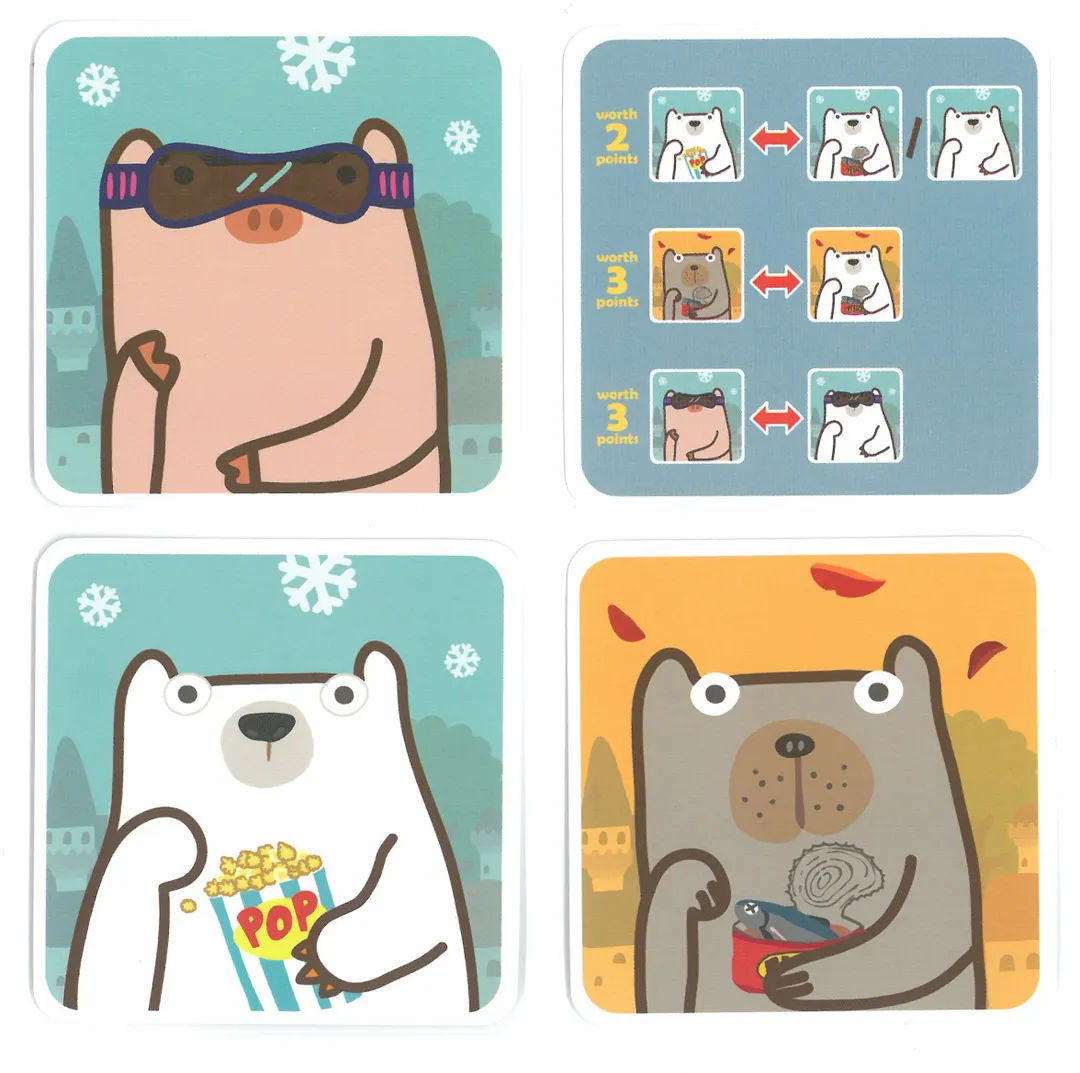
"Pick-a-Seal!" may combine with "Pick-a-Polar Bear!" for up to 8 players. Pick-a-Seal will be launched in Essen 2014. The nanuks are determined not to be sitting "bears" due to global warming. Sourcing a supply of canned fish may be a way to survive the diminishing sea ice — and if nothing else, it gives them a good reason to travel all the way from the North Pole to Germany to party down with their doggie friends there! Pick-a-Polar Bear, first published as Formissimo, features the same gameplay as Pick-a-Dog but with two new variants! To set up the basic game, lay out 30 cards in a grid and give one card face down to each player. Each card has five attributes, with each attribute having two states: large/small, with/without a raised arm, orange autumn/blue winter background, with/without goggles, and with/without canned fish. Someone shouts "Go!", then everyone looks at their card in hand. Players then start grabbing cards from the grid and stacking them in hand. The card grabbed must be identical to the top card in hand or differ from that top card in only one way. Thus, as you grab cards, the attributes of that top card will keep changing, forcing you to look for matches in new ways. Once a player thinks he can't grab any more cards, he yells "Stop!" The round ends, and all players check their card stacks. If someone made a mistake when grabbing cards, that player keeps none of the cards gathered that round. If the player who stopped the round made no mistakes, he earns an extra card. If, however, he stopped the round when he could have collected more cards, then he loses all the cards he's collected during this round. To set up for the next round, give each player a new face-down card and fill in the holes in the grid. When the deck runs out, complete that round, after which the game ends. Whoever has collected the most cards wins! Pick-a-Polar Bear includes two game variants. In the first, the player who has obtained the most cards in the preceding round cannot grab a card that's identical to his top card in the current round. For the second variant, shuffle eight "bonus round" cards into the deck. If when laying out the cards in the grid, the dealer reveals the back of a bonus round card when at least ten cards are on the table, everyone prepares for the bonus round. The dealer reveals this card, which shows two card elements such as upraised arm and goggles, and everyone races to yell out how many cards in the grid feature these two elements. Whoever yells out the correct answer first receives the bonus round card, which is worth 2 points; whoever yells out the wrong answer takes a -2 point penalty card. The dealer then continues filling the grid. (If the grid contains fewer than ten cards when a bonus round card comes up in the deck, discard this card and continue to fill the grid.)
Pick-a-Polar Bear supports 1–5 players according to the catalogue. This range comes from the publisher’s listed player count, so the game can be set up for any group size within it. Some setups, rules and scoring details may still vary by player count, so check your edition’s rulebook for the exact configuration.
The listed playing time for Pick-a-Polar Bear is 10–15 minutes. This is the publisher’s estimate for a full game. The actual duration depends on the group, the player count and familiarity with the rules: first sessions usually run longer, while experienced groups often finish faster. Setup and teaching time are not included in this estimate.
The catalogue lists Pick-a-Polar Bear for ages 8 and up. This is the publisher’s recommendation and reflects reading demands, rule complexity and small components rather than theme alone. Younger players can often join with help from an adult, so check the age guidance on your edition and consider your group’s experience with board games.
Pick-a-Polar Bear has a complexity rating of 1.0 out of 5 from BoardGameGeek players, which makes it a light game. The rating reflects how much rules knowledge, planning and decision-making a typical game demands. Expect a longer first teach for heavier games, and use a preparation guide before game night.
Pick-a-Polar Bear belongs to these categories: Card Game, Animals, and Party Game. Its main mechanics are Pattern Recognition. Categories describe the theme and setting of a game, while mechanics describe what players actually do on their turns. Each mechanic links to a catalogue hub with similar games, which helps when you want something comparable.
The credited designers of Pick-a-Polar Bear are: Torsten Landsvogt. These credits come from the published game data and name the people responsible for the game’s design, not its illustrators or publishers. Designer pages on MeepleRules collect other titles by the same designers, which helps when you enjoy a game and want to find similar ones.
The catalogue lists Pick-a-Polar Bear as a base game. It can be played on its own with the components in the box and does not require any other title. Expansions, if any exist, add new content or rules on top of it and are listed separately in the catalogue with a link back to this base game.