

- BGG rank
- BGG #4,062
- BGG rating
- 6.8
Magnastorm
- 2–4 players
- 70–100 min
- Complexity 3.1/5
- 2018
2009
Rules assistance for Power Struggle
Plain-language explanations of turns, card effects and disputed situations, with official source references and saved question history.
For 3 players
What would you like to know?
Answers come from the official rulebook, with the page to check.
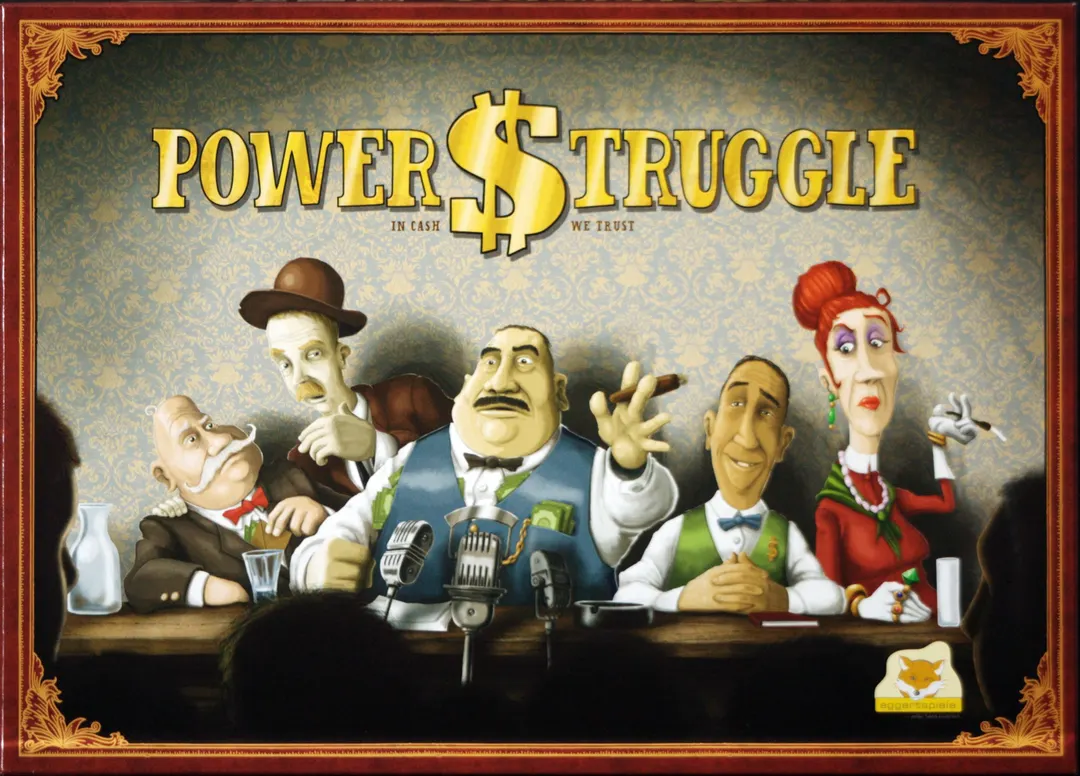
Power Struggle is a board game released in 2009 for 3–5 players, 105 minutes per game, and ages 12 and up. It was designed by Maximilian Maria Thiel and Bauldric & Friends and its main mechanics are Area Majority / Influence and Bribery.




This description was originally based on a review from BoardgameNews.com. In this corporation-themed game, players compete to be the first to acquire four out of six possible victory points. You earn a point by reaching certain numbers along tracks, such as at least 7 on the influence track or 8 on the majority track. You also may earn a point by beating your secretly assigned archenemy on three specified tracks. The game lasts a number of rounds, with each round consisting of a directors' meeting, followed by 4-7 turns. At the meeting, the "company chairman" is replaced (the next token in line moves up) and the "division heads" are named (by seeing who has the majority in each column of placed cubes). Chairmen and heads get salary bonuses and a card detailing a single advantage for the cardholder. The player who's the "communications" head then secretly looks at the Event cards and determines in which order they will be played (and so how many turns will be in the current round). Other heads' cards will let them pay less for stocks, for example, or place or remove bits. After each event card is revealed, players select one action to perform, such as "hiring and relocating employees" (placing or moving cubes), resigning as a department head, using an advantage card, or bribing players for their advantage cards. These actions result in points on the scoring tracks and sometimes money (which is only used for bribery and buying blocks of stock). A bribed card has more power than an earned one, giving incentive to accept bribes (the card is less useful or even useless to the original owner, depending on the workers' happiness scale). In addition to bribery getting you a power you want, it also moves you up the corruption track. A player who rejects a bribe, however, loses one cube on the majority columns. It's not a business simulation, and gameplay isn't as dastardly as the theme implies. The event cards provide most of the humor. (The card may read that you have failed to fix the breakroom game table, or vacations were canceled, so worker satisfaction goes down, which is what you want). The feel of rising through the ranks (getting more points) is there, and there are many things to attempt to excel in, by doing various business-related (at least in name) actions. Efficient manipulating of your opportunities will win you victory points and, if you gain four, the game. Awards: Machtspiele (Power $truggle) is derived from "Die Firma", which won a special prize in the 2009 Hippodice game design competition for best full-length game.
Power Struggle supports 3–5 players according to the catalogue. This range comes from the publisher’s listed player count, so the game can be set up for any group size within it. Some setups, rules and scoring details may still vary by player count, so check your edition’s rulebook for the exact configuration.
The listed playing time for Power Struggle is 105 minutes. This is the publisher’s estimate for a full game. The actual duration depends on the group, the player count and familiarity with the rules: first sessions usually run longer, while experienced groups often finish faster. Setup and teaching time are not included in this estimate.
The catalogue lists Power Struggle for ages 12 and up. This is the publisher’s recommendation and reflects reading demands, rule complexity and small components rather than theme alone. Younger players can often join with help from an adult, so check the age guidance on your edition and consider your group’s experience with board games.
Power Struggle has a complexity rating of 3.4 out of 5 from BoardGameGeek players, which makes it a medium-weight game. The rating reflects how much rules knowledge, planning and decision-making a typical game demands. Expect a longer first teach for heavier games, and use a preparation guide before game night.
Power Struggle belongs to these categories: Humor and Negotiation. Its main mechanics are Area Majority / Influence and Bribery. Categories describe the theme and setting of a game, while mechanics describe what players actually do on their turns. Each mechanic links to a catalogue hub with similar games, which helps when you want something comparable.
The credited designers of Power Struggle are: Maximilian Maria Thiel and Bauldric & Friends. These credits come from the published game data and name the people responsible for the game’s design, not its illustrators or publishers. Designer pages on MeepleRules collect other titles by the same designers, which helps when you enjoy a game and want to find similar ones.
The catalogue lists Power Struggle as a base game. It can be played on its own with the components in the box and does not require any other title. Expansions, if any exist, add new content or rules on top of it and are listed separately in the catalogue with a link back to this base game.