
- BGG rating
- 8.5
Rising Sun: Daimyo Box
3–6 players90–120 min2018
Complexity 3.4/5
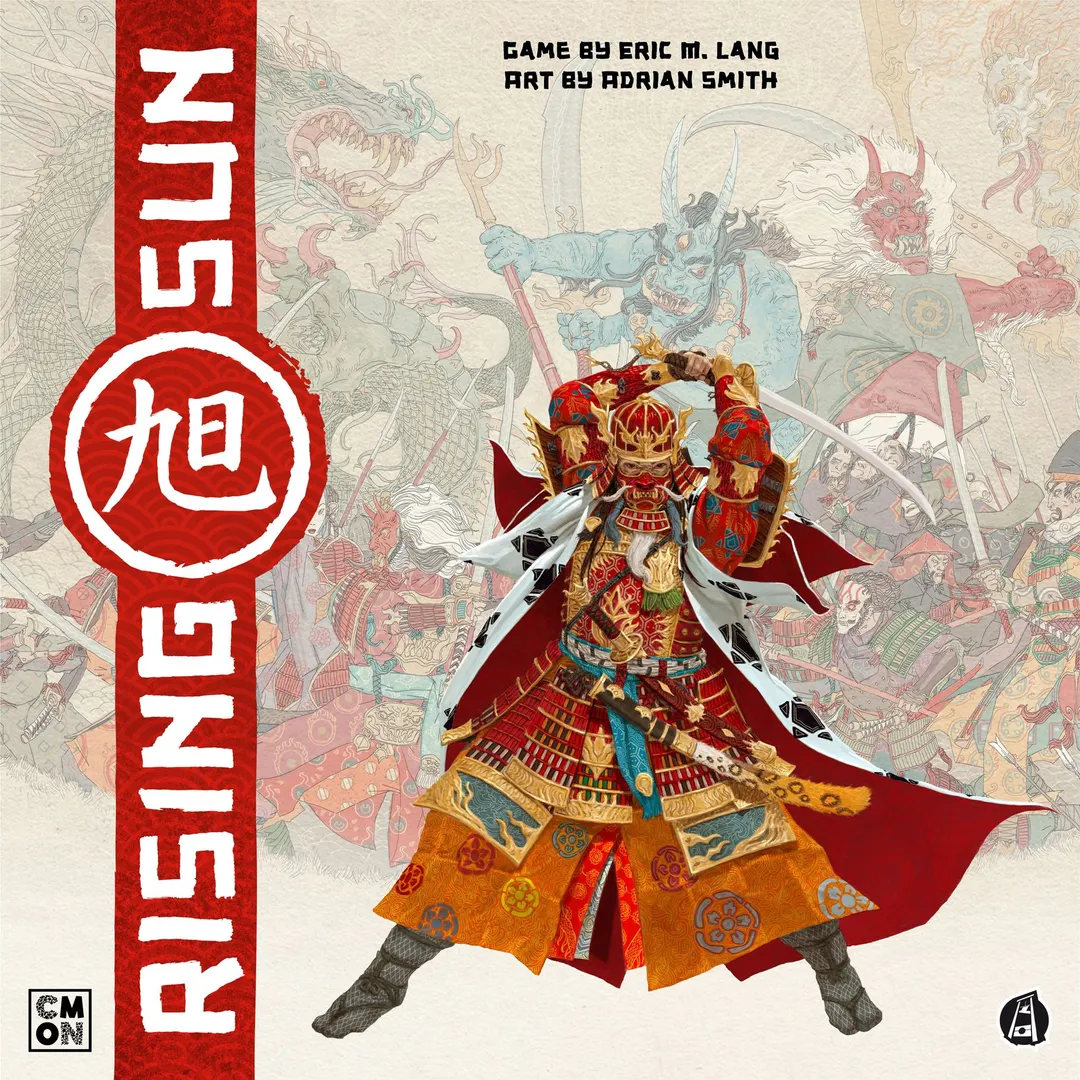
2018
Rules assistance for Rising Sun
Plain-language explanations of turns, card effects and disputed situations, with official source references and saved question history.
What would you like to know?
Answers come from the official rulebook, with the page to check.
Finish Winter with the most Victory Points; Honor breaks ties, while tied Allies share victory.
About 10 min · 9 steps
Step 1 of 9
Higher Honor breaks ties in Force comparisons and Coin bids. Honor also breaks ties for Victory Points at game end.
Normally, each moved figure travels at most once per Mandate to an adjacent Province by shared border or Shipping Route.
No. It stays off the Map and cannot move to the Map or another Shrine; after War, return it to its owner’s Reserve.
If only the two Allies have figures in a War Province, there is no Battle. In a Battle involving others, the winner does not kill their Ally’s figures.
Losing players discard their bid Coins. The winner distributes all their bid Coins among the losers, choosing who receives any remainder.
It returns to its owner during the next Season’s setup, and the captor gains one Coin for each returned figure.
Rising Sun is a board game released in 2018 for 3–5 players, 90–120 minutes per game, and ages 14 and up. It was designed by Eric M. Lang and its main mechanics are Variable Player Powers, Take That, and Set Collection. MeepleRules offers a rules assistant for Rising Sun that explains turns, card effects and disputed situations in plain language.
3–6 players90–120 min2018
3–6 players90–120 min2018
3–5 players90–120 min2018

3–5 players90–120 min2018

3–5 players2026
3–6 players120–240 min2011

2–6 players120–180 min2019

2–5 players30–45 min2014
5–9 players180–780 min2019
1–4 players45–60 min2025
2–5 players90 min2021
1–12 players15–45 min2022
2–6 players30–90 min2024
2–4 players60–90 min2015
2–4 players30–90 min2022
3–5 players45–60 min2019

2–4 players60–90 min2018
The great and forgotten Kami have returned from the underworld, displeased with the affairs of the Empire’s present Shōgun. At the start of spring in the Great New Year, the Kami have gathered their sacred clans with one quest: reclaim the lands of Nippon and return them to their honorable, spiritual traditions. However, each clan is bound by their own proud traditions to a unique vision for this great return and must wage a powerful diplomatic war across eight provinces. Alliances must be forged, betrayal is inevitable, honorable standing rises and falls. Political mandates must be navigated and devastating war must be fought, each won by expert skill and cunning negotiation. And only one may stand victorious at the coming of winter. You, honorable Shōgun, lead one of these great clans. Do you have the strength of honor, virtue, and spirit, as well as the mastery of steel necessary to deliver on this ancient promise? Rising Sun is a board game for 3 to 5 players set in legendary feudal Japan. Each player chooses a Clan and competes to lead theirs to victory by accumulating Victory Points over the course of the Seasons. Each Clan possesses a unique ability and differs in Seasonal Income, Starting Honor Rank, and Home Province. Over the course of the game, players will forge and break alliances, choose political actions, worship the gods, customize their clans, and position their figures around Japan. In the process, Honor is a palpable element in Rising Sun: Having high Honor gives several advantages, while having low Honor may grant the allegiance of the darker elements of the world. But above all, Honor settles all disputes: Whenever there is a tie, the tied player with the highest Honor wins. In Rising Sun, players are encouraged to use diplomacy, negotiation, and even bribery to further their cause. Players can make deals at any point in the game but no deals are truly binding. Victory Points can be gained in several ways, from winning battles, to harvesting the right provinces, to playing to the Virtues accumulated by your Clan. The game is played over the course of 4 rounds or Seasons: Spring, Summer, and then Autumn; when Winter comes, the game draws to a close and players calculate bonuses to decide who is the winner. Each Season is divided into five phases: 1) Seasonal Setup because every Season has a certain Season deck with different cards, 2) Tea Ceremony in which players sit down and negotiate their Alliances for the Season, 3) Political Phase during which players will select Political Mandates to prepare their Clans and position their forces, 4) War Phase, during which players battle over several Provinces, and 5) Seasonal Cleanup. As already mentioned, the start of the Winter Season signifies the end of the game. Peace falls over the land as it gets covered in white snow, and a new Emperor will rise under the power of the great Kami.
Use the rules assistant for Rising Sun to describe a turn, card effect or disputed situation. Get a plain-language explanation with official source references, then return to the question in your saved history. Select your edition when available so the sources match your game.
Ask about the rulesRising Sun supports 3–5 players according to the catalogue. This range comes from the publisher’s listed player count, so the game can be set up for any group size within it. Some setups, rules and scoring details may still vary by player count, so check your edition’s rulebook for the exact configuration.
The listed playing time for Rising Sun is 90–120 minutes. This is the publisher’s estimate for a full game. The actual duration depends on the group, the player count and familiarity with the rules: first sessions usually run longer, while experienced groups often finish faster. Setup and teaching time are not included in this estimate.
The catalogue lists Rising Sun for ages 14 and up. This is the publisher’s recommendation and reflects reading demands, rule complexity and small components rather than theme alone. Younger players can often join with help from an adult, so check the age guidance on your edition and consider your group’s experience with board games.
Rising Sun has a complexity rating of 3.3 out of 5 from BoardGameGeek players, which makes it a medium-weight game. The rating reflects how much rules knowledge, planning and decision-making a typical game demands. Expect a longer first teach for heavier games, and use a preparation guide before game night.
Rising Sun belongs to these categories: Fantasy, Wargame, and Bluffing. Its main mechanics are Variable Player Powers, Take That, and Set Collection. Categories describe the theme and setting of a game, while mechanics describe what players actually do on their turns. Each mechanic links to a catalogue hub with similar games, which helps when you want something comparable.
The credited designers of Rising Sun are: Eric M. Lang. These credits come from the published game data and name the people responsible for the game’s design, not its illustrators or publishers. Designer pages on MeepleRules collect other titles by the same designers, which helps when you enjoy a game and want to find similar ones.
The catalogue lists Rising Sun as a base game. It can be played on its own with the components in the box and does not require any other title. Expansions, if any exist, add new content or rules on top of it and are listed separately in the catalogue with a link back to this base game.


