
- BGG rank
- BGG #11,731
- BGG rating
- 6.9
Operation Michael
- 2 players
- 180 min
- Complexity 2.7/5
- 2002
2008
Rules assistance for Rock of the Marne
Plain-language explanations of turns, card effects and disputed situations, with official source references and saved question history.
For 1 player
What would you like to know?
Answers come from the official rulebook, with the page to check.
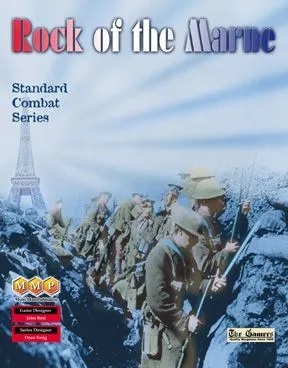
Rock of the Marne is a board game released in 2008 for 1–2 players and 180 minutes per game. It was designed by Dean Essig and John Best and its main mechanics are Dice Rolling, Hexagon Grid, and Simulation.







(from MMP website:) Rock of the Marne: The Second Battle of the Marne, 15 July to 25 July, 1918 covers both the final attack of the German army in July 1918, and the Allied counteroffensive that produced the battle known to Americans as the Second Battle of the Marne. The Germans believed they could launch an offensive on both sides of Reims, which would pinch out an Allied salient and draw in Allied reserves, and thus possibly produce a breakout across the Marne leading to the final drive to Paris. Despite gaining their bridgehead across the Marne, the Germans did not expect the fierce resistance offered by the Allies including the American 3rd infantry division-which earned its honorific name “Rock of the Marne” for its steadfast defense. An even bigger surprise awaited the Germans, however, when the Allies attacked them with crushing power from a wholly unforeseen direction three days later. Refusing at first to relinquish the initiative, the Germans showed why they were masters of defensive warfare in World War 1 as they exacted a fearsome toll in casualties from the attackers including the American 1st and 2nd infantry divisions. Rock of the Marne shares many of its design features with MMP’s earlier game on the 1918 battles - Operation Michael. The Germans’ striking power consists of the battle-depleted, but still dangerous, stosstruppen. Trained specifically in infiltration tactics, these hard-core infantry units can find a way to pick apart the toughest Allied defensive position. The Germans also have mobile, and deadly, machine-gun units that will wreak havoc on unwary attacking Allied units. The Allies used tanks in record numbers in their initial assault, and these are shown in the game, as well as the six big American divisions that participated including the famous 1st Infantry Div, The Big Red One, the 42nd Infantry Div, the Rainbow Division, as well at the 3rd. The air game has been significantly expanded in Rock of Marne as both sides deploy their air assets to bomb bridges, and strafe infantry. Finally, both the Allied and the German player must learn to operate within their constraints and opportunities of the WWI command and control environment, which means you may not automatically get to attack with all the units you had planned! Contents: One 22"x34" map 280 counters (1 countersheet) Series Rules Rock of the Marne Specific Rules Two Dice Part of the Standard Combat Series.
Rock of the Marne supports 1–2 players according to the catalogue. This range comes from the publisher’s listed player count, so the game can be set up for any group size within it. Some setups, rules and scoring details may still vary by player count, so check your edition’s rulebook for the exact configuration.
The listed playing time for Rock of the Marne is 180 minutes. This is the publisher’s estimate for a full game. The actual duration depends on the group, the player count and familiarity with the rules: first sessions usually run longer, while experienced groups often finish faster. Setup and teaching time are not included in this estimate.
Rock of the Marne has a complexity rating of 2.5 out of 5 from BoardGameGeek players, which makes it a medium-light game. The rating reflects how much rules knowledge, planning and decision-making a typical game demands. Expect a longer first teach for heavier games, and use a preparation guide before game night.
Rock of the Marne belongs to these categories: Wargame and World War I. Its main mechanics are Dice Rolling, Hexagon Grid, and Simulation. Categories describe the theme and setting of a game, while mechanics describe what players actually do on their turns. Each mechanic links to a catalogue hub with similar games, which helps when you want something comparable.
The credited designers of Rock of the Marne are: Dean Essig and John Best. These credits come from the published game data and name the people responsible for the game’s design, not its illustrators or publishers. Designer pages on MeepleRules collect other titles by the same designers, which helps when you enjoy a game and want to find similar ones.
The catalogue lists Rock of the Marne as a base game. It can be played on its own with the components in the box and does not require any other title. Expansions, if any exist, add new content or rules on top of it and are listed separately in the catalogue with a link back to this base game.