
- BGG rating
- 7.0
Santiago de Cuba: El taxi
- 2–4 players
- 60 min
- Complexity 1.5/5
- 2013
2011
Rules assistance for Santiago de Cuba
Plain-language explanations of turns, card effects and disputed situations, with official source references and saved question history.
For 2 players
What would you like to know?
Answers come from the official rulebook, with the page to check.
Santiago de Cuba is a board game released in 2011 for 2–4 players, 40–75 minutes per game, and ages 10 and up. It was designed by Michael Rieneck and its main mechanics are Track Movement, Dice Rolling, and Memory.
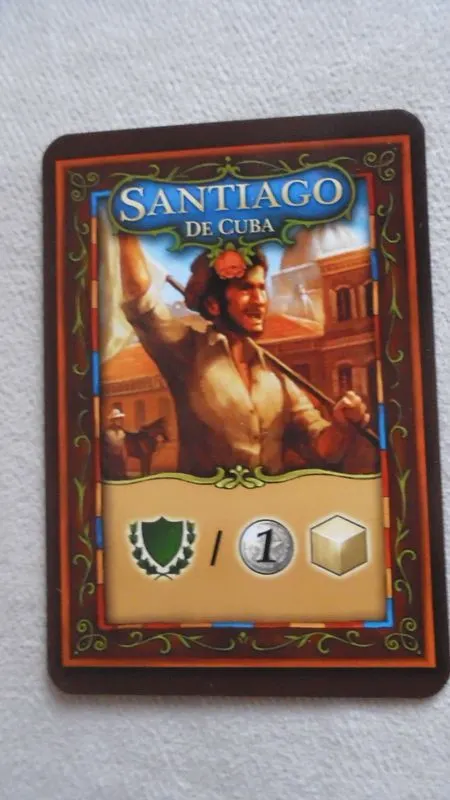
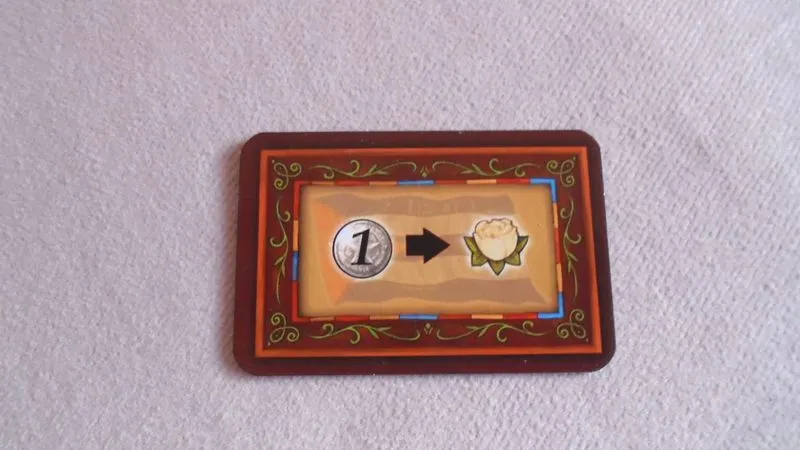







Welcome to Santiago, the second largest city in Cuba, home of legendary rum and birthplace of the revolution! The chaotic streets hum with the sounds of bustling crowds and busy commerce. Cargo ships constantly arrive and depart from the port. Demand is continuous, if unpredictable, for a supply of local products such as exotic fruits, sugar, rum, tobacco, and cigars. In Santiago de Cuba, your business card says "broker", but in reality you're a shady wheeler-dealer who arranges deals with the locals and with corruptible officials to move goods and meet the demand of those ever-present cargo ships – and your ability to procure these goods is only as reliable as your "connections". At the start of the game, nine locals – the Cubans – are randomly arranged on a path around Santiago, with the port being the tenth location on the circuit. Each Cuban has a different ability: e.g., give a player two tobacco, give a player a good of his choice, force opponents to give you something, give money or victory points (VPs), and seize a building or allow a player to use a previously seized building. What are these buildings? At the start of the game, twelve buildings are randomly placed on the game board in four color-coded groups (white, yellow, etc.) of three. As with the Cubans, these buildings give players a special ability when used: convert tobacco to cigars, change VPs to money or vica versa, increase the value of goods delivered to the ship, render a Cuban inactive for the next round, and so on. Players will deliver goods to seven ships throughout the course of the game. The demand for each ship is determined via a die roll; the active player rolls five dice – one for each type of good – then chooses four of the values rolled to represent demand for goods of the same color as the die. All players share a car and travel around the island together. On a turn, the active player can move the car to the next location on the path (whether Cuban or port) for free, or pay one peso for each spot moved beyond that. After taking a Cuban action, the player then must move his player piece to a building of the same color as the flower on that Cuban. If he takes an action in a building owned by someone else, that player earns 1 VP. (One Cuban allows a player to use the same building where his piece is currently located.) If a player moves to port, players take turns delivering all goods of one type to the ship to meet demand, adjusting the demand dice as needed. A player earns 2-4 VP for each good delivered; a player doesn't have to deliver goods. If the ship's demand isn't met after everyone delivers or passes, the VP bounty per good is increased by one and the ship remains in place – unless the value was already at 4 VP, in which case the ship sails. In this case, or when all the demand is met, a new ship comes into port with new demand values. After seven ships have sailed, the players earn 1 VP for every three goods still on hand, then tally their VPs. The player with the most VPs wins, with ties broken by goods remaining, then money. Each game poses new tactical challenges for the players, thanks to ever-changing combinations of buildings, Cuban inhabitants and demand for goods.
Santiago de Cuba supports 2–4 players according to the catalogue. This range comes from the publisher’s listed player count, so the game can be set up for any group size within it. Some setups, rules and scoring details may still vary by player count, so check your edition’s rulebook for the exact configuration.
The listed playing time for Santiago de Cuba is 40–75 minutes. This is the publisher’s estimate for a full game. The actual duration depends on the group, the player count and familiarity with the rules: first sessions usually run longer, while experienced groups often finish faster. Setup and teaching time are not included in this estimate.
The catalogue lists Santiago de Cuba for ages 10 and up. This is the publisher’s recommendation and reflects reading demands, rule complexity and small components rather than theme alone. Younger players can often join with help from an adult, so check the age guidance on your edition and consider your group’s experience with board games.
Santiago de Cuba has a complexity rating of 2.2 out of 5 from BoardGameGeek players, which makes it a medium-light game. The rating reflects how much rules knowledge, planning and decision-making a typical game demands. Expect a longer first teach for heavier games, and use a preparation guide before game night.
Santiago de Cuba belongs to these categories: Economic. Its main mechanics are Track Movement, Dice Rolling, and Memory. Categories describe the theme and setting of a game, while mechanics describe what players actually do on their turns. Each mechanic links to a catalogue hub with similar games, which helps when you want something comparable.
The credited designers of Santiago de Cuba are: Michael Rieneck. These credits come from the published game data and name the people responsible for the game’s design, not its illustrators or publishers. Designer pages on MeepleRules collect other titles by the same designers, which helps when you enjoy a game and want to find similar ones.
The catalogue lists Santiago de Cuba as a base game. It can be played on its own with the components in the box and does not require any other title. Expansions, if any exist, add new content or rules on top of it and are listed separately in the catalogue with a link back to this base game.