
- BGG rank
- BGG #33
- BGG rating
- 8.1
Arkham Horror: The Card Game
- 1–2 players
- 60–120 min
- Complexity 3.6/5
- 2016
2011
Rules assistance for Scoundrel
Plain-language explanations of turns, card effects and disputed situations, with official source references and saved question history.
For 1 player
What would you like to know?
Answers come from the official rulebook, with the page to check.
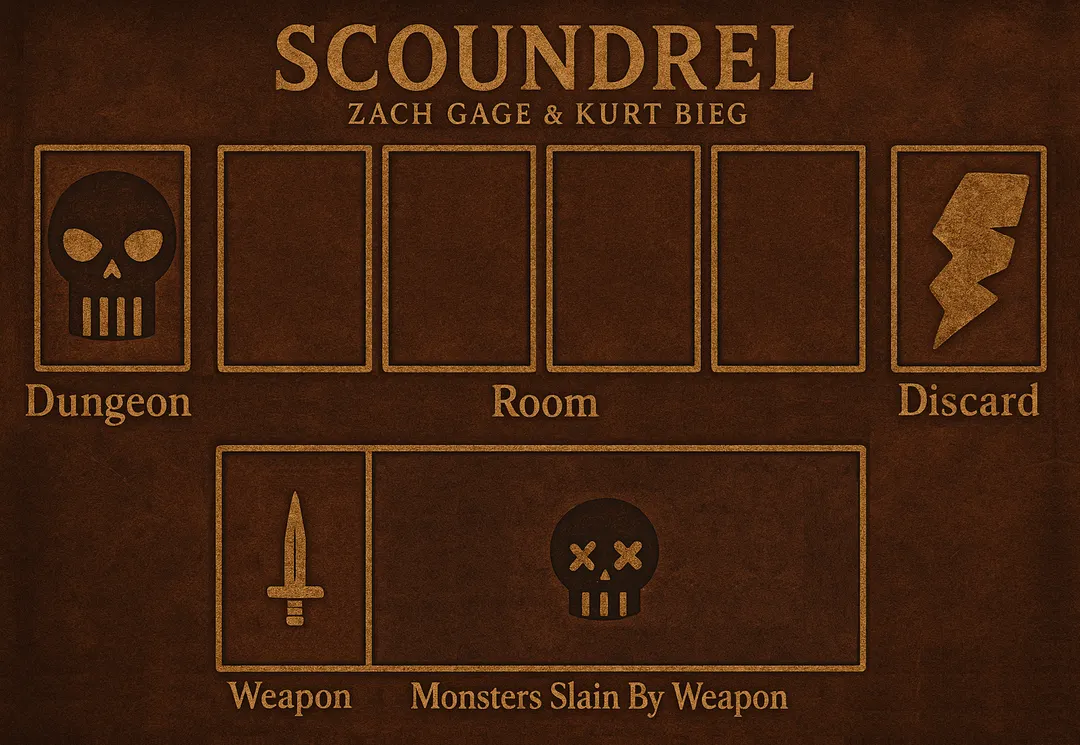
Scoundrel is a board game released in 2011 for 1 player. It was designed by Kurt Bieg and Zach Gage and its main mechanics are Role Playing and Solo / Solitaire Game.


Scoundrel is a single player rogue-like card game for use with a standard deck of playing cards. It was developed by Zach Gage and Kurt Bieg. All Jokers, red face cards, and red aces are removed from the deck. The remaining cards serve as monsters (spades and clubs), weapons (diamonds), and health potions (hearts) valued from 2–14 (with face cards being valued 11–14). The rooms of the dungeon are created by laying out cards in groups of four. Progress is made through the dungeon by resolving three of the four dungeon cards in each room. The fourth card serves as the foundation for a new room. Rooms can be deferred if needed, but never twice in a row — and the player will eventually need to come back to deferred rooms. Weapons may be equipped to attack multiple monsters, as long as each defeated monster is of lower value than the last monster defeated with that same weapon. To attack a monster of higher value, a new weapon must be equipped. Monsters can also always be attacked barehanded, but this depletes the player's health for the full value of the monster. Health potions may be used to recover life points up to the maximum starting value of 20. Playing a second potion in succession nullifies the effect of the second potion. The game ends in a loss when life points reach zero or in a victory if the player manages to clear all rooms of the dungeon.
Scoundrel supports 1 player according to the catalogue. This is the publisher’s listed player count, so the game is designed for exactly that number of participants. Variants for other group sizes, if any, are described in the rulebook of your edition, so check it before setting up a different configuration.
Scoundrel has a complexity rating of 1.1 out of 5 from BoardGameGeek players, which makes it a light game. The rating reflects how much rules knowledge, planning and decision-making a typical game demands. Expect a longer first teach for heavier games, and use a preparation guide before game night.
Scoundrel belongs to these categories: Card Game. Its main mechanics are Role Playing and Solo / Solitaire Game. Categories describe the theme and setting of a game, while mechanics describe what players actually do on their turns. Each mechanic links to a catalogue hub with similar games, which helps when you want something comparable.
The credited designers of Scoundrel are: Kurt Bieg and Zach Gage. These credits come from the published game data and name the people responsible for the game’s design, not its illustrators or publishers. Designer pages on MeepleRules collect other titles by the same designers, which helps when you enjoy a game and want to find similar ones.
The catalogue lists Scoundrel as a base game. It can be played on its own with the components in the box and does not require any other title. Expansions, if any exist, add new content or rules on top of it and are listed separately in the catalogue with a link back to this base game.