
- BGG rank
- BGG #2,846
- BGG rating
- 7.3
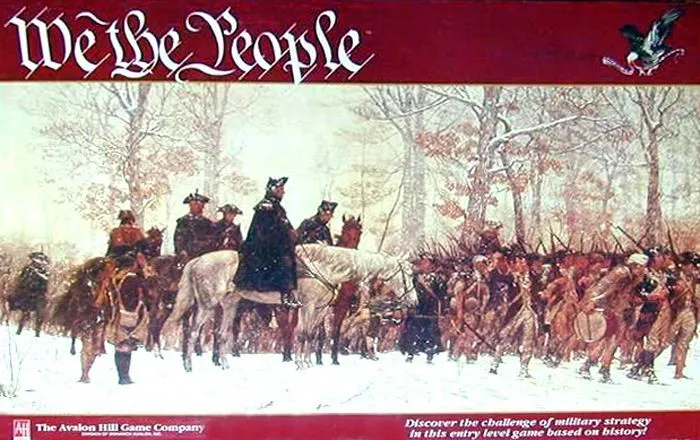
We the People
- 2 players
- 120 min
- Complexity 2.7/5
- 1993
1975
Rules assistance for Skirmish
Plain-language explanations of turns, card effects and disputed situations, with official source references and saved question history.
For 2 players
What would you like to know?
Answers come from the official rulebook, with the page to check.
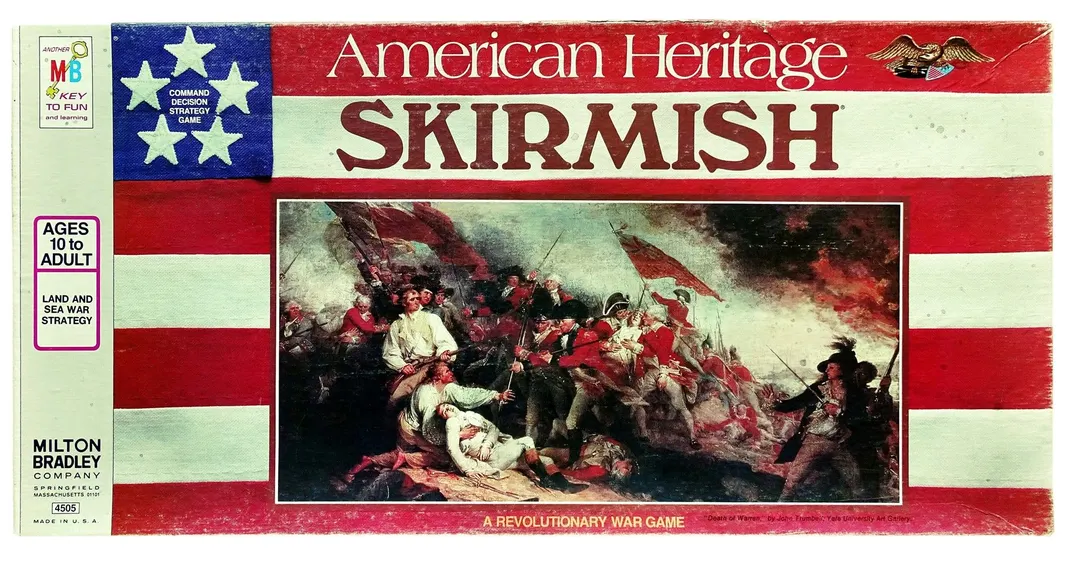
Skirmish is a board game released in 1975 for 2 players, 60 minutes per game, and ages 10 and up. Its main mechanics are Roll / Spin and Move, Dice Rolling, and Point to Point Movement.
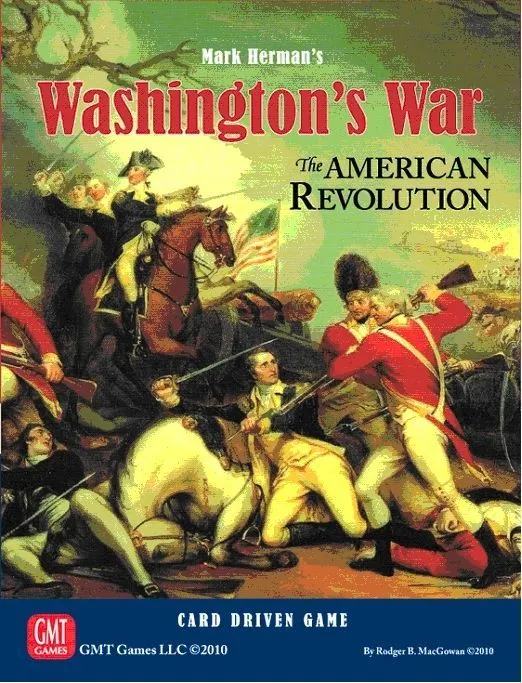
One of the American Heritage Command Decision Strategy Games, highly prized by collectors. This one is the American War of Independence game. The British have four armies of 5 units each, 3 warships and a troop carrier with 2 reinforcements on board. The Americans have 16 units spread all over the board (including a special "Continental Army" unit), 1 warship and a troop carrier with 4 reinforcements on board. The Americans use two dice for movement (unless down to just one unit), the British one. All three dice are 0-1-1-1-2-3. Both players roll their dice using shakers and peek at them. The British player designates the unit he'll move, then the American reveals his throw and moves. Finally, the Bristish reveals his throw and moves. A single unit is moved by each die --the grid is square and no diagonals are allowed. Units that end up on the same spot stack to form an army (which cannot be split), but each army is limited to 6 units. Naval moves are harbour to harbour except for the troop carriers (and any warship attempting to intercept them). A Skirmish occurs when opposing units are adjacent. A card is drawn to resolve the Skirmish. This can result in a unit loss for either side (sometimes two), a major battle being triggered, or one or both armies moving a space or two. Major battles normally occur when an army lands on an enemy army by exact count; numerical superiority is added to the stronger side's throw, and the adjusted throw difference indicates how many units the losing side lost (however, that loss is limited to the number of units in the winning army). Once the British have lost an army, they can call for Reinforcements. The Americans can do this once they've won a Major Battle. Reinforcement play is resolved separately from normal play. Two dice are used by both sides, one player trying to bring in his troop carrier whilst the other attempts to intercept with a warship (if the opponent has no warships left, the reinforcements automatically succeed). If the troop carrier makes it to a harbor, the reinforcements land (triggering a major battle if the harbor is enemy-held) and the troop carrier remains as a normal warship henceforth. The British win by eliminating the Continental Army, whilst the American wins by eliminating all four British armies. To keep the game from dragging on, if there is no skirmish nor major battle in 10 moves, the weaker side surrenders. The asymmetrical mechanics work surprisingly well; the British lacks mobility and try to force Major Battles on the Americans, whilst the latter skirmish as much as possible until they can muster a large enough army together to win a major battle and call in their reinforcements.
Skirmish supports 2 players according to the catalogue. This is the publisher’s listed player count, so the game is designed for exactly that number of participants. Variants for other group sizes, if any, are described in the rulebook of your edition, so check it before setting up a different configuration.
The listed playing time for Skirmish is 60 minutes. This is the publisher’s estimate for a full game. The actual duration depends on the group, the player count and familiarity with the rules: first sessions usually run longer, while experienced groups often finish faster. Setup and teaching time are not included in this estimate.
The catalogue lists Skirmish for ages 10 and up. This is the publisher’s recommendation and reflects reading demands, rule complexity and small components rather than theme alone. Younger players can often join with help from an adult, so check the age guidance on your edition and consider your group’s experience with board games.
Skirmish has a complexity rating of 1.8 out of 5 from BoardGameGeek players, which makes it a light game. The rating reflects how much rules knowledge, planning and decision-making a typical game demands. Expect a longer first teach for heavier games, and use a preparation guide before game night.
Skirmish belongs to these categories: Wargame, Age of Reason, and American Revolutionary War. Its main mechanics are Roll / Spin and Move, Dice Rolling, and Point to Point Movement. Categories describe the theme and setting of a game, while mechanics describe what players actually do on their turns. Each mechanic links to a catalogue hub with similar games, which helps when you want something comparable.
The catalogue lists Skirmish as a base game. It can be played on its own with the components in the box and does not require any other title. Expansions, if any exist, add new content or rules on top of it and are listed separately in the catalogue with a link back to this base game.