

- BGG rank
- BGG #2,056
- BGG rating
- 8.1
Aristeia!
- 2 players
- 60–90 min
- Complexity 3.0/5
- 2017
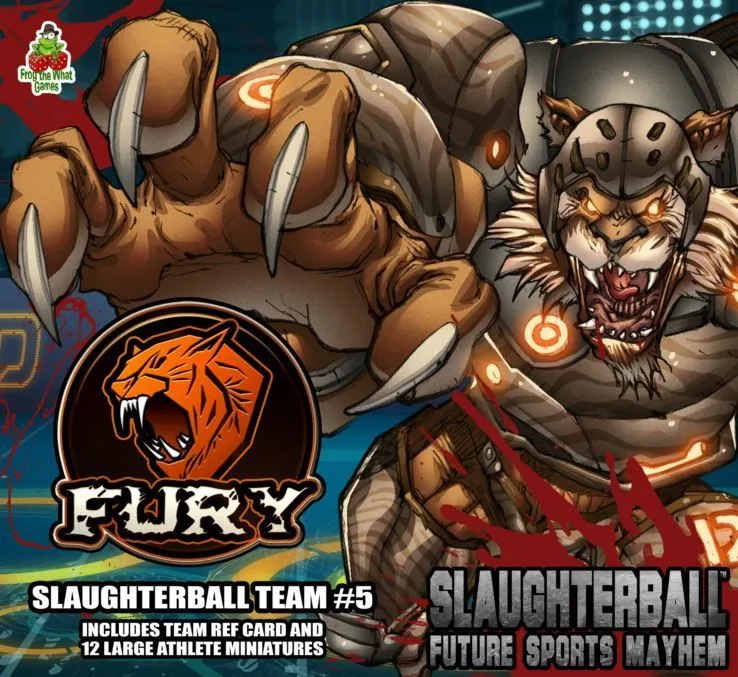
Rules assistance for Slaughterball: Team Fury
Plain-language explanations of turns, card effects and disputed situations, with official source references and saved question history.
What would you like to know?
Answers come from the official rulebook, with the page to check.
Slaughterball: Team Fury is an expansion for Slaughterball released in 2015 for 2–4 players, 60 minutes per game, and ages 14 and up. It was designed by Erik Kjerland and its main mechanics are Variable Player Powers, Dice Rolling, and Grid Movement.





Thirteen official plexes grace the continental jewel that is India. The largest is the Bengali Mahaplex with over 274 million citizens living within its walls. And every last one of them is a fan of Fury! Developed decades ago as the very first exotic Slaughterball team, Fury is a perennial favorite not just in India, but in all 72 metroplexes. Their distinctive feline beauty and grace, coupled with the savagery of their gameplay, has earned them a place in seven of the last ten Slaughterbrawls. Fury’s greatest strength, their savage claws that can rip other neohumans to shreds, are also their greatest weakness. These felinoids are very inept at handling the ball, and their razors are the worst shooters in the league. Fortunately, Fury razors are also the fastest, so they can usually get pretty close to the goals to take easy shots. So, you’re not going to win on goals. You better pounce on your opponents and do some damage. Thanks to the Savagery skill, you’ll be racking up the slaughter points. Don’t save those reactive cards (Penalty, Lost Momentum, etc.). You need to be sacrificing your cards to send opponents to the Slaughter Box early. Soon enough your opponents will team up against you to eliminate your butchers and slashers. So, attack with them early and often.
Slaughterball: Team Fury supports 2–4 players according to the catalogue. This range comes from the publisher’s listed player count, so the game can be set up for any group size within it. Some setups, rules and scoring details may still vary by player count, so check your edition’s rulebook for the exact configuration.
The listed playing time for Slaughterball: Team Fury is 60 minutes. This is the publisher’s estimate for a full game. The actual duration depends on the group, the player count and familiarity with the rules: first sessions usually run longer, while experienced groups often finish faster. Setup and teaching time are not included in this estimate.
The catalogue lists Slaughterball: Team Fury for ages 14 and up. This is the publisher’s recommendation and reflects reading demands, rule complexity and small components rather than theme alone. Younger players can often join with help from an adult, so check the age guidance on your edition and consider your group’s experience with board games.
Slaughterball: Team Fury belongs to these categories: Miniatures, Science Fiction, and Expansion for Base-game. Its main mechanics are Variable Player Powers, Dice Rolling, and Grid Movement. Categories describe the theme and setting of a game, while mechanics describe what players actually do on their turns. Each mechanic links to a catalogue hub with similar games, which helps when you want something comparable.
The credited designers of Slaughterball: Team Fury are: Erik Kjerland. These credits come from the published game data and name the people responsible for the game’s design, not its illustrators or publishers. Designer pages on MeepleRules collect other titles by the same designers, which helps when you enjoy a game and want to find similar ones.
The catalogue lists Slaughterball: Team Fury as an expansion for Slaughterball. Expansions add new content, rules or scenarios to the base game and usually cannot be played on their own, so you need Slaughterball to use it. Check that your edition of Slaughterball is compatible, as some expansions were revised between editions.