

- BGG rank
- BGG #2,056
- BGG rating
- 8.1
Aristeia!
- 2 players
- 60–90 min
- Complexity 3.0/5
- 2017
Rules assistance for Slaughterball: Team Gruesomes
Plain-language explanations of turns, card effects and disputed situations, with official source references and saved question history.
What would you like to know?
Answers come from the official rulebook, with the page to check.
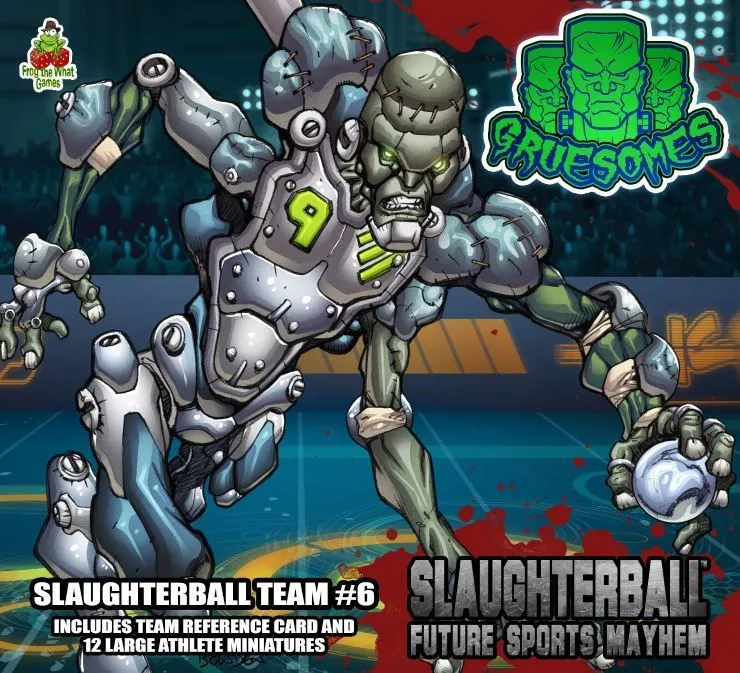
Slaughterball: Team Gruesomes is an expansion for Slaughterball released in 2015 for 2–4 players, 60 minutes per game, and ages 14 and up. It was designed by Erik Kjerland and its main mechanics are Variable Player Powers, Dice Rolling, and Grid Movement.





Perhaps the toughest team in the league, the Gruesomes have yet to prove themselves as contenders to the Slaughterbrawl crown. Like their other teams inspired by classic literature, Chemozoic Incorporated contracted Honeydew Labs to create this team genetic template. And while the athletes certainly look the part, their traits and skills have made it difficult to rack up the victories necessary to snag the championship. The Gruesomes as a team rely on their resilience and sheer strength to dominate opponents and survive attacks. Unfortunately, they lack the hand-eye coordination and speed to have full access to all possible Slaughterball strategies. Indeed, their shooting game is perennially inadequate. Even so, previous coaches have managed to build them into a respectable foe over the course of a season by training them with new skills and concentrating on the strategies explained below. Coaching the Gruesomes is a challenging task, but your victories will be that much sweeter knowing it was your coaching ability, not the athleticism of your athletes, that won the day. They are slower and less accurate than other teams, and as such you cannot rely on a shooting game to win. Instead, you should doggedly attack your opponents, even taking risky chops to knock them down. You should be chopping every turn. And get everyone moved toward the center of the pit as soon as possible. Field coverage is imperative for the Gruesomes, so they are always in range to attack someone. Your athletes’ resilience will help them stay out of the Slaughter Box, and the great Brawling values will usually result in chop success. Once you have your opponent on the ground, send your slashers and butchers over to foul them on the ground and then cancel any Penalty cards with the Scare Ref skill. Interrupt cards are very important to your fouling strategy, so be sure to cycle through your hand quickly. If you don’t have any Interrupt cards, discard your whole hand to find some. Being able to attack prone opponents and get four extra dice is paramount. Especially when you can avoid Penalties.
Slaughterball: Team Gruesomes supports 2–4 players according to the catalogue. This range comes from the publisher’s listed player count, so the game can be set up for any group size within it. Some setups, rules and scoring details may still vary by player count, so check your edition’s rulebook for the exact configuration.
The listed playing time for Slaughterball: Team Gruesomes is 60 minutes. This is the publisher’s estimate for a full game. The actual duration depends on the group, the player count and familiarity with the rules: first sessions usually run longer, while experienced groups often finish faster. Setup and teaching time are not included in this estimate.
The catalogue lists Slaughterball: Team Gruesomes for ages 14 and up. This is the publisher’s recommendation and reflects reading demands, rule complexity and small components rather than theme alone. Younger players can often join with help from an adult, so check the age guidance on your edition and consider your group’s experience with board games.
Slaughterball: Team Gruesomes belongs to these categories: Miniatures, Science Fiction, and Expansion for Base-game. Its main mechanics are Variable Player Powers, Dice Rolling, and Grid Movement. Categories describe the theme and setting of a game, while mechanics describe what players actually do on their turns. Each mechanic links to a catalogue hub with similar games, which helps when you want something comparable.
The credited designers of Slaughterball: Team Gruesomes are: Erik Kjerland. These credits come from the published game data and name the people responsible for the game’s design, not its illustrators or publishers. Designer pages on MeepleRules collect other titles by the same designers, which helps when you enjoy a game and want to find similar ones.
The catalogue lists Slaughterball: Team Gruesomes as an expansion for Slaughterball. Expansions add new content, rules or scenarios to the base game and usually cannot be played on their own, so you need Slaughterball to use it. Check that your edition of Slaughterball is compatible, as some expansions were revised between editions.