

- BGG rank
- BGG #638
- BGG rating
- 7.7
Space Empires 4X
- 1–4 players
- 60–240 min
- Complexity 3.4/5
- 2011
2020
Rules assistance for Stellar Horizons
Plain-language explanations of turns, card effects and disputed situations, with official source references and saved question history.
For 1 player
What would you like to know?
Answers come from the official rulebook, with the page to check.
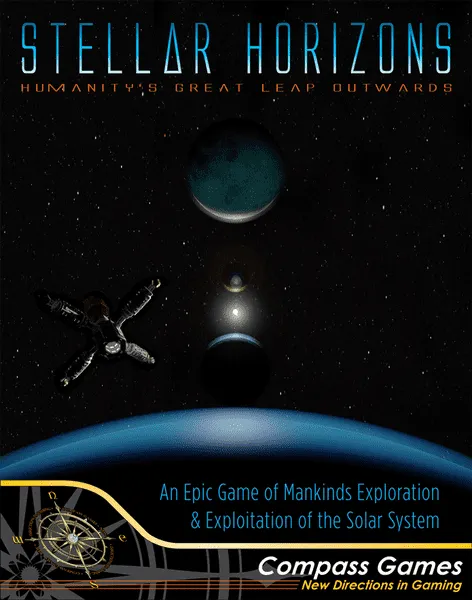
Stellar Horizons is a board game released in 2020 for 1–7 players, 120–240 minutes per game, and ages 14 and up. It was designed by Andrew Rader and its main mechanics are Income, Dice Rolling, and Simulation.



Stellar Horizons is a "build your own space program" game in which you lead one of seven Earth factions to explore and develop our solar system. Designed by a real-life space engineer with a PhD in long-duration spaceflight from MIT, Stellar Horizons is intended to be a plausible representation of the first steps of humanity towards the stars between 2030 and 2169, with each turn representing a year of time. You control your faction's space program, outposts, and fleets spanning across the solar system, although you also have some influence over your faction's politics back home on Earth as space development becomes more important. Movement is based on real physics. You move from orbit to orbit, or conduct long range transfers to move between planetary systems like Earth, Mars, or Jupiter. As you send out robotic explorers and crewed vehicles to explore the solar system, they bring back valuable data to further your scientific research. Technologies are intended to represent plausible extrapolations of existing development during the next 150 years: there are no transporters or warp drive, but you will be able to develop rockets powered by fusion and even anti-matter. In the engineering and biology domains, you'll eventually be able to construct space elevators and put your crews into safe hibernation for long journeys. You'll have access to a wide variety of robot explorers and crewed ships. These range from tiny probes intended to merely take photographs as you fly past Jupiter, to giant destroyers, cruisers, and battleships which ply the space lanes with peaceful or hostile intentions. New ship types become available as you gain access to better technology over the course of the game. You'll be given a budget to spend on Earth and can also build bases to harvest minerals, organics, and fuel to expands your economy. You can also forge diplomatic relationships with players and non-player factions alike, and trade resources at their bases to earn extra cash. Each of the seven factions has different strengths, weaknesses, abilities, and available ships based on their unique geopolitical situation. Military conflict is certainly possible but not always encouraged. Stellar Horizons features more diplomatic, technological, and economic competition than outright combat, although neglecting warships entirely leaves you vulnerable to pirates, trade embargoes, and sneak attacks by rogue players and factions. Stellar Horizons includes short co-operative and competitive scenarios lasting an hour or more, and campaigns lasting a day up to about a full weekend for experienced players. Up to seven players can play at a time and the game is most fun with at least two, but there are also one-player scenarios, and the campaigns are highly suited for solo play. There are three ways to win the campaign: be the first to develop an Interstellar Colonizer, terraform a world, or achieve dominance in space over your rivals.
Stellar Horizons supports 1–7 players according to the catalogue. This range comes from the publisher’s listed player count, so the game can be set up for any group size within it. Some setups, rules and scoring details may still vary by player count, so check your edition’s rulebook for the exact configuration.
The listed playing time for Stellar Horizons is 120–240 minutes. This is the publisher’s estimate for a full game. The actual duration depends on the group, the player count and familiarity with the rules: first sessions usually run longer, while experienced groups often finish faster. Setup and teaching time are not included in this estimate.
The catalogue lists Stellar Horizons for ages 14 and up. This is the publisher’s recommendation and reflects reading demands, rule complexity and small components rather than theme alone. Younger players can often join with help from an adult, so check the age guidance on your edition and consider your group’s experience with board games.
Stellar Horizons has a complexity rating of 3.9 out of 5 from BoardGameGeek players, which makes it a heavy game. The rating reflects how much rules knowledge, planning and decision-making a typical game demands. Expect a longer first teach for heavier games, and use a preparation guide before game night.
Stellar Horizons belongs to these categories: Economic, Wargame, and Exploration. Its main mechanics are Income, Dice Rolling, and Simulation. Categories describe the theme and setting of a game, while mechanics describe what players actually do on their turns. Each mechanic links to a catalogue hub with similar games, which helps when you want something comparable.
The credited designers of Stellar Horizons are: Andrew Rader. These credits come from the published game data and name the people responsible for the game’s design, not its illustrators or publishers. Designer pages on MeepleRules collect other titles by the same designers, which helps when you enjoy a game and want to find similar ones.
The catalogue lists Stellar Horizons as a base game. It can be played on its own with the components in the box and does not require any other title. Expansions, if any exist, add new content or rules on top of it and are listed separately in the catalogue with a link back to this base game.