

- BGG rank
- BGG #6,269
- BGG rating
- 7.7
Arquebus: Men of Iron Volume IV – The Battles for Northern Italy 1495-1544
- 2 players
- 60–300 min
- Complexity 3.0/5
- 2017
2016
Rules assistance for Tenkatoitsu
Plain-language explanations of turns, card effects and disputed situations, with official source references and saved question history.
For 1 player
What would you like to know?
Answers come from the official rulebook, with the page to check.
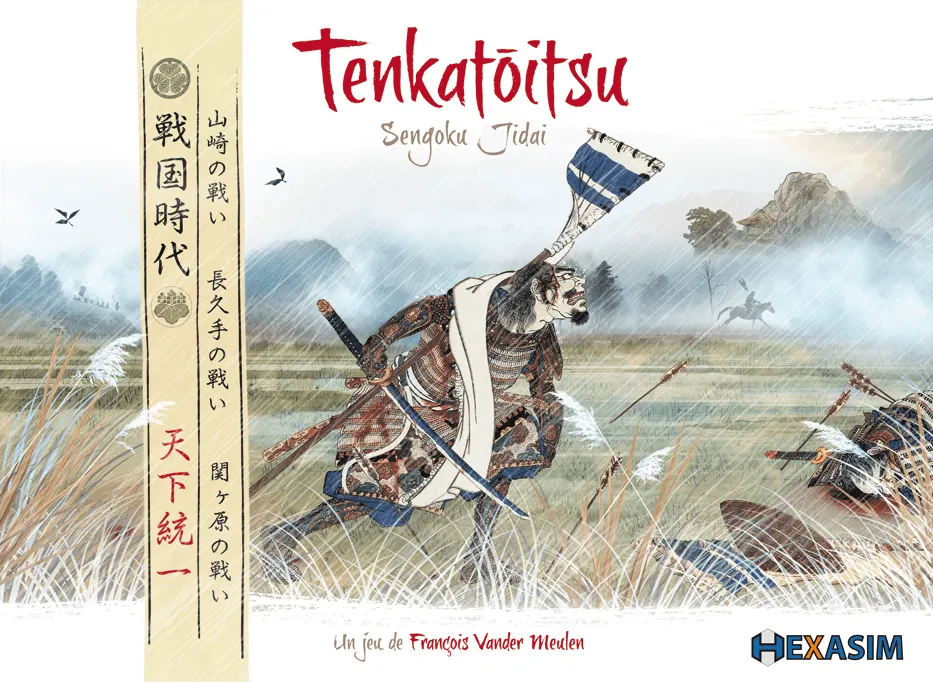
Tenkatoitsu is a board game released in 2016 for 1–2 players and 180–420 minutes per game. It was designed by François Vander Meulen and its main mechanics are Dice Rolling, Variable Set-up, and Grid Movement.










With Japan torn by war for decades, Oda Nobunaga, the first unifier, succumbs to the blows of his own vassal, Akechi Mitsuhide, in 1582. This event is an opportunity for Hashiba Hideyoshi, who defeats Akechi at the Battle of Yamazaki. Hashiba Hideyoshi must then confront Tokugawa Ieyasu, another vassal of Oda at the Battle of Nagakute. Hideyoshi then becomes the second unifier of Japan under the name of Toyotomi Hideyoshi. Bound to the status quo, Tokugawa Ieyasu awaits Hideyoshi's death before returning to the pursuit of his ambition. His accession to power is decided in the gigantic battle of Sekigahara. He will force the heir to Hideyoshi to commit suicide at the end of the siege of Osaka. This time, the unification of the country is final, and Tokugawa's heirs will lead Japan for 250 years. Tenkatoitsu is the sequel of Kawanakajima 1561. Tenkatoitsu means "Unity under the Sky". That was the name given to the era during which one Clan was victorious over the others, which in turn led to the end of the war (Sengoku Jidai). Tenkatoitsu simulates 3 battles of the end of Sengoku Jidai: Yamazaki (1582), Nagakute (1584) and Sekigahara (1600). The game emphasizes orders assigned to each army's Clans as much as the inertia of the battle. A game turn is divided in activation phases drawn from a recipient containing Clan chits and obligatory chits (for combat, movement, etc.). The game system is also remarkable for the battle plans that each players may choose before starting the engagement. Sieges played a key role in the battle of Yamazaki, and as such have their own specific set of rules. Players scores victory Points by destroying enemy units or controlling key locations.
Tenkatoitsu supports 1–2 players according to the catalogue. This range comes from the publisher’s listed player count, so the game can be set up for any group size within it. Some setups, rules and scoring details may still vary by player count, so check your edition’s rulebook for the exact configuration.
The listed playing time for Tenkatoitsu is 180–420 minutes. This is the publisher’s estimate for a full game. The actual duration depends on the group, the player count and familiarity with the rules: first sessions usually run longer, while experienced groups often finish faster. Setup and teaching time are not included in this estimate.
Tenkatoitsu has a complexity rating of 3.4 out of 5 from BoardGameGeek players, which makes it a medium-weight game. The rating reflects how much rules knowledge, planning and decision-making a typical game demands. Expect a longer first teach for heavier games, and use a preparation guide before game night.
Tenkatoitsu belongs to these categories: Wargame, Renaissance, and Pike and Shot. Its main mechanics are Dice Rolling, Variable Set-up, and Grid Movement. Categories describe the theme and setting of a game, while mechanics describe what players actually do on their turns. Each mechanic links to a catalogue hub with similar games, which helps when you want something comparable.
The credited designers of Tenkatoitsu are: François Vander Meulen. These credits come from the published game data and name the people responsible for the game’s design, not its illustrators or publishers. Designer pages on MeepleRules collect other titles by the same designers, which helps when you enjoy a game and want to find similar ones.
The catalogue lists Tenkatoitsu as a base game. It can be played on its own with the components in the box and does not require any other title. Expansions, if any exist, add new content or rules on top of it and are listed separately in the catalogue with a link back to this base game.