
- BGG rating
- 7.4
Mamluk
- 2 players
- 240 min
- Complexity 3.6/5
- 2006
2004
Rules assistance for The Devil's Horsemen: The Mongol War Machine
Plain-language explanations of turns, card effects and disputed situations, with official source references and saved question history.
For 2 players
What would you like to know?
Answers come from the official rulebook, with the page to check.
The Devil's Horsemen: The Mongol War Machine is a board game released in 2004 for 2 players, 240 minutes per game, and ages 12 and up. It was designed by Richard H. Berg and Mark Herman and its main mechanics are Hexagon Grid and Simulation.












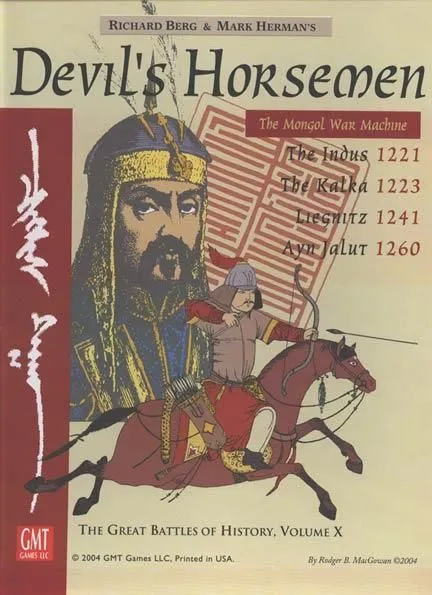
"The Mongol War Machine in the 13th Century" - Volume X in the Great Battles of History Series (GBoH). (from GMT Games website:) The Great Battles of History series is back with Devil's Horsemen, an examination of the military tactics of steppe tribe warfare, as immortalized by the mighty armies of Genghis Khan and the Mongols. The game focuses on cavalry and archery action, featuring mounted archers of exceptional skill. Devil's Horsemen depicts the four major battles of the era - The Indus, The Kalka, Liegnitz and Ayn Jalut. Devil's Horsemen features basic rules for both regular and SimpleGBoH play. The rules bring the system into full flower of mounted archery, with a detailed, augmented set of archery and cavalry mechanics that include various types of Shower Fire (as opposed to plain Volley Fire), Impetuosity and Aggression, Feigned Retreat, Harass and Disperse tactics, and Rally to Standards, with the various armies and units being rated for their ability to use these. Devil's Horsemen presens a truly colorful array of armies for you to lead into battle: there are 10 full tumen (divisions) of Mongols, plus Polovtsians, Galicians, Chernigovians, Kievans, Persian Khwarazmians, Poles, Silesians, Bohemians, the great Teutonic Knights, and the first army to ever significantly defeat the Mongols, The Mamluks. These mighty armies show up in four great battles of the period (ranging from battles needing 1/2 mapsheet to two full-mapsheets). The Indus (Genghis Khan vs. Shah Jalal ad-Din and the Khwarazmian Persians, 1221). One mapsheet in size, this is the battle that gave The Mongols control over all of Central Asia. The Kalka (Prince Subudei vs. the combined Armies of Rus, 1223). Two mapsheets in size, this battle includes two massive (and very nattily dressed) armies, with the Rus suffering under fractured command, and the Mongols giving us a foretaste of the famous Zulu horns of the buffalo tactics. Liegnitz (Prices Baidan and Kaidan vs. Henry the Pious and an army of Eastern Europeans, 1241). A 1/2 mapsheet battle which introduced Europe to the Mongols, and from which we get the famous Christian prayer of the era, From the Fury of the Tartars, oh Lord, Deliver Us. But you do get to use the best European heavy cavalry of the day, the Teutonic knights, under fearsome commander, Poppo. Ayn Jalut (Prince Ketbugha vs. The Mamluks, 1260). A 1/2 mapsheet battle that saw the first real defeat of a Mongol Army, this time by the new Middle East Muslim power, the Mamluks. Granted, this was a second-rate, rear-guard group of Mongols, but the Mamluks showed they were a new force to reckon with. COMPONENTS 979 full-color counters Two full-color double-sided 22x34" mapsheets Rules Book Scenario Book One Player Aid Card One 10-sided die DESIGNERS: Mark Herman and Richard Berg ART DIRECTOR/PACKAGE DESIGN: Rodger B. MacGowan MAP ART: Mark Simonitch COUNTER ART: Mark Simonitch, Rodger B. MacGowan, Mike Lemick
The Devil's Horsemen: The Mongol War Machine supports 2 players according to the catalogue. This is the publisher’s listed player count, so the game is designed for exactly that number of participants. Variants for other group sizes, if any, are described in the rulebook of your edition, so check it before setting up a different configuration.
The listed playing time for The Devil's Horsemen: The Mongol War Machine is 240 minutes. This is the publisher’s estimate for a full game. The actual duration depends on the group, the player count and familiarity with the rules: first sessions usually run longer, while experienced groups often finish faster. Setup and teaching time are not included in this estimate.
The catalogue lists The Devil's Horsemen: The Mongol War Machine for ages 12 and up. This is the publisher’s recommendation and reflects reading demands, rule complexity and small components rather than theme alone. Younger players can often join with help from an adult, so check the age guidance on your edition and consider your group’s experience with board games.
The Devil's Horsemen: The Mongol War Machine has a complexity rating of 3.4 out of 5 from BoardGameGeek players, which makes it a medium-weight game. The rating reflects how much rules knowledge, planning and decision-making a typical game demands. Expect a longer first teach for heavier games, and use a preparation guide before game night.
The Devil's Horsemen: The Mongol War Machine belongs to these categories: Wargame and Medieval. Its main mechanics are Hexagon Grid and Simulation. Categories describe the theme and setting of a game, while mechanics describe what players actually do on their turns. Each mechanic links to a catalogue hub with similar games, which helps when you want something comparable.
The credited designers of The Devil's Horsemen: The Mongol War Machine are: Richard H. Berg and Mark Herman. These credits come from the published game data and name the people responsible for the game’s design, not its illustrators or publishers. Designer pages on MeepleRules collect other titles by the same designers, which helps when you enjoy a game and want to find similar ones.
The catalogue lists The Devil's Horsemen: The Mongol War Machine as a base game. It can be played on its own with the components in the box and does not require any other title. Expansions, if any exist, add new content or rules on top of it and are listed separately in the catalogue with a link back to this base game.