- BGG rank
- BGG #7,643
- BGG rating
- 7.6
Fief: France
- 3–6 players
- 120–180 min
- Complexity 3.9/5
- 2023
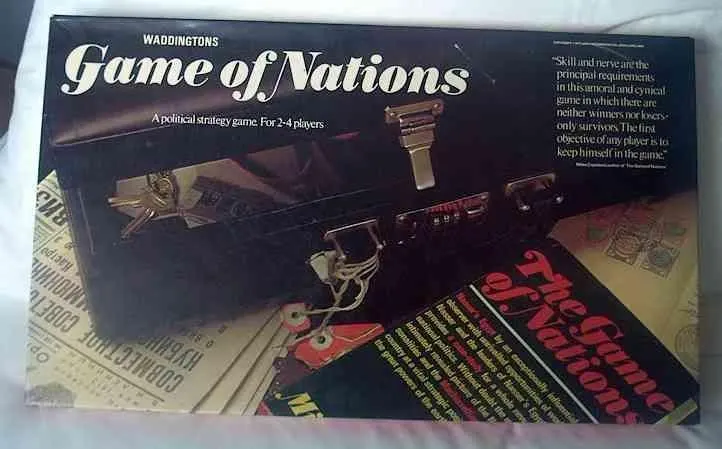
1973
Rules assistance for The Game of Nations
Plain-language explanations of turns, card effects and disputed situations, with official source references and saved question history.
What would you like to know?
Answers come from the official rulebook, with the page to check.
The Game of Nations is a board game released in 1973 for 2–4 players, 120 minutes per game, and ages 12 and up. It was designed by Miles Copeland and its main mechanics are Player Elimination, Area Movement, and Variable Set-up.





This game is a geopolitical simulation of local influence in the Middle East on the flow of oil supplies to the rest of the world. The map shows 8 fictitious Middle Eastern oil producing countries, one of which controls the Canal that links both ocean sides. If your superpower is on one ocean and you try to obtain oil from a country bordering on the other ocean, the Canal becomes of vital strategic importance. The alternative is to connect that country to another on the "correct" side of the board (through the land-locked middle countries, which are also bigger producers) with a series of pipelines. To move oil you must, of course, have a friendly leader in place at the head of that country. You start with a leader of your color on the capital of a country and one tanker that can transport oil from that country's port to your country. To reflect a level of organisation, oil is worth more per shipping if a king or politician is in place than a dictator or guerrilla, whose job is more offensive. You spend money to move leader pieces about the board, with the managing pieces costing more than the offensive pieces. Secret agents also move each turn and are used to defend attacks by blocking the path of opposing leaders and for moving onto "?" spaces to take a gamble on an incident card. At face value, half the cards are favourable and half not, but all offer diplomatic opportunities for the country who is most stable. To survive players must continually manage risks while trying to maximize their oil revenue. Early bold attacks, even combined with the right incident card, are not recommended: a co-operative approach to the game maximises revenue to offset the many accidents which can happen in the game. From the Waddington ad for the game dated 1972: A political strategy game "In the modern world of international diplomacy and intrigue, there are many stakes in this game of economic survival. That means energy and the key to energy is oil. In this game there is but one object - and that is to survive"
The Game of Nations supports 2–4 players according to the catalogue. This range comes from the publisher’s listed player count, so the game can be set up for any group size within it. Some setups, rules and scoring details may still vary by player count, so check your edition’s rulebook for the exact configuration.
The listed playing time for The Game of Nations is 120 minutes. This is the publisher’s estimate for a full game. The actual duration depends on the group, the player count and familiarity with the rules: first sessions usually run longer, while experienced groups often finish faster. Setup and teaching time are not included in this estimate.
The catalogue lists The Game of Nations for ages 12 and up. This is the publisher’s recommendation and reflects reading demands, rule complexity and small components rather than theme alone. Younger players can often join with help from an adult, so check the age guidance on your edition and consider your group’s experience with board games.
The Game of Nations has a complexity rating of 2.2 out of 5 from BoardGameGeek players, which makes it a medium-light game. The rating reflects how much rules knowledge, planning and decision-making a typical game demands. Expect a longer first teach for heavier games, and use a preparation guide before game night.
The Game of Nations belongs to these categories: Economic, Political, and Spies / Secret Agents. Its main mechanics are Player Elimination, Area Movement, and Variable Set-up. Categories describe the theme and setting of a game, while mechanics describe what players actually do on their turns. Each mechanic links to a catalogue hub with similar games, which helps when you want something comparable.
The credited designers of The Game of Nations are: Miles Copeland. These credits come from the published game data and name the people responsible for the game’s design, not its illustrators or publishers. Designer pages on MeepleRules collect other titles by the same designers, which helps when you enjoy a game and want to find similar ones.
The catalogue lists The Game of Nations as a base game. It can be played on its own with the components in the box and does not require any other title. Expansions, if any exist, add new content or rules on top of it and are listed separately in the catalogue with a link back to this base game.


