
- BGG rank
- BGG #22,557
- BGG rating
- 6.1
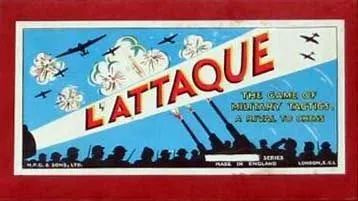
L'Attaque
- 2 players
- 20 min
- Complexity 1.3/5
- 1909
1932
Rules assistance for Tri-Tactics
Plain-language explanations of turns, card effects and disputed situations, with official source references and saved question history.
For 2 players
What would you like to know?
Answers come from the official rulebook, with the page to check.
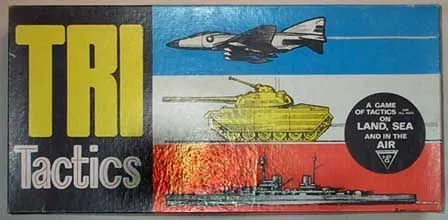
Tri-Tactics is a board game released in 1932 for 2 players, 240 minutes per game, and ages 12 and up. It was designed by Hermance Edan and Harry Gibson and its main mechanics are Secret Unit Deployment.


Popular and intriguing military air, sea and ground forces tactics game TRI-TACTICS by Harry Gibson History: This board game was launched in 1935 by Gibsons aiming to provide an amalgamation of three other tactical board games: - L'Attaque (1909) - the U.K. rights were acquired by Gibsons in 1925. - Dover Patrol (1911) - Aviation: The Aerial Tactics Game of Attack and Defence (1925) All of these Gibsons games, marketed at the time as Series: The Big Four (Gibsons), predate Stratego (1942) by Jumbo which shares many similar aspects of play, but is now much more well known. Gameplay: The game is played on a special 12x12 board which illustrates land and sea spaces equally for each side, and each with two special squares, an HQ and a Lake containing a Naval Base. Two players, one RED, the other BLACK, command combined Navy, Airforce and Army forces, with a total of 112 prices, each player starting with 56, comprising the following: Infantry 5 Battalions - rank 1 4 Brigades - rank 2 3 Divisions - rank 3 2 Army Corps - rank 4 1 Army - rank 5 Artillery 5 Anti-Aircraft gun - rank AA 4 Field Artillery - rank FA 3 Heavy Artillery - rank HA Naval Force 4 Destoryers - rank 1 3 Cruisers - rank 2 2 Battleships - rank 3 1 Aircraft Carrier - rank 4 1 Submarine - rank SM 4 Flying Boats - rank FB Air Force 4 Reconnaissance Planes - rank 1 3 Bombers - rank 2 2 Two-Seat Fighters - rank 3 Auxiliary 8 Searchlights - rank SL At the beginning of game, these 56 pieces are placed by a player to occupy the first 5 rows of one side (but not on the HQ or Lake), with the other player doing likewise with their 56 on the opposite side’s 5 rows. This leaves two whole rows in the centre of the board empty, as well as the HQ, Lake, and 2 other squares between the two forces facing each other. All types and ranks of the pieces are hidden at the beginning of the game The object of the game is to occupy the opponent’s HQ with an Infantry piece, or the Lake with a Naval piece (not including the FB), which must approach via the river. The players draw lots to decide who commences play, by moving one piece, and thereafter play alternates between the players, by moving one piece per turn. All pieces can move one square at a time, forwards, backwards or sideways, with the exception of the Searchlight which can move multiple squares in a single direction (but only when attacking), as long as the squares are unoccupied. To attack, a player must move a piece adjacent to an opponent’s piece and announce ‘Attack’. They may choose not to, in which case they state ‘No Attack’. In that case, the opponent cannot on their turn attack that adjacent piece without first moving another of his pieces. The two adjacent pieces of each player are then revealed. The attacks are resolved by consulting the Value Table; as a general rule, the highest rank wins, but there are various combinations that apply, particularly when comparing land, sea and air pieces on land, sea or over a coastline. If successful, the attacker remains where they are, and the defender’s square becomes empty as the defender’s piece is removed. If the attacker loses, their piece is removed, and the defender’s piece remains where it is. If the pieces are the same rank, both are removed. It is allowed to place Land pieces on the sea and Naval pieces on the land, but with the risk that when attacked, any such piece found to be operating ‘out of their element’ will immediately forfeit and removed. Excluded from this rule is the FB as well as all Air Force pieces and the Searchlights. The River is a special area which is classified as Land or Sea depending on which piece is occupying it. When a Naval piece does so, the square is designated Sea, and when a Land price occupies it, then it is classified as Land. On the rest of the board, where land and sea meet, then the spaces are classified as Sea or Land depending on which is in the majority. The coastline in each case separates these defined areas of Land and Sea. Should there be an attack between a Ship and a Land piece over a coastline, the attacker is forfeit, except for HA and AA when the ordinary ruling applies. Also, Bombers and FB destroy Infantry and FA. The HQ and Lake must not be occupied but a piece may be move over these squares in consecutive turns or else be forfeit. Only Ships (not FB) may attack and capture the Lake, and to do so must move up the River (it cannot capture the Lake by entering via Land, or then it must exit via the river to sea); in doing so, in this special case it captures all Land pieces in attacks, except HA. Similarly, only Infantary pieces (not Artillery) may attack and capture the HQ. Similar to: L'Attaque Dover Patrol Aviation: The Aerial Tactics Game of Attack and Defence Stratego
Tri-Tactics supports 2 players according to the catalogue. This is the publisher’s listed player count, so the game is designed for exactly that number of participants. Variants for other group sizes, if any, are described in the rulebook of your edition, so check it before setting up a different configuration.
The listed playing time for Tri-Tactics is 240 minutes. This is the publisher’s estimate for a full game. The actual duration depends on the group, the player count and familiarity with the rules: first sessions usually run longer, while experienced groups often finish faster. Setup and teaching time are not included in this estimate.
The catalogue lists Tri-Tactics for ages 12 and up. This is the publisher’s recommendation and reflects reading demands, rule complexity and small components rather than theme alone. Younger players can often join with help from an adult, so check the age guidance on your edition and consider your group’s experience with board games.
Tri-Tactics has a complexity rating of 2.5 out of 5 from BoardGameGeek players, which makes it a medium-light game. The rating reflects how much rules knowledge, planning and decision-making a typical game demands. Expect a longer first teach for heavier games, and use a preparation guide before game night.
Tri-Tactics belongs to these categories: Wargame and World War II. Its main mechanics are Secret Unit Deployment. Categories describe the theme and setting of a game, while mechanics describe what players actually do on their turns. Each mechanic links to a catalogue hub with similar games, which helps when you want something comparable.
The credited designers of Tri-Tactics are: Hermance Edan and Harry Gibson. These credits come from the published game data and name the people responsible for the game’s design, not its illustrators or publishers. Designer pages on MeepleRules collect other titles by the same designers, which helps when you enjoy a game and want to find similar ones.
The catalogue lists Tri-Tactics as a base game. It can be played on its own with the components in the box and does not require any other title. Expansions, if any exist, add new content or rules on top of it and are listed separately in the catalogue with a link back to this base game.