

- BGG rank
- BGG #7,195
- BGG rating
- 6.8
Cobra: Game of the Normandy Breakout
- 2 players
- 120–480 min
- Complexity 2.8/5
- 1977
1993
Rules assistance for Victory in the West: Plan Yellow, The French Campaign 1940
Plain-language explanations of turns, card effects and disputed situations, with official source references and saved question history.
For 2 players
What would you like to know?
Answers come from the official rulebook, with the page to check.
Victory in the West: Plan Yellow, The French Campaign 1940 is a board game released in 1993 for 2 players, 360 minutes per game, and ages 14 and up. It was designed by David James Ritchie and its main mechanics are Dice Rolling, Variable Set-up, and Hexagon Grid.
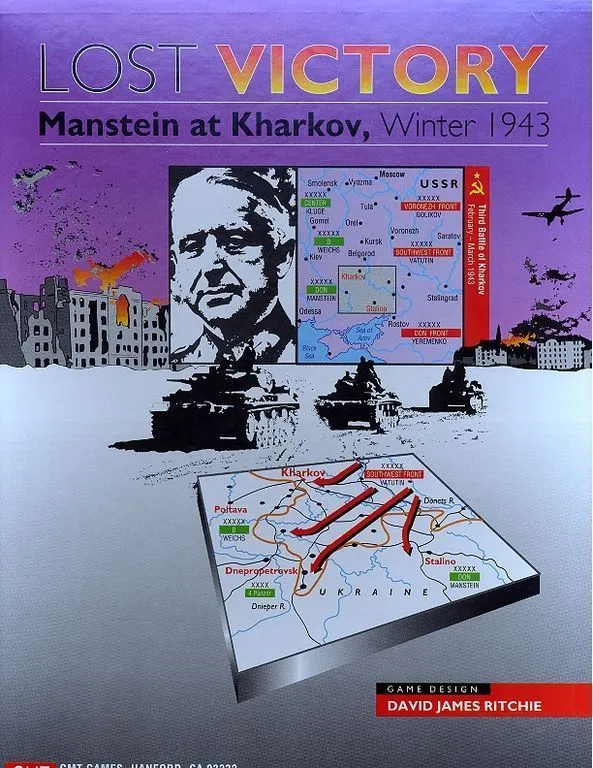






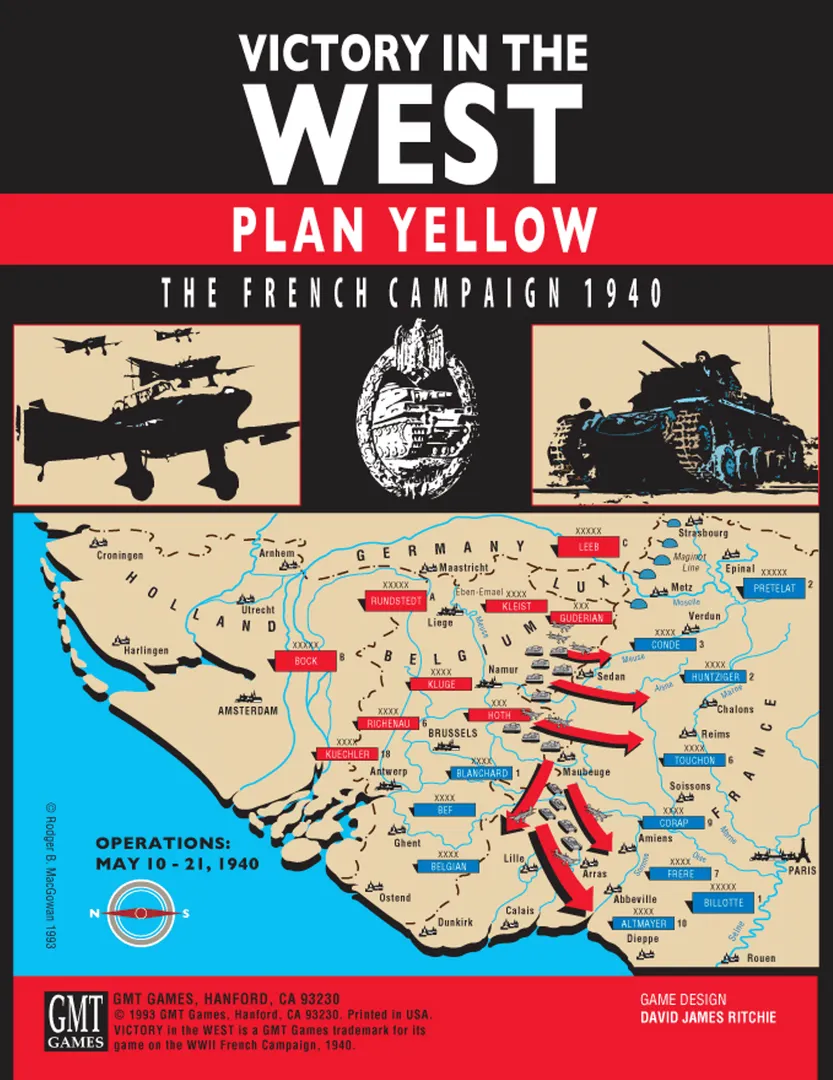
Victory in the West: Plan Yellow, The French Campaign 1940, is a realistic two-player game that accurately recreates the 1940 campaign in all its aspects except one: the outcome is totally up to you. The game's centerpiece is an options system that lets the Allied player trade Victory Points for changes to his armies and policies that might (or might not) have changed history. Can you, as the Allied commander, repel the Germans with the forces on hand in 1940? How about if you train them better? Or give them a better command structure? Or provide them with more and better anti-aircraft an anti-tank guns? What do you think is the key to victory in the west? Can you, as the German commander, still beat the Allies if the French Army is motorized like the BEF? And how does your strategy change if the French don't build their Maginot Line, but do build a bigger and better air force? Do you still try to sneak through the Ardennes forest with your Panzers? Or do you ignore Allied bombers and wheel across the open plains of northern Belgium in a repeat of the 1914 Schlieffen Plan? Or do you do the unexpected and land a left hook through the Alsace? Your commanders await your orders. The future of Europe is in your hands. 10 May, 1940 ... The German Wehrmacht opened its long-awaited campaign in the West by smashing across the frontiers of Belgium and Holland. For the German High Command, it was seen as a daring move. Hitler's fledgling legions faced the combined armies of France, Britain, Belgium and the Netherlands. These Allied forces had more and better weapons of almost every type, and at least two of the opposing armies, those of France and Britain, were considered to be the best in the world. The Germans had the element of surprise and the new Blitzkrieg tactics of mobile warfare. Six weeks later, it was all over. The British Expeditionary Force (BEF) had been driven from the continent and the French, Belgians, and Dutch had all capitulated. Hitler had achieved a victory in the west, and the world would never be the same. But, what if? It didn't have to happen that way ... Bad generalship and correctable flaws in their armies hastened the Allied defeat. What if the High Command had bothered to stay in radio contact with its armies on the frontier? And had then reacted promptly to the developing situation? What if the Maginot Line had been extended to cover the Meuse crossings at Sedan where Guderian's Panzers broke into the Allied rear? What if the BEF had included a strong British mobile corps that could have fought Rommel's Panzers on even terms at Arras? What if the French had prepared to meet the Blitzkrieg by building eight tank divisions instead of three? Or by mechanizing their cavalry the way the Germans did after the Polish campaign? Or even by developing their own blitzkrieg doctrine? The Allies could have taken any or all of these actions, and any of them would have altered the campaign's course. But which ones would have changed the outcome? Game Scale: Game Turn: 2 days Hex: 6.8 miles / 11 kilometer Units: Battalion to Army Game Inventory: One 22 x 34" full color mapsheet One 17 x 22" full color mapsheet Three dual-side printed countersheets (720 1/2" counters) One 32-page Victory in the West rulebook One 8-page Victory in the West Example of Play booklet One 4-page Victory in the West Design Notes booklet Five dual-side printed Player Aid Cards One 10-sided dice Solitaire Playability: High Complexity Level: Medium Players: 2 or more Playing Time: 2-20 hours DESIGNER: David James Ritchie DEVELOPER: Kevin Boylan and Gene Billingsley ART DIRECTOR: Rodger B. MacGowan MAP ART: Mark Simonitch
Victory in the West: Plan Yellow, The French Campaign 1940 supports 2 players according to the catalogue. This is the publisher’s listed player count, so the game is designed for exactly that number of participants. Variants for other group sizes, if any, are described in the rulebook of your edition, so check it before setting up a different configuration.
The listed playing time for Victory in the West: Plan Yellow, The French Campaign 1940 is 360 minutes. This is the publisher’s estimate for a full game. The actual duration depends on the group, the player count and familiarity with the rules: first sessions usually run longer, while experienced groups often finish faster. Setup and teaching time are not included in this estimate.
The catalogue lists Victory in the West: Plan Yellow, The French Campaign 1940 for ages 14 and up. This is the publisher’s recommendation and reflects reading demands, rule complexity and small components rather than theme alone. Younger players can often join with help from an adult, so check the age guidance on your edition and consider your group’s experience with board games.
Victory in the West: Plan Yellow, The French Campaign 1940 has a complexity rating of 3.4 out of 5 from BoardGameGeek players, which makes it a medium-weight game. The rating reflects how much rules knowledge, planning and decision-making a typical game demands. Expect a longer first teach for heavier games, and use a preparation guide before game night.
Victory in the West: Plan Yellow, The French Campaign 1940 belongs to these categories: Wargame and World War II. Its main mechanics are Dice Rolling, Variable Set-up, and Hexagon Grid. Categories describe the theme and setting of a game, while mechanics describe what players actually do on their turns. Each mechanic links to a catalogue hub with similar games, which helps when you want something comparable.
The credited designers of Victory in the West: Plan Yellow, The French Campaign 1940 are: David James Ritchie. These credits come from the published game data and name the people responsible for the game’s design, not its illustrators or publishers. Designer pages on MeepleRules collect other titles by the same designers, which helps when you enjoy a game and want to find similar ones.
The catalogue lists Victory in the West: Plan Yellow, The French Campaign 1940 as a base game. It can be played on its own with the components in the box and does not require any other title. Expansions, if any exist, add new content or rules on top of it and are listed separately in the catalogue with a link back to this base game.